Unknown's avatar

35

  •  The jersey number of Phil Esposito.
  • The atomic number of bromine.
  • The US Interstate highway that runs between Texas and Minnesota. 

And the number of years without a Triple Crown winner. Orb (tracing back to Ruffian’s full sister, Laughter, on his dam’s side) was soundly beaten in the Preakness this past Saturday. I don’t think he ran badly – he did pass two in the stretch – but he fell victim to his need for a decent pace (opening half mile was quite slow) and being uncomfortable trapped on the rail. It leaves a lot of questions specific to the situation, but also on a broader front.

There were four Triple Crown winners in the 40’s and then none until Secretariat’s win in ’73 (followed by Seattle Slew in ’77 and Affirmed in ’78). We’re in a multi-decade long funk like we were between the 40’s and 70’s. Why? Are we going through a phase of breeding where the horses aren’t good enough, or has the competition and talent increased such that it’s nigh impossible for one individual to standout?

The Kentucky Derby is always the most traffic laden of the three races. I consider it the second hardest of the three to win based on the large field that always goes to post. A lot of expected winners have run into bad racing luck, getting shuffled back, getting trapped in the pack, being interfered with, or having to go extremely wide covering extra distance. Orb managed to stay out of trouble by settling near the back of the pack and then circling wide, which was right in his racing style wheelhouse. Everyone was practically gushing over his performance on an off-track, I thought it was okay.  He benefitted from a super fast opening and was passing tired horses.

The Preakness is the shortest of the trio and least suited to come-from-behind horses like Orb. Front runners and those with tactical speed have an advantage.  Oxbow, this year’s winner, ran a pretty impressive Derby finishing sixth.  He was near the front for all those super fast fractions and was the only front runner not to crawl home.  Once he got the easy lead in The Preakness with a sedate pace, the race was over.

The final leg, The Belmont, is the grueling mile and a half. The field is usually short for this race, the distance not an American TB favorite. A lot of horses have won the first two races only to have their crown denied at Belmont Park. Five horses won the Derby and Preakness in the 60’s only to lose in the Belmont. An additional two (to the three Triple Crown winners) did the same in the 70’s – that was a big decade in racing; one we’ve arguably been unable to repeat, three in each the 80’s and 90’s conquered the first two legs and another five have managed the task since the turn of the century.

There’s always a lot of talk about the timing of the three races; just two weeks between The Derby and The Preakness, and The Belmont three weeks after that. Three races in five weeks done by horses that typically only race once every couple of months or so. Of course, if the Triple Crown was for four or five year olds, with better training bases on more mature bodies instead of for three year olds in the spring…

The racing industry is desperately hoping for another Triple Crown winner to increase interest and support to a sector that’s been harshly criticised over the years; a horse that the people can rally behind. It won’t be this year.

Unknown's avatar

The Long And Short Of It – Part 3 – Loin

The loin is arguably one of the most important structures in the horse. It is inherently weak in its design, being a freespan (having no ribs to add support and strength), and therefore is susceptible to injury. The loin of the horse is equivalent to the transmission of a car; it transfers power created by the haunch (engine) forward. A mismatch of a powerful haunch (engine) to a weaker loin (transmission) all but guarantees ‘spinning tires’ and often structural failure.

To put it in simple terms;

  • The shorter the loin is in length, the more strength it possesses.
  • The deeper the loin, the more strength it possesses.
  • The broader the loin, the more strength it possesses.

The strongest loin is therefore a short, deep, broad one. This type of loin is virtually indestructible and guarantees full transmission of haunch power brought forward, but can produce a rough ride if it gets muscle bound. Think of it in terms of a body builder with their massive strength, but often times lacking flexibility. A horse with this loin absolutely must have a training focus on creating and maintaining suppleness. Of course we now know that how far the ribcage carries back plays a role in lateral flexibility. A short loin guarantees ribs that carry back well for lateral flexibility, so the potential for suppleness is clearly there with a short loin.

The weakest loin is a long, shallow, narrow one. This type of loin is highly susceptible to damage. It can combine with other traits to make a rather smooth ride because the horse that possesses it often hollows the back and becomes a leg mover, but invariably it breaks down under anything but the lightest of workloads.

Six lumbar vertebrae make up the loin.

Image 

There is no specific loin measuring system in terms of garnering a specific percentage. We use various body references to determine its length.

1) The ‘quick and dirty’ hand measurement discussed in the Part 2b – Ribcage article. Greater than a spread hand’s width (8″) and the loin is long; about a spread hand’s width and the loin is medium, and less than a spread hand’s width and the loin is short.

2) The loin should ideally be as deep as the chest. A significant difference and a loin is very likely long. Note: Excellent riding and training can deepen and strengthen a loin.

3) The further behind the point of hip that the LS joint is, the more likely the loin is long.

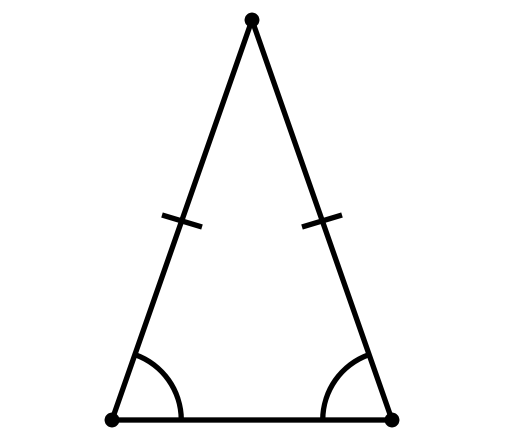
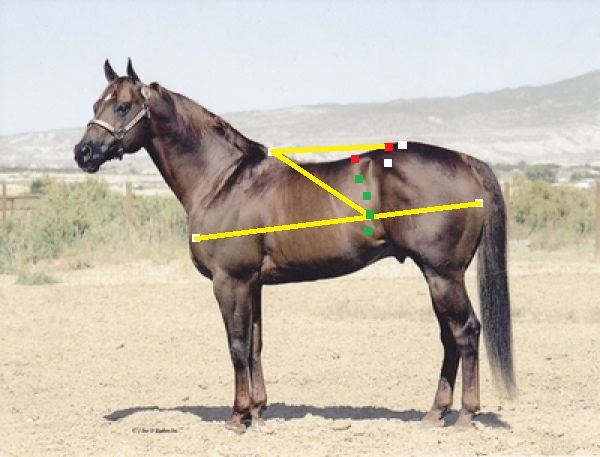
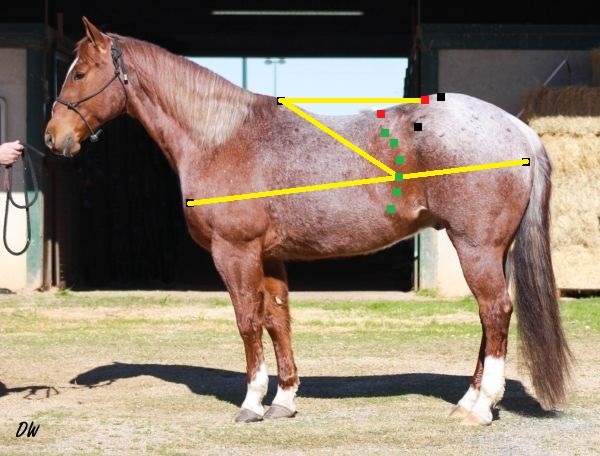
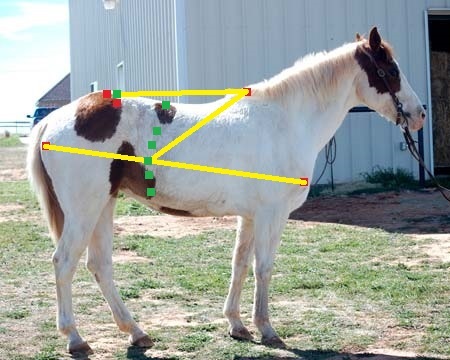
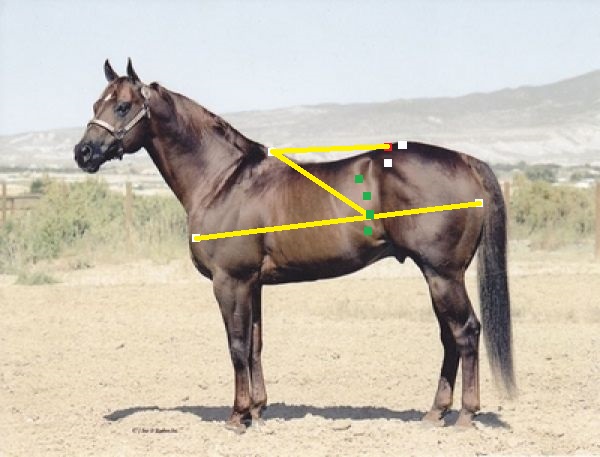
4) Probably the most telling view for the loin is a top down view. Marking the points of hip, the LS joint and the first lumbar vertebrae, then connecting the points (minus the LS joint) will produce a triangle. An equilateral triangle with the LS joint inside the base line would be a short, broad, deep and strong loin, whereas an isosolese triangle is going to indicate a longer, less broad, less deep and therefore less strength.

Equilateral Triangle

Image

Isosolese Triangle

Image

Let’s take a look at our six horses, concentrating on their loins. 

Horse #1 – QH stallion:  This is a short loin with great depth.  We don’t have any overhead shots of our horses, but if we did this horse would also be broad across his loin.  Our horse with the biggest hip has a loin of more than sufficient strength.

Image 

Horse #2 – QH gelding: This loin is longer than our first horse because the LS joint is placed further back.  If it was placed in the same location as our first horse, the loins would be identical.  Still this loin remains medium in length and has excellent depth and breadth.

Image

Horse #3 – 4yr old QH: This loin is also medium in length, but just.  It’s not as deep as our first two horses, but likely possesses good breadth.   

Image

Horse #4 – Arabian Stallion: Another short, solid loin.  It lacks a bit of depth, which I blame on the table top croup preventing engagement.

Image

Horse #5 – TB Gelding:  The shortest loin of our group.  It has good depth (don’t let the distended belly fool your eye).  This is another one that likely isn’t particularly broad and thus why it isn’t as deep relative to the shortness.

Image

Horse #6 – Paint mare:  Here we have a long loin that lacks significant depth and likely breadth as well.  This is a highly susceptible construction and we can be thankful that she doesn’t possess the same kind of hip as our first three horses or she’d be in big trouble.

Image

   Summary 

Based on what we have analyzed so far; hip, back, loin, lumbo-sacral joint, ribcage, to a lesser degree the withers, and setting aside any personal or breed biases, or anything else we might know or suspect about the individuals in question, how must this group of horses be ranked? Before you peek, think about it. Which horse at this stage seems to have the most athletic potential AND ability to stay sound through the back and loin doing whatever task they may be asked in the future…all other things being equal and relative. And who appears to have the least? And why?

In reverse order:

6. Horse #6, Paint mare. Her back is long, her loin is long, her ribcage does not carry back well, and neither do her withers. She possesses adequate hip length and might very well produce some easy gaits to sit to by means of hollowing the back and being a leg mover. Of the group, this horse requires the most knowledgeable rider to prevent topline breakdown and improve its strength.

5. Horse #4, Arabian Stallion. There is just no getting around the table top croup, it’s just that severe of a fault and the camel withers don’t help. What saves this horse from breaking down through the topline are the shorter back, the short loin and the ribcage that carries back well, all of which add significant structural strength.  While this is no novice ride, this horse is far less likely to succumb to topline breakdown from hollow riding than our Paint mare.  For that reason he garners one spot up from the bottom.

4. Horse #2, roan QH gelding.  Simply based on having the poorest LS joint placement of the remaining candidates, increasing the difficulty of engagement. 

The next two placings are very close and arguments can be made for switching them based on discipline and type of issues a person prefers to deal with. 

Tie for 2nd – Horse #1, QH stallion and Horse #3, grey QH gelding.  Our stallion is shorter backed, has a short, deep, broad loin, a huge hip, a good LS joint placement, and ribs that carry back well giving us super longitudinal strength, super power potential, super potential to engage, but perhaps lacking a bit of lateral flexibility through the body compared to the grey gelding with a longer (yet still medium) back, a medium loin (that does lack a bit of depth), a big hip, a very good LS joint placement and ribs that carry back well.  His withers aren’t as well defined or designed, but still functional.  This one may possess a bit more flexibility, but also may tend to evade through the body more.  Still plenty of power and engagement ability, this one might very well ride a bit smoother.

1. Horse #5, TB gelding. The horse with the least hip length currently heads our list because there is so much strength in the rest of his topline that that lack of pure power can be overlooked – as long as we’re not going to ask him to be a sprinter, or an International/GP competitor. He has a great short loin and LS joint placement, withers and a ribcage that carry back really well to add longitudinal strength to the medium back and should possess a good amount of lateral flexibility as well.  This horse should present as the most viable individual, for the most people, with the widest range of knowledge and ability.  There is not so much power or movement potential that a beginner/novice couldn’t handle this horse, and yet there’s enough longitudinal strength to protect the horse against that sack of potato rider.  Additionally there’s plenty of lateral flexibility and engagement potential that a more advanced rider could also enjoy this topline. For those reasons this horse takes the top spot – for now.

We’ve only just begun our analysis of this group of horses; there’s so much more to look at and consider. I suspect *wink* that the current rankings may change as we delve deeper into the conformation of these individuals. Will your original choice end up at the top of the list? (Insert appropriate musical cue) Stay tuned for the next series of articles discussing body levelness and shoulders.

Unknown's avatar

NEW! Book Of The Summer Club

…because there’s no way I can do it in a month’s time.

I thought it would be great if *we* occasionally picked a horsie book to read and talk about ala Oprah.  Nothing can replace putting our hands on the horse and working directly with it, but there’s still value in discovering from books.

I went ahead and picked *our* first book, though, I’d be happy to go with a consensus for the next one. 

The Tao Of Equus: A Woman’s Journey Of Healing And Transformation Through The Way Of The Horse by Linda Kohanov

I know!  Super Oprahesque, right?  But I’m telling you it’s got some good stuff in it.  So, I invite all to pick up a copy and begin reading.  It’s readily available on Amazon and I note that there are less expensive used copies of the book that can be purchased.  My first blog installment won’t be until about mid-June so there’s time.  Please join me.

In other news, the final Part 3 of The Long And Short Of It series should be up by Friday (17th).  I apologize for the slowness of late, but I’ve been out of the country.  There will be two other shorter interruptions for Hooves in June and July, while I head out to do some long overdue horsey things.

Unknown's avatar

From Behind

For those that don’t know, I started my horse adventures with Standardbreds as a teenager.  It’s a long story, not terribly interesting, but that’s where it began.  I will carry a deep fondness for the breed for all eternity; they treated me well.  I still own one that I bred, raised, trained and competed.  Half blind now, he’s living the pasture ornament’s life.

I’ve got tens of thousands of driving miles behind me; many more than riding miles, and thusly I always feel more at home behind a horse than on a horse.   Both offer a different perspective of equal importance and so I encourage all to drive your horses, if not for the pleasure of it, then for the information you can garner.

Being positioned behind the butt of a horse isn’t necessarily a glamorous place to be.  Indeed, you can be pooped on.  But that kind of a view affords a window to your horse’s gaits that you otherwise never get to see.  Most people watch horses move from the side.  A vet or farrier will occasionally watch a horse from the front or back when doing diagnostics, but mostly it’s that side view that people watch.  Not so when you drive a horse.

Take a look at this helmet cam view. 

The tail sometimes makes it tough to see, but I assure you, when you’re sitting there, you can see the legs and feet.  You can see the flight and footfalls.  You can see the timing of the gait.  (This is a pacer, but it applies to walking and trotting just as well).  You can see if a horse is travelling with the haunch to one side, if one foot wings while the other one paddles.  You can get a sense of how the stifle points ‘out’ so that when the leg comes forward it can clear the ribcage.  You can see the hocks articulating, if they twist.  You can see if a foot lands flat or if it twists.  You can see if each hind foot is stepping equally forward because you can immediately see the hoof prints below you.  You can see if a horse will interefere, when and where, as well, how important timing of the footfalls are to avoid interference.  And if you look higher, you can see how the haunch muscles work, if they are even, if one hip is higher than the other.  In the lines there’s a very clear feeling of the mouth, if the horse carries the bit equally or if he grabs one side of the bit harder than the other.  You can see and feel if the horse carries their shoulders straight, their neck, and their head.  Sure, some of these things you can see and feel when upon the horse, but sometimes feeling them from a different perspective helps.  

The time on that race was 1:52.1 for the mile.  That’s real decent.  Man, I miss my Standardbreds right in this moment.

Unknown's avatar

Speed Kills

In the last article (To Plow Or Not To Plow) I talked about horsepower, where it comes from structurally, what bone ratios are needed to get the power ‘forward’, what kind of build allows for  ‘4-wheeling into the ground’, and what type of a loin can survive it.  Now we switch ‘gears’ and look at where speed comes from and why it can be deadly. 

Speed requires certain conformation traits, just as power does, to be achieved.  It starts its generation from power.  We can assume, then, that we have to start with some of the same conformation traits of that big plow horse.

1) A well-placed lumbo-sacral joint (created between the last lumbar vertebra (L6) and the first sacral vertebra (S1) that the entire hindquarter pivots on).  The LS joint needs to be located at, or in front of, the point of hip to get the full benefit of;

2) Good length of pelvis, at least 33% of the entire body length, however, if you want to get serious about horsepower (and therefore speed) that number should be upward of 35% or more.

3) Proper angulation of the hind leg.  Over angulation of the hind leg (a leg mathematically too long for the body) puts the brakes on speed.  Its stroke is too long, too slow; it can’t get fully under the body to power a horse forward.  It’s also prone to injuries like curbs and bog spavins, and is often accompanied by cow hocks or bow-leggedness.  The latter two create torque that ratchets up exponentially with speed.  And while a post-legged hind leg (a leg mathematically too short for the body) lends itself to quick strokes and thrusting with power, it’s also undesirable as it places too much stress on the stifle and hock with their wide open, and therefore unprotected, joints.  Sticking stifles and arthritic hocks are often occurrences.  Having said all that, the angulation of a ‘speedy’ leg will be ‘straighter’ – but still fall within the acceptable range of ‘proper angulation’ – than that of the slower dressage or gaited horse hind leg.

4) A loin no greater than medium in length, so that all the power generated by the haunch can be transferred forward without blowing up the loin.   Short is just as okay here as it is in the draft horse.  The loin is a freespan (has no ribs to support and add strength), therefore length is its enemy.  Strength in this area is of greatest importance, especially if the horse has great pelvic length, which it must have to be fast.  We also need broadness across the loin and depth.  (Note: A racing fit horse will appear shallower through the loin.  This does not necessarily reflect inherent weakness of the loin.  Whereas a shallow loin on a non-racing fit horse, a riding horse or a draft horse is immediate cause for concern.) 

5) Either a square build or a ‘proper’ rectangular build.   A square built horse is compact front to back and stands low to the ground; height and length of the body are the same.  A ‘proper’ rectangular build is a slightly longer body, where the horse stands over more ground, but doesn’t stand over a lot of air.  This horse also remains relatively low to the ground.  Good racehorses tend towards the ‘proper’ rectangular build, especially horses that go distance.   The leggier the horse, the more energy is wasted swinging the legs the length of their stride and the more easily things can break.  Consider how much easier it is to break a one inch thick, two foot long stick over your knee, versus a one inch thick, one foot long stick.


While some traits remain consistent, others change and the degree of difference varies.  We want third gear for speed, not just the powerful, but slow first gear.  So now that we have power potential from the above traits, how do we keep it, get top gear, and more importantly keep the horse sound?

5) Hocks and stifles set higher; that is stifles that are clearly above the height of the elbow, and hocks that are clearly higher than the knees.   The height of hocks and stifles is determined by bone lengths in the hind limb, and the ratio of those bones to each other plays the role of determining ‘gear ratio’.  In a racehorse we expect to see the tibia exceeding the length of the femur.  That’s exactly the opposite of what we require for the draft horse (and for the riding horse).

6) Substance.  Big, clean joints.  Bone thickness is typically less for a racehorse, than for a riding or draft horse.  This is a compromise we’ve allowed over the years mainly because racehorses perform on level, manicured surfaces, and the less weight having to be carried over the distance, means less energy required to do it, which in turn means faster times over distance. However, it’s not a ‘requirement’ that a racehorse possess less bone; meaning a racehorse can possess greater bone thickness and still be fast.  There does remain a ‘minimum’ bone requirement for racehorses, which is 6” per 1000lbs; a full inch less than for all other horses. Think about that and keep it in mind for later.  Here I’ll include feet.  They should be of an appropriate size, shape and construction.  Foot faults can be disastrous in any horse, but in a racehorse they are a red flashing neon sign.

7) Appropriate muscle mass and type.  Sprinters should display larger amounts of the big, bulky, fast twitch muscles, while horses that run distances of greater than two miles will possess significantly more lean, slow twitch muscling (think Arabian muscling versus QH muscling).  The middle distance runner possesses a balance of both.  Soft tissue attachments should be clean and smooth regardless of type.

8) Downhill Build     usually and mostly.  A more level build can be seen in gaited racehorses and sometimes in distance runners.

9) Not Too Much Limb Action      This references mostly the front legs.  The more joint articulation (ie., knee action) a racehorse has the faster that entire leg has to be to complete the stroke compared to a less articulating jointed leg, AND the more energy burned trying to do it and maintain it.   That means a ‘fancier’ moving racehorse must possess more stamina to maintain speed than the more efficient less fancy mover.   It also tends to mean that a ‘fancier’ moving racehorse requires more distance to get up to speed and you are likely to find this kind of mover coming from off the pace, rather than setting it.  (Note: An exception to that would be trotters, who require more front leg joint articulation to remain interference free and time the trot at high speed.) 


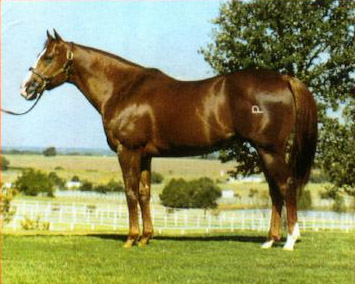
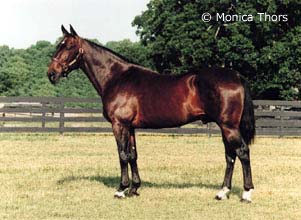
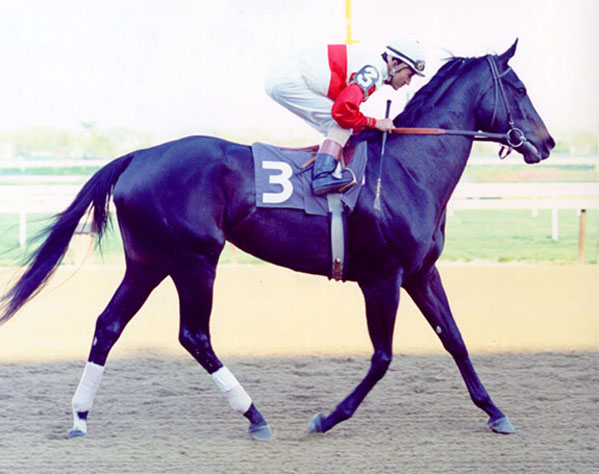
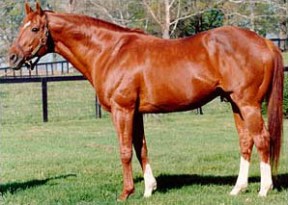
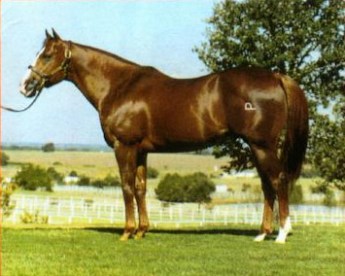
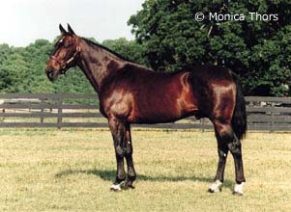
We now have the basic build of a horse designed for speed.  Let’s look at a few of the great ‘speedsters’;  TB – Secretariat, QH – Dash For Cash, Standardbred (pacer) – Niatross

They look remarkably similar.  And yet, there are distinct differences as expected.  Three different breeds, one gaited, but all essentially sprinters.
Image

Though Secretariat raced the furthest distance of the three (Belmont, Rothman’s International (that one on turf) at a distance of 1 ½ miles), he showed tremendous bursts of speed that he maintained over distance.  His advantage was three-fold; rateability, extraordinary joint flexibility, and stamina (that extra-large heart).   His heart was never weighed during the necropsy, but it’s widely considered a fact that Secretariat possessed a heart of extraordinary size.  Adding his sprinter type speed to those factors, and we  have track records set by him in all three Triple Crown Races that still stand four decades later.  He went 16-3-1 in 21 lifetime starts.  He’s known today as a broodmare sire.
Image

Dash For Cash is the second all-time money earner for QH racehorses with over $500,000 followed only by his son First Down Dash.  That’s saying something since he did it almost forty years ago.  He won 21 of his 25 lifetime starts and had three 2nd place finishes. He’s the leading broodmare sire and you’d be hard pressed to find a top money earning running QH that doesn’t have him in his pedigree.
Image

Niatross won 37 of his 39 races, thirteen of those as a two year old.  He finished 4th in an elimination round of The Meadowland’s Pace after breaking stride and in is only other loss he spooked during the race and fell over the guard rail. He was the first Standardbred to break the 1:50 barrier with a 1:49.1 record that stood for many years and retired the richest earner in history at the time.

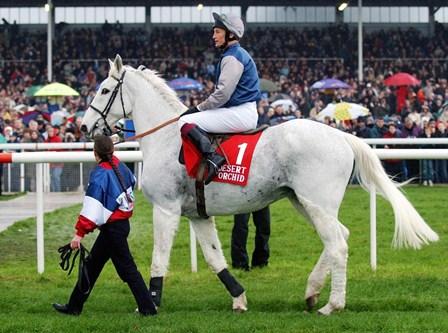
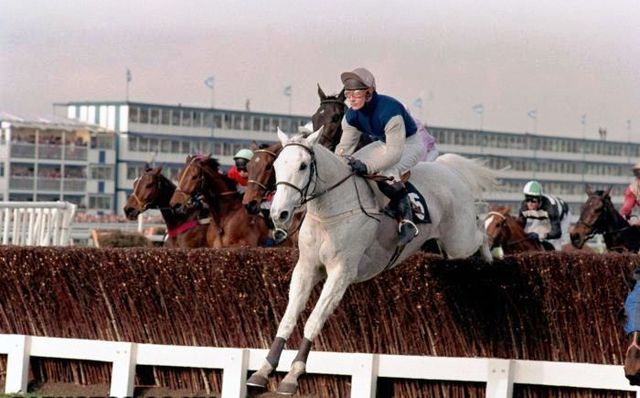
Not to forget about the popular European racing sport of Steeplechase: the great Desert Orchid.

Image

Image

Desert Orchid raced an astonishing 70 times and finished with a record of 34-11-8.  He had an attacking front end style of racing and is considered by many to be the greatest in that category, as well as the greatest jumper.  One conformation trait to note is the height of his knees.  A lower position created by a short cannon bone and longer forearm is desirable for jumping. (Actually, it’s desirable for most disciplines.)  Secretariat’s knee is the next lowest of the bunch, so it’s not surprising that he’s been known to throw some individuals with jumping form.


Racehorses have enjoyed the attention of the scientific and veterinary communities and undergone hundreds and hundreds of tests and evaluations, all with the intention of understanding the rigors placed on them, and with the hopes of being able to decrease the likelihood of breakdowns.  There is no discipline more demanding of the horse’s entire body than that of racing. 

Standardbreds are unique in the racing world in that they rarely have catastrophic breakdowns on the track.  I’ve followed the sport closely for three decades, and watched thousands of races from grass roots level to top stakes competition.  I’ve never seen a single Standardbred have a catastrophic breakdown on the track.  I’ve seen a few dozen fall down, and three collapse in races from heart attacks.  This is not to say they don’t ever hurt themselves on the track, because they do, but rarely is it catastrophic – unlike Thoroughbreds.  I can’t comment so much to Quarter Horses as my exposure to them is far more limited, but of the few hundred QH races I’ve seen, nothing catastrophic has happened.

So why is that?  There are a few reasons;

1) Standardbreds race at speeds of 10%-15% slower.  As speed increases so does the pounds per square inch of pressure placed on soft tissue, joints and feet.  I couldn’t find a study from which to quote figures, but I did find the following study of four QH’s.  It’s a lot of numbers and technical jargon, but if you can muddle your way through, it’s fascinating.  http://www.iceep.org/pdf/iceep2/_1129105705_001.pdf  What was most striking to me wasn’t the amount of pressure the legs and feet sustained (I already expected that to be high), but how that pressure varied on each foot of the stride and how the amount of pressure changed depending if the horse was on the straight versus on the turn, as well the noted change of pressure when the horse switched leads and how it differed from the other lead. 

2) Standardbreds get to divide the pressure placed on their legs and feet, since both trotting and pacing see two feet hitting the ground at (almost) the same time. (The hind feet actually touch a fraction before the front.)  While a galloping horse must support all the weight and pressure on one foot at a time.

3) Standardbreds tend to carry more bone, often exceeding the required minimum of a riding horse of 7” per 1000lbs.  Circumference matters.  You don’t put a big building on skinny pillars, unless you want to have a problem.  I can see the hands going up – but, but – what about bone density?  Here’s the deal, dense bone is great but dense bone can be brittle.  Circumference matters.  The pillar doesn’t have to be as dense to support the structure if it has circumference.

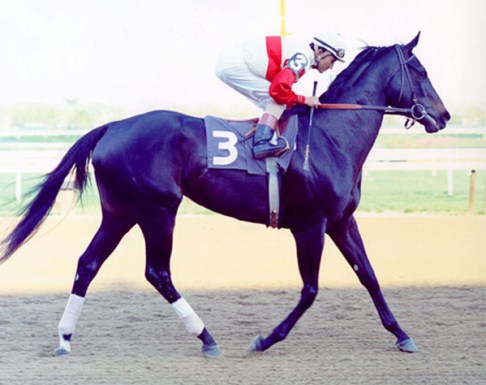
Here’s a picture of the famous Ruffian.  Many consider her as a candidate for the greatest racehorse of all time.  
Image

Upon close examination, Ruffian possessed every conformation trait required to be fast, but she lacked the one that probably would have saved her:  Substance.  It’s clear at 17h that her joints weren’t big enough, and that she didn’t possess the minimum requirement of 6” per 1000lbs.

Her sire, Reviewer, broke down three times on the racetrack and his fourth breakdown, which led to his euthanasia, happened in his paddock.  Her dam, Shenanigans, broke two legs during her lifetime and was later euthanized after colic surgery.  Shenanigans sire, Native Dancer, is rumored to be the one responsible for a ‘soft’ bone issue in his offspring, but frankly, I don’t buy it.  But if it is true, why does he show up so often and so much in the pedigree of many of today’s Thoroughbreds, almost four decades after Ruffian’s demise?  Why would TB breeders purposely take the chance of passing on genetically weak bone from generation to generation?  What good is a fast horse that can’t stay sound?  Because one out of a thousand might be able to? 

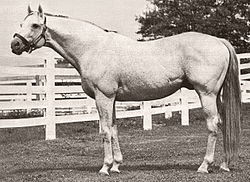
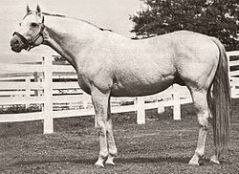
Here’s Native Dancer.  He certainly had substance.
Image

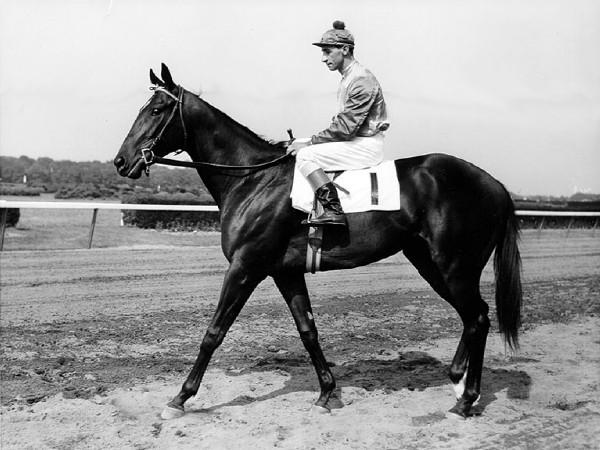
I was unable to find a picture of Reviewer or Shenanigans to see how much bone those horses carried.  But I did find a photo of Bold Ruler, the sire of Reviewer.  Hmm…it might be my eyes, but I see a striking resemblance between him and Ruffian.

Image

So here I am, still on the substance bandwagon.  Let me explain why it’s so darn important.

The front legs of the horse are designed to act as pillars, whereas the hind legs act as springs. As with any foundation column, straightness, size and integrity determine whether the building it supports stands for all eternity, begins to lean under its own weight, or collapses. The same is true of the horse with an additional caveat; the horse is not a static structure, but a moving one. Consider the greater importance of the foundation of a skyscraper that sways in a stiff breeze versus a one-story home the doesn’t budge under the same windy assault. Not only must we consider moving weight above, but now torque comes into the equation.  Therefore, the horse’s front legs need to be straight, possess enough substance (circumference) to support the weight above and be free of fault.  Those requirements become even more important when we consider the following:

To be fast, a racehorse MUST perform on its forehand. Go back to the QH study I linked and see that the front legs always carried a greater burden.  Racing is biomechanically opposite to that of correct riding. Dressage is the antithesis of racing, with the horse transferring weight to the haunch, rounding the back, lifting the withers, raising the base of neck, dropping the head from the poll and coming onto the vertical, while increasing the depth and center body step of the hind leg and decreasing the stroke speed. The Dressage horse’s body compresses, impulsion shifts forward energy into upward energy and the horse carries itself on its haunch high off the ground, propelled by hind legs that coil and uncoil like springs. The racehorse transfers weight to the front legs, hollows its back, drops its withers, drops its base of neck, drops its poll and sticks its nose out, while the stroke of the hind leg thrusts with quick, shorter (relative) strokes. Impulsion is all forward energy, the horse pushing itself forward with the coiling and uncoiling of the hind legs and pulling itself forward with its forelegs, as it lengthens its body and lowers it to the ground.

To be fair, bone alone isn’t enough.  There are other factors besides a lack of substance that can lead to catastrophic breakdowns;

Poor foot balance and bad shoeing choices.  Under those pillar-legs are feet.  Any deviation from correctness has an exponential disaster rate under the pressure of speed.  No human sprinter or distance runner would think to run in shoes that put undue stress on their knees, ankles or feet, and yet…  Here’s a study of how different shoes increase or decrease the likelihood of breakdowns.  This one addresses toe grabs on shoes, something you see in all the racing breeds.  http://www.thoroughbredtimes.com/horse-health/1997/march/29/a-potentially-dangerous-step.aspx 

Bad training and conditioning.  It’s widely understood that the reason racehorses are started at such young ages is to begin bone remodelling.  But that has to be done slowly and carefully over a long period of time.  Push a horse too fast, too soon, and the horse ‘bucks its shins’ (micro fractures of the cannon bone).  Push beyond that and you can bet on a disaster.  Note:  I’ve only ever seen one Standardbred suffer from bucked shins and that was a big (17h) two-year old trotter that I will plainly say was being trained by an ultra-idiot, but I’ve seen lots of Thoroughbreds succumb.  Is that because Standardbred trainers are generally better conditioners of horses, or perhaps because Standardbreds carry more bone in general and are less susceptible?

Some ‘other’ sort of conformation fault.  This could be a benched knee, a too long pastern such that when the horse gets up to speed it starts smacking its sesamoids on the racetrack.  Cow-hock, bowleggedness, deviated cannon bone, rotated pastern, flat soled feet.  Pick your poison; some work faster than others, but the end result is always the same.

A problem with soft tissue.  Suspensory ligaments can tear, tendons can rupture.  This can be related to conformation faults, like that too long pastern.  It can also happen because of poor foot balance or bad shoeing choices.  And it certainly can happen with improper training and conditioning techniques.  It can also be because of;

Accidents:  A racehorse can take a bad step.  They can hyperextend a limb.  They can get jostled in a race, lose their balance, fall down.  They can stumble coming out of the starting gate.  But that’s not what happened to Ruffian.  She was galloping along just fine in her match race against Foolish Pleasure.  She didn’t have a race accident like Niatross pictured below.

NiatrossFall

Here’s the video of Niatross’s fall if you’re a sucker for having your heart in your throat:  http://www.youtube.com/watch?v=LpUSssOlKEg  

And if you want to break your heart, here’s the video of Ruffian’s last race:   http://www.youtube.com/watch?v=YnZFnCvKspw

I say one more time:  Speed Kills.  So if you want to play the game, including playing it on your barrel horse, on your eventing horse, on your speed round jumper horse, or even on your endurance horse, where besides speed you’ve also added torque and sometimes uneven terrain, do the horse a favor and pick one suited to not only the task but one most likely to stay sound doing it.  And then, train, ride, and compete with consideration and caution.  This is a living, breathing animal, not a machine.

My final thought, perhaps unpopular:  The demise of Ruffian had an upside; she could not pass on her small-jointed, spindly stick-legs.
Unknown's avatar

The Good: Succinctly Said

My first mentor was a crotchety old man, who hardly spoke to me the entire time I worked for him and when he did the words usually came out as grunts and mumbles; mostly of approval, a couple times of disappointment. I couldn’t have asked for a better mentor, he was a brilliant horseman. I developed a basic set of equine philosophies that I still believe in today and I honed my skills of observation, as well as the ability to decipher Caveman talk.

My first (serious) riding instructor was a crotchety old German woman. She didn’t talk much either and when she did it was a mix of English and German.  I typically only understood every third or fourth word. The more German words in a sentence, the more frustrated she was with me. And when the entire sentence was German, well, that basically meant I was on my own; sink or swim. (I sank a time or two.)  I couldn’t have asked for a better riding instructor at the time; that was when I stopped being a passenger.

Both proved (to me) that you don’t have to write a novel or orate endlessly to teach effectively.  Indeed, that might not be the best way at all.  (It might also have proven that I was a willing student.) 

There are many greats, whom none of us will ever have the privilege of attending, but we can still learn from them because they have left behind gargantuan nuggets of wisdom about horses and horsemanship expressed in just a few words.

“When the human calls the horse dumb, stupid, stubborn, etc…, they are working from where they are, not where the horse is.” – Ray Hunt

Nothing drives me crazier than when a person labels a horse ‘lazy’. I want to smack them upside the head with something a lot harder than a baguette.  It seems, though, from Mr. Hunt’s words that I should be sticking a cattle prod up their derrieres instead.

“My horses are my friends, not my slaves.” – Reiner Klimke

I prefer to use the term partner to friend, but I definitely agree that a horse shouldn’t be viewed as a slave, and yet I see that all the time.

“It is the difficult horses that have the most to give you.” – Lendon Grey

This quote resonates with me more than any other. Two of the most difficult horses I’ve owned were, without a doubt, my greatest teachers. If you really want to learn, embrace the challenges.

“No hour of life is lost that is spent in the saddle.” – Winston Churchill

Clearly a man who understood the allure of horses and what they give us.

What are your favorite quotes or words of wisdom?

Unknown's avatar

Fun And Games

There’s having fun and then there’s having fun.  When the latter involves horses, safety has to play a big role; safety for horse, safety for rider and safety for third party innocents.  I cringe every time I see a video like this one.  On the surface it seems harmless; a young girl jumping her pony, but the ways in which this can turn bad in a second make me cringe.  Plastic lawn chairs are not a suitable obstacle for horse and rider to jump – ever.  Neither are people.  Yes, I’ve seen a video of someone jumping their horse over people lined up lying on the ground (six or seven of them), like Evel Knievel jumping fourteen buses in a row – and of course I can’t find it now, but I did find this.  Pretty tame, but still.

What about this?

Image

It’s all fun and games until someone loses a testicle…

Here’s taking helmet safety to another level and I appreciate the foresight.

If you’re a car person, you’ll want to skip the next video.  Not sure if they were organizing for a parade or what, but this is one very busy and dangerous area to be assembling horses.  Poor car, but imagine how much worse this can get in an instant.  Perhaps something like this could have happened?  (I do wonder why cars continue to zoom alongside these horses.  Did the drivers think the horses would just suddenly come to their senses and realize they were on a road and get off it?)

My favorite video illustrating creativity, imagination, training evolution AND safety.  Simply an extension of long-lining and ground driving training, the equipment used on the horse is well designed and fits, the rider is helmeted and the skier is fully decked out in helmet, long sleeved shirt, knee pads and gloves, and is far enough behind the horse that an errant kick won’t make contact.  Check it out:  Fun, exciting, and with safety in mind.

I would have enjoyed this event a whole lot more if they’d been shirtless.  Or…  if one of them was doing a handstand in Speedos, while two others held his legs apart and the rest jumped over exposed testicles.

Unknown's avatar

The Good: Flecha’s Human Seeks Guidance

We have our first sucker…I mean…brave and generous soul.  Haley, the human, has come with an open mind, willing heart and a passionate desire to do her very best by her horse, Flecha.  If anyone steps on her courage, even so much as a baby toe, I’ll rip them a new one…with a spoon (because it hurts more).


Haley has also offered to take all the input she gets from us, document her rides, and then do another video in about three months so that we can see her and Flecha’s progress.   How cool is that?


Haley writes:


Contact, Roundness and Correctness: What am I doing wrong?  How do I set my horse up for success?


I’m Haley, and this is my young mare, Flecha.  I’m currently training her in dressage and hoping to take her to a show mid-May.  We’re staying at intro level for now.  I want to move up to training level in the next year, but of course, I think we have some serious work to do before we get there.  Hence, crowd-sourcing The Hooves blog!


I would rate this video of the two of us as “okay”.  Then again, if she and I were perfect, there wouldn’t be much to evaluate!  I think the video demonstrates both some good, soft movement, and also some pretty resistant moments (especially through her transitions).


Right away I can see weaknesses in my riding that I need to fix: hands too low/uneven reins, rounding at the shoulders, and tenseness in my hip and leg that prevents me from following her trot.  After making this video and reviewing it, I had a session with my trainer and made a serious effort to pick up my hands, sit up straight and relax my seat.  These are things I technically KNOW I should be doing all the time; it’s not until I saw myself on film that I realized how often I lose my riding form!  A real eye–opener.


As for Flecha, I can see how much we have to work on in terms of 1) forward and 2) stretching.  Two days before this video we had a riding session where I kept her on a long rein and pretty much all I did was ask her to stretch down and hop over some trot and canter poles.  Flecha was VERY happy that night.  But in this video, on a shorter rein? Not so much.


Could the trick be to put in a month or so of riding in a longer rein and then gradually increase the time we spend on a shorter rein?  This is where I wonder about the physiology of roundness and being on the bit.  Is it too physically demanding for her?  Or am I confusing her by riding ineffectively?  I realize there are probably a myriad of different factors influencing this, so I’m very thankful to have some experienced horsepeople look at this video (and Flecha!) and help me help my horse.  Here’s some info about her to help complete the picture.


Flecha just turned 5 in March.  Her father was a young stallion with a gelding appointment scheduled, but who still managed to cover the two mares he was inexplicably living in a field with.  Later, all three of them came under the ownership of my barn manager, who quickly surmised the two mares were pregnant.  One foal she sold right away, the other was Flecha.  In spring 2009, the barn manager asked me if I’d like to adopt her, and being 20 years old and a little dumb, I said yes.  Fortunately Flecha was easy to start (under saddle about a year and a half now) and is a smart, sensitive sweetheart.  I think that with more time and physical conditioning, she could be a nice dressage horse.


She’s about 15.1 and lives in 24-hour turnout.  When she runs and plays in the field, she spends a lot of time with her head up, looking around like a telescope; so yes, staying low and round probably doesn’t come easily to her.  Conformationally, the greatest fault I can see is that she’s over at the knee.  I’m sure more experienced eyes can see other issues that might be affecting Flecha’s way of going.  She also used to have pretty square, balanced halts, and now tends to halt with her right hind stretched back (you’ll see in the video).  She was diagnosed with mild EPM last fall, which was cleared with a round of treatment.  Since then is when she started camping out that right leg.  Correlation? Causation? Not sure.  She is otherwise sound to the best of my knowledge.


I ride about three times a week on average, and probably we’d be farther along if I could ride her every day and see a trainer more than once every two weeks.  But this is what my budget and gas costs (I drive about an hour to the barn) can handle.  Maybe someday I’ll be able to ramp things up.  I love her and want her to be calm, interested and willing in her work.  Any advice on how to get her there is much appreciated.  Thank you all!

Image

Ride Video

I’ll start us off since Haley originally contacted me for an article on the topic before I asked her if she’d be a guinea pig for the blog.

It’s important to start by knowing what we can expect from the horse in terms of athletic potential, as well,  what areas we might expect to encounter resistance or difficulty.

Image

Keeping it in terms of the question posed, the traits we are most concerned about would be:

1)      LS joint placed a bit behind point of hip
2)      Back as long as we ever want to see it
3)      Ribcage doesn’t carry back as far as we’d like to see
4)      Withers don’t carry back as far as we’d like to see
5)      Loin longer than we like and lacking depth
6)      Downhill build
7)      Low neck set

The LS joint would be better served if it was located further forward in line with the point of hip, however, Flecha possesses a good length of hip to help compensate.  She loses a bit of coiling ability, but that nice length of hip, and the fact her femur is as long as her tibia (and I believe her hind limb angulation is at least adequate)…the LS joint placement isn’t a deal breaker and the potential for engagement remains quite good.

Her back is at the higher end of medium, right about 49%.  Unfortunately, she doesn’t get any added longitudinal strength from her withers or from her ribcage.  We might also expect her to struggle a bit with lateral flexibility through her torso with that shorter ribcage and longer loin.  The loin also lacks depth (perhaps broadness too) and therefore strength.  This combination of traits adds difficulty to training and riding.

The yellow line represents the spine, and as we can see Flecha is downhill built.  Note as well where the yellow line crosses the scapula line…just above 50% (around 52%) indicating that Flecha also has a low/medium low set neck (though structured well, which is a big plus).  These two traits are the ones that are going to present the biggest training and riding challenge in terms of the question posed to us.  Flecha will have to work harder to shift weight to her haunch and engage.  Lifting her base of neck will also require more strength from her scalenus muscle than if she had a higher set neck.

One other thing going on in this photo is that Flecha is standing with her front feet too far underneath her and thus is ‘leaning over her point of shoulder’.  This adds to the ‘downhill’ effect and also serves to close her shoulder angle.   This is not a ‘normal’ or ‘proper’ way for a horse to stand and if this is something that she does regularly, then there’s a deeper, bigger problem.  For starters, I don’t believe her front feet are balanced and are in part contributing to the stance.  I also note that her back is too tight and lacks fullness, but then her abdominals lack strength and her loin lacks depth…all indicating that Flecha doesn’t move with much engagement – ever, but rather travels hollow on a regular basis. 

When I consider her as a whole, the potential to move better (more correctly) and the potential to reach the set goals is definitely there, but it’s going to require a conscience (and consistent) effort on the part of Haley.  That she’s put herself out there and is asking the questions, tells me that the chance of success is very high.

Haley seems to have a really good grasp of what she needs to do as a rider and I think just the few changes that she’s already mentioned upon viewing her video will definitely make Flecha a happier camper.  The hands, currently, while quiet are too quiet.  They need to follow the horse’s mouth.  Yes, they are too low and yes, they are often uneven, but it’s mostly that they are ‘dead’ that is annoying Flecha.  Haley’s instructor should immediately insist on a hand correction.  On her own, Haley should walk her horse with her eyes closed, feel the motion of Flecha’s mouth in her hand and follow it.  Tying a couple of pieces of baler twine/ribbon in Flecha’s mane, Haley could grip a piece in each baby finger to help her regulate the unevenness of her hands.  Ultimately, she needs to ‘memorize’ a new feeling, which at first will feel wrong and awkward, and it needs to be done right off.

Additionally, riding from her core will correct the shoulder and hip issues.  Again, her instructor can physically position her correctly so that Haley can memorize a new body feel.

In some of my initial conversation with Haley, she was happy with her ride and Flecha’s response at 5:23-5:38 of the video feeling it represented ‘acceptance of contact’.  I disagreed and offered that the only time Flecha ever sought contact was at 3:30-3:32, and that what happened later  was just Flecha finding a combination of bracing and evasion that gave her a break.  I noted that for most of those 15 seconds Flecha tilted her head, which is an evasion.  She’s also taking itty bitty steps behind and the canter depart from the forehand at 5:39 clearly indicates that what was happening before it was incorrect. 

So here’s my advice:  Back up.

Neither horse nor rider is quite ready for ‘contact’.  Before all else we must have ‘forward’.  There are multiple times in the video where there is a distinct lack of forwardness.  Once that is established then we need rhythm and relaxation, followed by suppleness.  It isn’t until we have all of that, that we can have ‘acceptance of contact’.  And here’s the next thing that needs to happen; the rider needs to wait for the horse to indicate that she can take up the reins by ‘seeking’ contact – that is; stretching the topline, swinging freely and regularly through the back, lifting the base of neck and telescoping it, opening the throat, and physically and psychologically ‘looking for’, ‘wanting’, ‘seeking’ the support of the rider’s hand.  Only then should the rider pick up the rein and shorten it to the length which the horse indicates.  It is in that moment that you have ‘acceptance of contact’.  When a rider ‘takes’ rein before a horse ‘seeks’ contact, or takes up more rein than a horse has to give, the horse responds by inverting then shortening its frame, followed by either bracing against the unwanted hand or twisting to evade it.

So, how do you get to that point?  Haley needs to incorporate more transitions in her riding and at this point I’d particularly have her doing transitions within gaits and playing around with forwardness; shortening and lengthening the gaits while maintaining forwardness and without speeding up or slowing down.  Certainly she needs to do more transitions between the gaits, but I think within the gaits serves her and Flecha better in this moment.  Haley needs to learn about preparing Flecha better for gait changes and so transitions within the gaits teaches her the nuances of aids and communicating.  She can build on that and move onto transitions between gaits.

I also want to see Haley change direction more frequently and alter her circle size.  I’m not suggesting she do a volte, but playing with 15-20m circles would be beneficial, as well, adding some subtle spiraling in and out paying particular attention to the inside leg to outside hand.  Haley should be able to drop her inside rein at any given time and Flecha should remain on the circle.

The use of groundpoles and cavelletti consistently at this stage would also be beneficial.  It can act as a way to get Flecha to look down, thus causing her to stretch.  It also increases joint articulation that Haley can use to encourage a more engaged step from Flecha.  

I also thought that Haley should praise more during her ride.  Identify behaviors she wants Flecha to repeat and make sure that she offers positive reinforcement in those moments so that Flecha is more apt to try again and to try harder.   Some more spirited conversation between the two would be nice to see.

There are several other options that can be implemented to progress horse and rider that I’m sure others will suggest.  

This is a pleasant horse/rider combination.  They have accomplished much as a team and are close to having a major breakthrough that will propel them to the next level.

Thank you, Haley, for putting yourself out there and being such a good sport.   *Arming myself with a spoon…*

Unknown's avatar

The Long And Short Of It – Part 2b – Ribcage

There isn’t a lot of range of motion between the equine vertebrae, a lot less than people think. I mentioned in part 2a of this series that a long back isn’t necessarily more flexible than a shorter back; sometimes it is, sometimes it isn’t. And here’s why:

The back is made up of thoracic vertebrae and lumbar vertebrae. The thoracic vertebrae have more range of motion between them than the lumbar vertebrae. Indeed, the lumbar vertebrae are all but fused in the adult horse to help add stability and strength to that section of the back, which is the weakest and most susceptible because it’s a freespan having no ribs to support it. Youngsters show more flexibility and ability to ‘twist’ than an adult because their vertebrae aren’t done growing and ‘setting’. Think of it like a baby’s skull that is soft and still in ‘pieces’ and then as the baby grows and matures the skull hardens and fuses. This is just one of the many reasons why riding young horses can be detrimental to future soundness and it’s also a main reason why so many racehorses hurt their backs, but that’s a topic for another day.

If a horse has a medium length of back, but a loin that is proportionately long, then that horse will have less lateral flexibility than a horse with the same medium length of back, but with a loin that is proportionately shorter. Let me phrase it another way: the longer the loin proportionately, the longer the freespan of relatively immobile vertebrae, therefore, the less  lateral back flexibility.

So now we want to take a closer look at our six horse’s backs and determine how much potential flexibility they possess. First we want to see how far the ribcage carries back. (I’m saving the loin for our final part of the series.) The further the ribcage carries back, the more strength it adds to the back (similar to withers that carry back well), AND the more potential for lateral flexibility because that means the more thoracic vertebrae length we have proportionately.

There are two methods for determining how well the ribcage carries back; one is a ‘quick and dirty’ method and one is our trusty measure and calculate method. We’ll start with the latter.

  • A horse with the maximum potential for lateral flexibility (which, btw, is the ability to perform a volte or 6m circle) will possess a ribcage that exceeds 100% of its back length.
  • A horse that possesses an average potential for lateral flexibility will possess a ribcage close to 100% of its back length.
  • A horse that possesses a below average potential for lateral flexibility will have a ribcage well below 100% of its back length.

Remember, though, that all other things would have to be equal. For instance, a horse with a medium back that had a ribcage of 95% would have less lateral flexibility potential than a horse with the same medium back length that had a ribcage of 110%. BUT, a horse with a medium back that had a ribcage of 110% would have more lateral flexibility potential than a horse with a short back and a ribcage of 110% because the medium back possesses more thoracic length to start with than the short back regardless of having the same ribcage length. Still with me?

To determine the ribcage length we start by measuring back length (highest point of wither to LS joint).  Then we draw a body length line (point of shoulder to point of buttock) and a second line from highest point of wither to the last rib.  Where that second line intersects the body length line is the end point of our ribcage.  We then divide the ribcage length by the back length to get our ribcage percentage.

Our skeleton with the points and lines marked:

Image

Horse #1 – 10yr old QH Stallion

Image

So, you’re staring at our first horse and maybe wondering where is that last rib?  This is another point on a horse that can sometimes be hard to identify in a photo.  It is always best to look at a horse in real life, make a guess, and then palpate to determine how close you were.  Over time your eye develops and you start to be able to pick up the nuances of muscle, skin, shading and lighting that can indicate, not just in real life, but also in a photo where such a point is.

Image

Without even measuring we can see that the ribcage line is almost as long as the back line.  My measurement is about 97%, so that’s a ribcage that carries back well, adding strength and flexibility to the back.  But remember, this horse had a short back, so even though the ribcage length is very good, that overall shortness does bite into potential lateral flexibility.

Horse #2 – QH Gelding

Image

This horse doesn’t have the same muscle definition as our first, so judging where the last rib resides is more difficult.

Image

Here’s another one where we can see the ribcage line is very close in length to the back line.  This horse measures almost 95.5%, so close to horse #1.  This horse also had a rather short back (just a touch longer than horse #1), so we can conclude that both horses are likely to have similar lateral flexibility potential.

Horse #3 – 4yr old QH

Image

The sun helps a little bit here to locate that last rib.

Image

This horse’s ribcage measures pretty much right on 100%, so carries back well and with a good amount of lateral flexibility potential.  This horse also measured at the longer end of the medium spectrum, so there’s even more potential for flexibility.

Horse #4 – Arabian Stallion

Image

Image

Another horse with a ribcage that carries back well at 95%, but with a back length that falls on the short side.

Horse #5 – TB Gelding

How does this horse’s ribcage measure up to the previous ones?

Image

Image

If you guessed that this horse’s ribcage carried back the furthest, then good eye!  Finally, we have a horse with an exceptional ribcage at 104%.  Our TB and our grey QH had similar back lengths, being at the higher end of medium in range, but our TB has a ribcage that carries back further, so should possess a bit more lateral flexibility potential.  Indeed, this horse should have the most potential of any of the other horses in that area.  And lastly, remember that the further the ribcage carries back, the more strength it adds as well.

Horse #6 – Paint Mare

How far back does this horse’s ribcage carry?

Image

Image

Our poor Paint mare takes another hit with a ribcage that carries the least distance back at just under 91%.  She also possessed our longest back of the group right at 50%.  So here is a situation where longer is NOT more flexible.

Now that you’ve got the hang on the measuring method, I’ll tell you about the ‘quick and dirty’ method.  Place your hand between your horse’s last rib and point of hip.  More than a ‘spread’ hand’s width (8”) is a ribcage that doesn’t carry back very far.  A ‘spread’ hand’s width is a ribcage that carries back well, and less than a ‘spread’ hand’s width is a ribcage that carries back very well.  You cannot have a ribcage carry too far back.  The further back it goes, the better.