Unknown's avatar

Book Of The Summer Club – Tao, Part 3

I don’t have a whole lot to say about the last section of this book.  I thought it rather serendipitous that the author would mention Nikola Tesla, but that doesn’t belong on this blog.  Mostly she talked of results within her program and otherworldly connections between mankind and animals.  It stretches the beliefs for even the most spiritual.  Whether you buy into any of it or not, if you have any ability to see from another perspective or are willing to accept that sometimes things happen that you can’t explain, then there’s something to take away.

At the very least the author explores that special, often undefinable, connection that people have with their horses.  We sometimes forget it exists until it’s not there anymore.  I’ve had to say goodbye to my horses for the time being and it changes how I feel – about everything.  The empty void and restlessness can only be cured by a moment of contact with horse flesh.

There’s something magical about the horse.  Be as left brain as you want, it can’t be denied.  We all know it exists.  The author explores that cover to cover, and while you may not agree with her conclusions there’s enough every day evidence to know she’s right to ask the questions and explore.  Just listen to those who work in therapeutic riding programs describe how their uncommunicative pupil suddenly lights up; a poetic soliloquy erupting from their mouth as they nuzzle against the horse, or how that juvenile delinquent on a collision course for a long term jail cell quiets the rage inside and takes back control of their life simply by having to be responsible for a horse.

Winston Churchill got it right when he said, ‘There’s something about the outside of a horse that’s good for the inside of a man.’  But there’s more to it than that.  There’s also something inside the horse that’s good for us all.

Thank you to those who’ve read this book along with me.  It was a tough read at times.  And thank you to all the others who participated in the discussion anyway.

Unknown's avatar

Assessing The Youngster

Predicting how a growing baby will finish is tough.  Though we know the general rate at which the horse’s bones grow (see pages 7&8: Equine Studies – Ranger Article by Dr. Deb Bennett ) and we even know that foals are born with approximately 80% lower limb length, that still isn’t enough information to correctly predict final bone lengths and ratios, or joint angles; all of which can play significant roles in athletic potential for specific disciplines.

*Take the time to read the entire Dr. Deb Bennett article I linked.  It has invaluable information in it.

Here are some things we do know with certainty:

  • LS joint placement is set.  If it’s poorly placed in the youngster, it will remain poorly placed in the adult.  We’ve discussed before the importance of this joint location as an athletic potential gauge and for future ease or difficulty of engagement
  • Shoulder angle is set.  A closed shoulder angle (less than 90 degrees) is a serious fault in the horse.  If the youngster possesses one, it will remain so as the individual grows.  It must be noted, though, that the ‘crooked baby leg stance’ can artificially close the angle
  • Shoulder slope is set.  Since the withers are not fully developed, and therefore the highest point of wither is not easily seen, slope can be harder to see
  • Neck set is set.  This can be harder to see in the baby because, again, the withers are not yet developed, the scapula (that which we use to determine set) is still growing, and babies go through awkward stages of growth that can temporarily distort how the neck is held
  • Depth of neck is set.  This is purely an aesthetic trait and has no bearing on athleticism
  • The location, shape and set of the eyes and ears are set.  Any faults (such as pig eyes) in the youngster will remain into adulthood
  • If the neck, back or loin are long in the youngster, they will end up long in the adult
  • If the hind legs are post-legged in the youngster, they will end up post-legged in the adult

There are other things, but that’s enough to get us started.  Let’s examine a few youngsters and see what we can see.

Baby #1 – QH colt – Mozzie Man, owner: bokojones (Thank you!)

Image

Right off the bat we notice the huge hip on this baby, but that’s not surprising to see as it’s a trait we’ve come to expect to see in QH’s.  Already he shows the big muscle masses he’ll carry as an adult.  He’s compact front to back with a deep and super short loin (last rib is practically on top of his point of hip).  While this doesn’t mean he’ll end up with those features as an adult, it does increase the odds that he won’t end up long through the back and/or loin.  To know for sure, we’d have to look to his parents, grandparents and siblings.  His LS joint is solidly placed.  He also has a gorgeous neck, set deeply and higher than is often seen in QH’s; none of that will change as he grows.  He also has a beautiful large, almond shaped eye.  Currently he’s downhill and there’s no way to know if he’ll level out or finish downhill (though, a large percentage of QH’s are downhill built), other then again examining his parents, grandparents and siblings.  We should note here that currently his upper hind leg bones are ahead of growth compared to his upper forelimb legs. (Elbow and stifle are very close in height.)  This happens in a lot of individuals to various degrees, often associated with breed.  (Meaning, there are breeds that tend to grow more evenly than others.) 

So far there’s a lot to like about this youngster.  I do question that shoulder angle, though.  It looks like it’s closed (85 degrees with the horse currently standing with the joint artificially more open than it truly is with that front leg stance), which is typical of a lot of QH’s.  This results in limited stride length of the foreleg.

Image

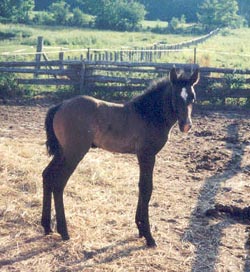
 Baby #2 – Arabian colt – Sir Alie, owner: Abby (Thank you!)

Image

Right off we notice this youngster’s long neck.  It’ll finish long (and that’s a fault), but it is set on well.   It’s hard to tell from this angle, but it doesn’t appear his LS joint is as well-placed.  Certainly there is more general loin length and less depth than the QH suggesting this youngster might finish a bit weak behind in structure.  The overall longer, lankier look of this colt is partly due to breed and partly due to growth phase.  He doesn’t carry nearly as much hip as our QH, but then we wouldn’t expect him to.

Notice this baby is pretty close to level built.  Arabians are one of those breeds where individuals tend to grow more evenly and certainly most end up level or close to level in build.  We can assume that for this one as well. 

The front limbs look straighter, whereas our QH baby looks to toe out.  This is a non-concern for our QH.  Wide chested horses will often toe out as babies, and you want them to because as the chest widens the forelimb will rotate in its socket and straighten.  Arabians are much narrower bodied individuals, so you don’t want to see them toeing out noticeably as babies.  

This one has a better shoulder angle, even though, he too is standing with it a touch artificially open.  He possesses nice length to his vertical humerus bone (an excellent trait) and has a loose elbow.  This youngster will finish with much more expression in his front leg gait and a longer, looser stride through the entire length of his limb than the QH.

The picture cuts off his right front foot a bit (and I can’t see the left at all), but this youngster seems to be carrying more heel than is normal.  It might be a farrier issue, or it might be this one has a club foot.   

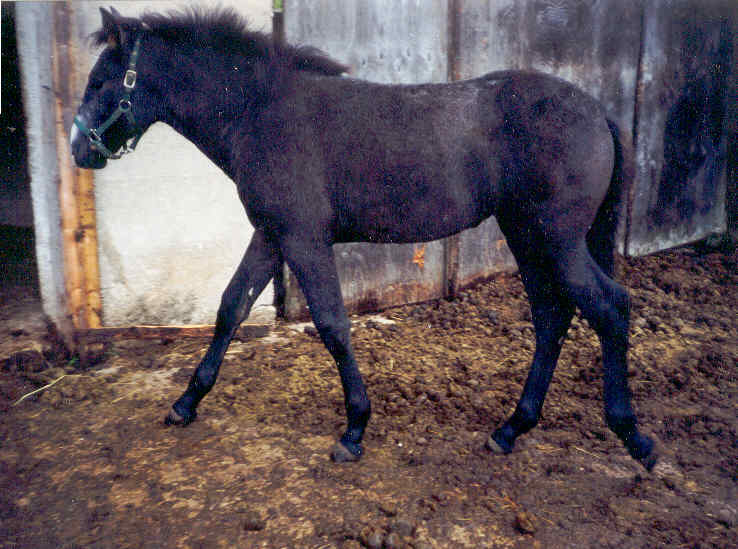
Baby #3 – Spanish Norman (AndalusianXPercheron) filly – Alexia EP, owner: Sarah

Now let’s look at some progression pictures.

15 Days

Image

Very leggy, big hip, laid back shoulder, long humerus, short forearm and deeply set neck are the features that stick out at quick glance.  Forelimbs toe out a lot and that’s not just from an awkward stance. 

4 Months

Image

Looks like a different horse already, eh?  That deeply set neck looks ultra-short (but we don’t worry about that, yet, since the neck is one of the last things to stop growing) and the hip appears to have lost its size.  The other difference to note is that the loin suddenly got long.  At this early stage of growth, that’s a bad sign and likely foretells of a long loin in adulthood.  The forearm still looks shortish, but the humerus is long.  Look at the right front…there’s a hint of the toe out.

10 Months

Image

Phew!  The neck lengthened and the hip grew, but that loin still looks too long for this early on.   We’ve also hit a phase of butt highness and this has stressed the horse’s posture.    That forearm still appears short.  Look at the front limb stance, toed out.

18 Months – 15.2h

Image

She’s looking more compact again, but that loin lacks depth.  Notice the toed out stance, still.

3 Years

Image

The hip shows plenty of length, but the loin is long.  Much less toe out in front.

5 Years – 17.2h

Image

As an adult with the same deeply set neck, set high on a laidback shoulder, and a good sized hip.  The loin finished long, the humerus has good length, and though the fence cuts off the rest of the front legs, the forearm is shorter than ideal.  The horse no longer toes out.

10 Years

Image

This picture shows the massive width in the chest and why as a youngster this horse toed out so much.


The best indicators for baby growth will always be examining the parents, grandparents and siblings.  An individual will be a combination of traits of its parents and to a lesser degree its grandparents (and negligibly great-grandparents), where recessive genes and traits that ‘skip a generation’ can come from.  There’s absolutely no use pulling out a picture of some distant relative and thinking that’s what you’re going to get, unless the sire or dam look like that.

If you breed a short-backed horse to a long-backed horse you aren’t going to get a medium-backed horse.  You’re going to get either a short-backed or a long-backed one, so if your goal is to shorten that long-backed mare, then the stallion should come from medium-backed parents, be of a medium back and be prepotent for that medium back, otherwise there’s a good chance you’ll get a long-backed offspring.

Unknown's avatar

Bachlorette Blooper

On a lighter note…

As my husband sat down on the couch beside me, he said, “You have two choices.  You can watch voluntarily, or I’ll make you watch by putting toothpicks under your eyelids.”

Clearly I opted for the voluntary option – under GREAT duress.  He turned the station to ABC and Desiree was riding a big, bay draft cross down a path in Antigua.  Waiting at the other end was Drew, who hauled himself up onto an almost equally large Paint cross. 

I thought, ‘Wow, those are some nice looking horses.  Shiny, in good condition.  Usually when you see people on a tropical island vacation going for a ride, they’re on sickly looking old nags.’  What I said was,  “Wow, those are some nice looking horses.  Shiny, in good condition.  Usually when you see people on a tropical island vacation going for a ride, they’re on sickly looking old nags.” 

So enthralled with the show, hubby said nothing, so I repeated myself.

*Grunt*  (Awesome!  He’s listening.)

They rode at a lackadaisical walk down to the beach and dismounted.  A few seconds later I perked up.  “Did I just see that?!”

“Yep,” he said.

“That really happened, didn’t it?!”

“Yep,” he repeated.

So what did the rest of you think when you saw that?  Oh, you don’t watch reality TV, really?  Tsk, tsk.  Well, the show had edited out the part where our lovebirds had dismounted.  On the beach and getting settled down to have that ‘I’m breaking up with you’ heart-to-heart talk, for a split second the Paint cross walked into the camera shot, his/her head down sniffing the sand for a blade of grass with the reins dragging on the ground, then another quick edit and the horse was gone.

I live for these TV and movie gaffs  It’s an opportunity to act incredulous.  Like The Mask Of Zorro movie, starring Anthony Hopkins as the aged Zorro.  The narration in the background talking about Toronado being a rare, black Andalusian, while a Friesian filled the movie screen.  I darn near leapt to my feet, feeling insulted on all fronts that the producers thought they could fool me into mistaking a Friesian for an Andalusian.  Pfft!  Not even if I was blind, dudes.

For fun, let’s list all the TV and movie horse errors that Hollywood has made.

Unknown's avatar

How To Start The Engagement Process

1.      Find a sucker…
2.      …with a six-figure salary
3.      Tell them what they want to hear
4.      Don’t fart or burp at the dinner table, or…
5.   … apply for The Bachelor/The Bachelorette and you’ve narrowed competition down to just 24 other – fill in adjective/s of choice – people (those are damn fine odds!)

I have a point, but I’ll come back to it in another article.  Right now I want to discuss the other kind of engagement, the one that involves horses.  Here is another blogger article called:  Five Ways To Engage Your Horse’s Hind Leg

*We* take exception to a few things about this article; the first being the use of the terminology ‘rocking him back on his hind leg‘.  Ugh!  All day long, every day.

Thank you to jrga for addressing this specifically:

This article contains some basic misconceptions that really shouldn’t be perpetuated.

One is that you can rock a horse back onto its hind legs. Technically that is correct, but generally what you are saying is you will unbalance the horse so much it rears. Engaging the hind leg is not about pulling the horse back onto its rear legs, but asking the rear legs to come forward, up and more importantly, under to the midline. As soon as you ask an overly hand-obsessed human being (and we are made that way, why else walk on two legs) to start doing things like rock a horse back, you will have too much hand and defeat your ultimate purpose.

If you want the rear legs to move, you don’t rock them, you don’t shift weight onto them in any kind of backwards motion, traction on the reins, etc. You get weight on them by getting the horse to step under and put the weight on them.

So yes, proper transitions, proper half halts, can help get a horse under itself. But they aren’t magic and done improperly will leave the horse more strung out. Hill work is great (and some Tevis or Tevis-like picture is a poor illustration of hill work) done properly too; meaning slowly, one step at a time with each hind leg coming under equally to bear weight, no crookedness, crabbing movement up or down the hill. If you have no idea how to straighten a horse on flat ground, you won’t be able to do it on hills either. The hill won’t fix the horse automatically. A horse accepts the challenge of the hill by going to a higher gait, not walking straighter and exercising its rear to develop weight bearing.

The basic movement to engage the hindquarter is to ask the inside foot to step under towards the midline.  You can practice this on a leadline; ask them to walk forward in a nice comfortable loose walk, then using a dressage whip or the end of the lead line if it is long enough, point to the inside hind near the flank, and ask the horse to step slightly more inward.  At first you may have to touch the horse or swing the rope so it makes a big movement so they step away rather hurriedly, which will stop their forward movement in many cases. Just start over, most horses catch on quickly that you just want them to get that hind foot under them. Remember with horses, that a cue like this works best when the horse is off the foot, so time your cue for when the swing forward of the foot is just beginning, the horse can adjust the placement of any foot when it is in the air, can’t do anything about a foot on the ground. If you pay attention, you will notice that the horse’s rib cage will swing more inward out of the way so the stifle can move into the spot where the rib cage was. (See recent video linked by saraannon http://vimeo.com/19772295) That increases the amount of apparent bend the horse can make, so now you are killing two birds with one stone, more engagement of the hind foot, and building in the flexibility and stretch into a bend.

When you start, your horse may have a definite ability to step up and under much better on one side or the other. Congratulations, you now have an actual visual for crookedness, both hind legs cannot step up and under with equal ease to bear weight, which means on one side the horse pushes off with more power, moving the horse more strongly on that side, and voila, drift off the center line or whatever straight line you meant to walk.

Next you practice with this at the walk on the horse’s back. Other than your first step every time you mount a horse, ie, ask for flexion to the inside so that the first vertebra (refer to blog article Optimal Neck Position) unlocks the spine by moving slightly right or left, not pulling the head around, but again, ask the horse to unlock at the poll. Then start asking the inside hind foot on a bend (can be a large circle, down the track, but create an inside bend of large circumference) to come under. Remember the hind foot is coming forward when your hip sinks on that side of the horse (have a practice session or two if you can’t find that cadence in the walk where you feel the hind foot on the ground/off the ground, use a ground person to help if at all possible), which makes sense, once the horse’s foot is off the ground nothing is holding your weight up on that corner of the horse. At that point, you will feel a subtle shift of the rib cage moving away from your leg as it accommodates the swing of the stifle. The stifle is narrower than the belly, for a big step up and under, the ribcage has to get out of the way so the stifle can fold up. Hence the reason your horse should be a back mover (feel the swing of the back as the rib cage shifts) and not a leg mover, leg movers don’t have room to step up and under. You encourage a slightly larger step up and under as you feel your hip sink and the rib cage start to swing by letting your leg move in with the rib cage with a little more weight, to encourage it to move just a little further than in your horse’s normal walk. Your horse, if the sensitive type may take a really big step or even do a transition upwards, don’t pull back or punish, just start over. It did what you asked. On a really dull-sided horse, it may not feel like you got any response at all, if possible, use your surroundings to your benefit, if he tends to like to head for the gate, practice this at first heading for the gate.

Once you get some reaction, experiment, a couple big steps, then remove the aid and allow a normal step, just see what happens to the horse as you change how much under you ask for. Remember, you are bending the horse, and just with an actual circle, we never lean in or look down at the ground, it overweights that leg, inhibiting it from doing what we asked, stay in the middle of the saddle, head up, looking out in the direction of travel. Notice this in not about hands or reins. If your horse can’t walk on a loose rein, you may need to do course corrections, but you are teaching your horse to move off a leg aid, a very subtle one here. You don’t need heel, spur, kicking or generally even a whip for this, you just exaggerate slightly what your horse would do in any event.

Practice both directions. Once your horse starts to understand and step under on the bend, experiment again.  See what you get doing a shallow serpentine.  Can you get your change of bend almost entirely with your legs?  Can you do a circle almost entirely with your legs?  Can you start to do lateral movement off a straight line just with moving the hind feet?

If your horse tenses up in any of this, gets hollow or high-headed, address the tension, get it to create flexion and relax, and start over.

Now you have the proper tool to help you start doing better transitions where you can straighten the horse, walk up and down hills on a straighter horse, and get the benefits of these exercises rather than perpetuating crooked movement through the exercises and missing the benefit.

Adding: This is Buck Brannaman doing the circle exercise, using a flag:

A flag is a strong aid, maybe not something to use if you don’t have help in person to get it right. Note that Brannaman is much more sophisticated than me, or what I just described. He has a ton of experience and skill, and this horse has done this before. He uses the flag to the rear of the horse for impulsion, going forward, note his body position, hand and eyes are at the flank of the horse, asking for the over (note early in the video where he steps into the horse to first get it moving and stepping over (yield away from me), that is another ‘strong’ aid).

But watch those hind feet step up and under and the amount the hip of the horse engages. Occasionally the horse actually crosses over the midline, you don’t need to start there, that is lateral movement beyond what you need to start, because a horse needs some strength to bear that weight without damaging joints. Just start at up and in enough to follow the line of the front hoof on the inside, not cross over.

Brannaman is also able to time aids on the lead rope to encourage softness and rounding up slightly, that is another whole level of skill you will eventually want to get to, but nobody starts there.

Unknown's avatar

Choosing An OTTB

I’ve mentioned multiple times that what a horse does with its body to be fast is very different than what the horse does to collect under a rider. That means that there are significant physical differences between the two, but there are also several, very important similarities such as good hip length, well-placed LS joint, big, clean joints and straight legs.

The differences mean that not all racing bred Thoroughbreds are well-suited to carrying riders in secondary disciplines. Indeed, I’ll go on record as saying the vast majority are not well-suited, particularly for the average owner. Yet the breed is plentiful and certainly there have been many who’ve gone on to be successful in a second career. This article will discuss the major (different) traits that make (or break) an easy transition from racehorse to riding mount.

In no particular order:

Levelness Of Build – A large percentage of racing bred TB’s are downhill built. Already this is a disadvantage in riding disciplines putting more weight on the forehand and making engagement more difficult in direct relation; the more downhill, the more of a disadvantage. Remember to look at the spine, not at the withers and croup. (See blog article:  The Up And Down Of It – Levelness Of Build) A horse doesn’t have to be downhill built to be successful on the racetrack, so look for one that is close to level built.

Neck Set – There is also a large percentage of racing bred TB’s that have low set or ewe necks. Again, this is not a requirement for a racehorse but neither is it detrimental to producing speed so it’s been allowed to perpetuate in the breed. It is, however, a fault in a riding horse making engagement significantly more difficult. Necks set on low posturally (it’s a word now) want to drop at the base (lower cervical curve deepens), this in turn lifts the head, drops the withers, hollows the back and pushes the hocks into a trailing position. (See blog article: What Is The Optimal Neck Position?)

Hind Limb Angulation – A racehorse will carry a straighter (relative) hind leg, one with less angulation. That in and of itself isn’t going to prevent the horse from being a good riding mount, but if the leg is too straight (post-legged) then there’s going to be issues. 

Hind Limb Bone Ratios – The most significant ratio is femur length to tibia length. Many racehorses will possess a tibia longer than a femur. This is contrary to what we want in a riding horse, where we like the femur to be at least as long as the tibia, but hopefully longer. A longer femur means more potential for stroke length. The racehorse takes shorter, quicker, thrustier (relative) strides, whereas we want the riding horse to take longer, slower, carrying strides.

Hock And Stifle Set – Many racehorses with have high hock and stifle sets. This tends to go hand-in-hand with a downhill build, shorter femur and longer tibia. The higher the hocks and stifles, the harder it is for the horse to ‘sit’ (lower the haunch), a requirement for engagement and collection.

Feet – Racing can be hard on the feet and the TB in North America has become known to be rather flat-soled and often possesses under run heels.  The latter can often be improved.

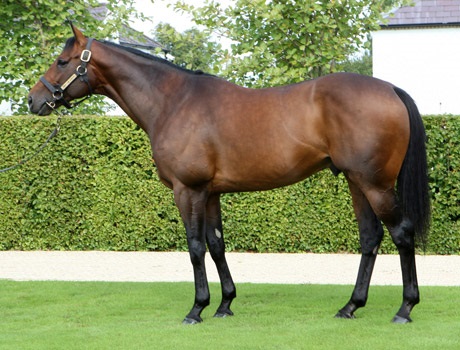
Let’s exam three random TB’s and see which one might best be suited for a secondary career under saddle.

Horse #1

Image

This individual is clearly downhill.  His neck set is about as low as we’d ever want to accept for a riding horse.  Certainly its musculature and posture could be significantly improved.  It’s roughly attached and some of that would also improve with correct work.  He’s quite straight through the hind leg with a higher hock and stifle set.  On the plus size he’s got really good bone, a low knee and decent hip.  The loin currently lacks depth, but that too would improve with good riding.

Horse #2

Image

A little less downhill than our first horse, a better neck set with the neck attaching more smoothly, significantly more angulation through the hind limb, hock set higher than our first horse, but the stifle is set lower.  This horse’s knee, though, is set quite a bit higher and is tied in a bit.  Look how that high knee adds length to the cannon bone and shortens the forearm.  Not the combination you want on a riding horse.  The high knee interferes with jumping form and the short forearm interferes with lateral movement.  His hip length is just as good as our first horse, and he has a loin that is shorter, deeper and stronger, but this horse is lighter boned – the lightest substance you want to see on a racehorse.

Horse #3

Image

Real close to being level built.  Great neck, great hip, super loin, medium back length, withers and ribcage carry back really well, super low set stifle (hock higher than ideal), phenomenal pants muscling – simply screams ‘Ride me!’- UNTIL – the legs are such a disappointment; too light of bone, a bit too straight through the knee, a bit tied in, and another high knee (not as high as horse #2, but higher than #1).  If this horse is really straight-legged with minimal offsets, deviations and rotations of bones, which we can’t see from this photo, and you don’t want to pound his legs with a lot of jumping or jumping at speed, then odds become more favorable that he can stay sound.  We can’t see his feet, but they’re likely on the small side, still, he’s the individual in this bunch that could most easily transition to a ridden discipline, followed by horse #2.  Horse #1 is still capable of being a decent mount, but will require a much more skilled rider/trainer for a riding discipline.  This horse will always naturally want to plow around on his forehand.

Now that we’ve looked at physical traits, it’s time to discuss temperament, personality and retraining the racehorse. Know that the horse that walks off the track is not the ‘real’ horse. It takes a number of months for a racehorse to ‘let down’. Many right off the track are high on concentrates, experiencing chronic pain, and haven’t seen a pasture in months (or years). They’re often underweight and certainly are carrying next to no body fat, often have been allowed to have their way with humans, or have been ‘roughed up’. All are stiff and one-sided with musculature honed for speed rather than carrying a rider effectively and efficiently.

Probably the hardest part of retraining is that racehorses are taught, allowed, and encouraged to grab the bit and lean on it/pull against it.  In their secondary careers they need to learn to accept contact and yield to the slightest changes in rein pressure, learning to rebalance, slow and stop by dropping their haunches rather than throwing their weight over their point of shoulder and onto their front legs.

The other significantly tricky aspect to retrain is their inherent nature to want to race against other horses in the ring.  A good way to start the retraining process is to put them in the Dressage ring by themselves.  When enough retraining has occurred and the horse understands acceptance of contact and the half halt, and is more physically able to shift weight rearward, then slowly introduce other horses into the training arena with cooperative friends and test the new skills in this controlled environment.  Hack alone and then, again, once retraining has progressed far enough, slowly introduce other horses on the hack in a controlled manner.

Realistically, if everything goes right and the horse is relatively sound to begin with, you’re looking at a year’s time to let down, remold musculature, and retrain to a very solid Dressage training level.  This is not a process you can rush if you want what’s best for the horse.

Unknown's avatar

What’s The Optimal Neck Position Of The Horse?

This questioned was posed on a bulletin board.  The OP had recently been diagnosed with abnormal curvature in her cervical vertebrae and it brought to mind for her how the horse’s neck might be affected by a rider working against the horse.  Rolkur anyone?

Jrga responded to the question and graciously agreed to have it brought over here for further discussion.  Here is the response:

There is no optimal position of the neck, as it is meant to be flexible and move in different ways to accomplish different things for the horse in nature.

That being said, just as in a human, there are positions it was never meant to hold for any length of time. What is always optimal is that the vast majority of time that the neck is not in any forced position, and that it is ‘stretched’ appropriately to the task at hand.

Mechanically, different neck vertebra are shaped differently, and trying to force movement that is limited by the bone structure will cause catastrophic injuries. The first vertebra is to move up a tiny fraction, and down when released from muscle tension, it is meant to move right or left, ie, flexion at the poll. Note, it is to move right or left, not break down or back to any great degree or to rotate, flexion is not primarily about engaging the first vertebra but releasing it. The second vertebra is the swivel, useful to a horse, not something we wish to engage as riders, ie, to cause head tilt. The infamous third vertebra and the ones behind it can give up and down movement as well as side to side movement. Since the third vertebra bends down by engaging muscles, many pulled upon horses (too much rein, tie downs, martingales used improperly, break the neck at the third vertebra incorrectly. 

If we engage the vertebra enough in ways that they aren’t meant to be engaged, use tie downs and leverage devices to force a shape, then the muscles and ligaments tend to tighten accordingly, reinforcing poor positioning of the vertebra and causing chronic ‘tightness’ and pain, etc.

Deb Bennett gave a lecture at the George Morris clinic this year on biomechanics, and she demonstrated with a skull and neck bones, there are few better demonstrations on how necks work. If they are still there, it would be worth going over the the US Equestrian site and hunting through the video links for those lectures, they are free of charge.

Basically, the combine system of neck bones and muscles work correctly, ie, optimal for horses generally, when the appropriate muscles are engage to stretch the neck out of its resting S curve shape to a flatter shape, which shape actually starts to arch as it stretches to its fullest extent. As the stretch becomes more pronounced and the curves behind the poll and at the base of the neck flatten, the top line (nuchal ligament and muscles) stretch and relax. This produces the greatest flexibilty and strength for the neck, relaxed muscles don’t tear, they move easily. A by product is that the short muscles around the poll release allowing the nose to drop towards vertical. The end result is the base of the neck is raised, flattening the horse’s spine from shoulder to rump as much as possible within the limits of the horse’s conformation, and the neck arches, poll approaches the highest point, there is a hollow gullet below the neck and the nose drops towards the vertical. Raising the back, arching the neck through stretching the top line, is one of the most important aspects of collecting a horse. The single and foremost step is engagement of the hindquarters at the SI, ie, engaging the musculature of the power center to lift its side of the back as well as bring the rear legs under the horse, relaxing the neck so that the base of the neck may raise and the S curve stretch and flatten out, is the second step.

If you pull the nose in, the horse will generally tighten the base of the neck, using the large muscle under the neck, drop the base of the skeletal structure,increasing any tendency to be down hill that already exists in the horse, and hollow the back and make it impossible for collection to occur. The front legs are also affected negatively by this, they can’t swing freely, and the horse drags itself along with its front feet, tightening chest muscles, losing flexibility for lateral work, and stressing tendons and ligaments meant to stabilize the leg by forcing them to function in place of the big butt and thigh muscles in the rear that were meant for locomotion.

No horse was meant to have its neck all arched up in collection all the time, nor pulled back by restrainig hand or devices, if you want to take the do no harm position, long and level is good, but it doesn’t help a horse to counteract the weight of a rider nor exhibit particularly athletic movement.

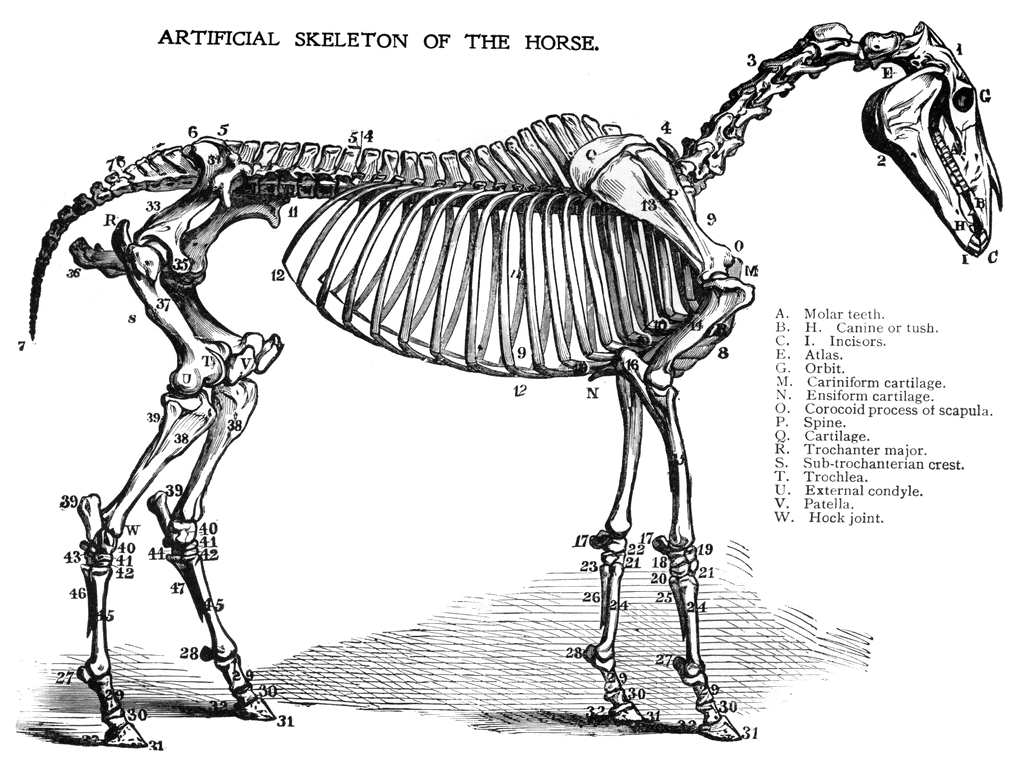
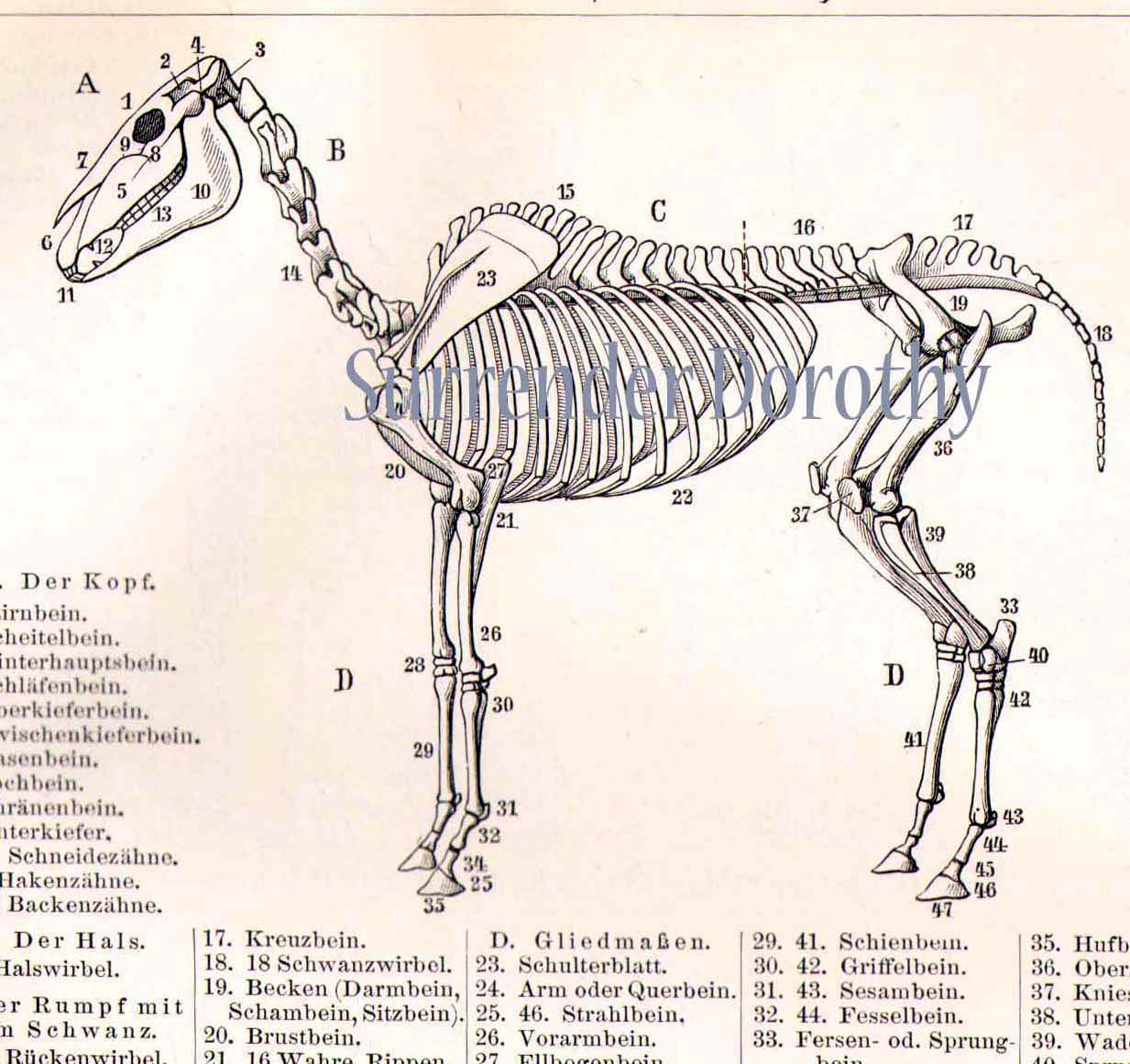
First link is a skeleton drawing that show the upper and lower curves, an Arab would probably have a more pronounced and longer upper curve in the S, the much desired mitbah that contributes to their swan neck look, an ewe necked horse would have a lower and deeper and longer part to the lower S curve, which is why they bulge out in the under neck and tend to stargaze: 

The second link is a skeletal drawing where the neck has stretched, forming an arch and spine is made level (not all horses will be level even with properly engaging the neck, it depends on how downhill or uphill their conformation is:

Relaxed long and low:

A horse carrying its neck this way is going to be hammer-headed, note there is no turnover at the upper S curve, the spine meets the head like the handle of the hammer meets the head of a hammer:

Relaxed long and low in a real horse, but also note that the rider still hasn’t fully released the neck and note the reflection along the top line, it drops at the withers, by holding the nose too much, the base of the neck has dropped too much given that the horse is in long and low, this is not yet optimal:

A horse similar to the hammer headed look, dropping in the base of the neck, also notice how short the neck looks, it isn’t stretched, this horse looks ‘ewe necked’ but I don’t think in his case it is a natural part of his conformation but a result of how he is typically handled, either way, ths is far from optimal:

This looks like an actual long low base of the neck, honest to goodness ewe neck to me, YMMV, whoever posted the picture captioned it as such, as well:

A nicely built neck, showing long and straight stretch, follow the reflection of light along the top line, ignore the crest, and see that it does not drop from the withers, there is a gullet below (base of neck raised) and a fairly smooth column of muscle at mid neck, showing even without the horse being engaged, note honest flexion, nose to inside but not tilted or nose held in in any way:

Fully stretched and arched neck (on a horse with ‘baroque characteristics”, ie, heavy and muscular with a deep neck, broad back and large haunch, note this is levade not rear, a highly collected movement, hindquarter engaged, neck stretched and handler’s head is in the way, but the nose would actually be slightly in front of the vertical:

This is just ugly, a beautifully built neck being abused for no reason, and won’t create collection, this is pulling that is so beyond not optimal:

http://cdn.thehorse.com/images/cms/2012/10/TH-LEGACY-IMAGE-ID-484-neck-hyperflexion.jpg?preset=medium

I haven’t shown you a nicely optimal neck in a highly collected ridden horse yet, I’m still looking, which is kind of sad. There are some out there, but you have to kiss a lot of frogs first.

I think questions such as these would be a great addition to the blog.  If you have a question, or you have an answer to a question, email to:  thehoovesblog@gmail.com
Unknown's avatar

Update – Western Dressage Association Of America

Without rehashing everything I find wrong with the idea of creating a specified discipline called Western Dressage – seriously, why can’t they just simply have Dressage classes (tests) at Western Shows and call it a day? – I cringed just a little bit more when a good friend came across a tiny article in this month’s edition of Quarter Horse News.

Apparently, the “WDAA has submitted an application petitioning the USEF for affiliate association status for the discipline of Western dressage.”  They site that the motivation for such an affiliation is multi-fold, and specifically mention “to provide a platform and resources for USEF breeds to offer classes in the discipline of Western dressage.”  They also want such competitions “to be bound by the USEF mission of horse welfare, in particular to the drug and medication rules.”  *sarcasm on* (But not the definition of Dressage gaits?) *sarcasm off*

I suppose becoming affiliated with USEF might add credibility to the sport and a certain set of rules, *sarcasm back on* if you afford the USEF credibility in terms of enforcing the rule book?  *sarcasm back off*

Yeah, I’m still not convinced.


*Note:  I’ve extended my visit an additional week, so new articles (of substance) are likely to cease to exist until such time.  🙂 

Unknown's avatar

AC4H Update

Thanks to *Samantha* for sending in another update on this sleazy organization.  As you probably all remember, shortly after I posted the picture of a roach backed Clydesdale gelding in obvious pain being ridden and offered for ‘adoption’ by AC4H, that organization was raided by the FBI.

Here’s a link to an early May update:  http://www.ratemyhorsepro.com/news/fbi-seeks-victims-of-another-chance-4-horses-rescue.aspx

Upon going to FB, I see that they are still in business.  WTH!?  How naïve of me to think being raided would be the end of them.  Any time now I’d be happy for Justice (Karma) to move its ass.  Feel free to spread the word and potentially help the FBI gather evidence if you want to see this organization shut down once and for all, and its participants punished. 

Unknown's avatar

Book Of The Summer Club – Tao, Part 2

Though just a couple of people chose to read The Tao Of Equus along with me, a vibrant conversation ensued anyway.  I want to thank those who particpated in that discussion, along with everyone else who takes the time to post their thoughts on other topics.  Without interaction the blog is nothing more than me seeing myself in print.  And while I find myself entertaining (insert *smirk* here), it’s infinitely better when others express their thoughts and opinions.  Part 2 of Tao is a much larger section of the book, covering about half its entirety.  I’ve picked just a few points to discuss.

‘Joy’ is a client and begins the ‘equine therapy’ program that the author runs.  On Joy’s first day she’s shown to a paddock of four horses and is asked to assess each horse’s personality and placement in the herd, then to pick the most appropriate one to work with based on her assessment (and including her own limited equine experience and personality).  She is immediately attracted to the horse which approaches her boldly and nibbles at her clothing.  She thinks the horse is cute, friendly.  She’s wrong.  As it turns out the horse is the bully in the herd and was just recently saved from slaughter because he was too aggressive and dangerous.  To make a long story short, Joy also picks the same kind of men in her life and it’s one of the reasons she begins the program.

How many of us know (or have heard of) someone who’s picked the wrong animal?  Be it dog, cat, horse, doesn’t matter.  They quickly find themselves in over their heads and unable to deal with an animal that has taken over their lives.  It’s why animal trainers/behaviorists like Caesar Millan and Jackson Galaxy have successful businesses and TV shows, and why *equine gurus* have become all the rage.  The inability to correctly assess temperament, personality, emotion etc… in an animal is a huge barrier for many to overcome.  And that’s not even considering the knowledge required to train the animal.

The author believes it starts with (and goes back to) incongruence in people, in ourselves.  If you don’t know who you are (particularly in the moment), you can’t know who anyone else is (in that same moment).  You also can’t correctly identify what’s behind those big, almond shaped eyes.  It’s not necessarily *our* fault.  Many times we grow up not knowing, having learned incongruence from our parents and later experiencing it in our peers, co-workers, authority figures.

Do you know what you like in a horse and why?  Do you know what you don’t like in a horse and why?  Can you identify those traits in an individual even if they’ve come from a trying situation and therefore unlikely to be their true selves in the moment?  Do you know that the horse that cowers in the corner and trembles is more likely to hurt you when you aren’t looking than the one who aggressively comes at your face with teeth bared?  Can you tell the difference between the horse that acts out because of insecurity and fear over the one that acts out because it wants you to cease to exist?

Which brings me back to the incredible popularity of *equine gurus*.  The author talks at great length about this phenomenon (and not always in a positive light). The seemingly instant miracles, the extensive marketing and promotion of specialized tack (required of course to get desired results), videos, books and of course the ‘apprenticeship’ model whereby a student can rise through the levels and ranks to become a clone of the guru himself.  She discusses how participants in clinics fork over wads of money and go home with arms full of product and a head full of ideas only to find that implementation of the methods isn’t nearly as easy as the guru made it look.  There’s a lot wrong with the entire process, but it boils down to the fact you can’t teach someone how to effectively communicate (long term) with a horse by having them spend gobs of money on specialized tack and a few minutes imitating you.  It takes years to develop the unspoken nuances of horse training, the ability to assess a situation and adjust your approach on the fly, and the humility to accept that today might not be the day the horse allows you to ask that of it.

The author also talks of laying down a horse and how it can induce a form of disassociation which changes the horse’s personality instantly, and is akin to the survival ‘freeze’ response that happens to prey animals just before they die.  I posted a video of just such an occurance not too long ago in another blog entry.  If you recall, I’m against laying down a horse.  Very against it.  It makes me physically ill every time I see it done.  Asking a horse to lay down because you’ve introduced a series of cues in a systematic way so you can perform it on command is a different story; the horse always has the option of saying, no.  Forcing an animal into a position of pure submission against its will is despicable and speaks to the person’s (at the very least) ignorance and (at the very worst) their cruel nature.  The author claims to have witnessed a way to lay down a horse in the moment and to prevent disassociation, but you’ll have to read the book to get the nitty gritty details.  I’m inclined to agree with her, especially the point she makes about it requiring a skilled horseman, but I’m still against it.

Other ways to create disassociation in a horse and change its personality;

  • Tying the head tightly, often times for extended periods of time
  • Application of conflicting aids, over and over again causing confusion and frustration until the horse can no longer stand it and checks out
  • Drilling exercises, especially if conflicting aids are also utilized
  • Unfair and/or inconsistent treatment
  • Repeated abuses
  • Poor management practises that rob the horse of its very nature; lack of social experiences, lack of adequate movement

When I think of all that I’ve seen done to horses, it makes me wonder why they ever trusted us in the first place and I’m equally amazed they’re ever willing to particpate in human therapy programs (of all kinds, not just the author’s) to help us.  Do we really deserve that kind of generosity?


Note:  I’m taking off in a few days for a week’s time and there’s likely not going to be a blog entry until I return, unless someone drops me a line (thehoovesblog@gmail.com) with their own contribution, which of course I encourage you all to consider doing. 

Unknown's avatar

The Good: When Equines Are Confused

I have a cat.  (I know, right?)  Anyway, I often think he’s confused about the fact he’s a cat.  He regularly brings me toys and drops them at my feet in anticipation of me throwing them for him.  If I don’t respond within milliseconds he will talk at me (not to me – there’s a difference) until I comply.  It’s almost as annoying as a dog giving those pathetic *please, pleaseeeeeee, PLEASEEEEEEEEE* eyes and then resorting to barking happily until the ball is thrown, except that I find it way funnier when my cat does it. 

Obviously I’m super well-trained and it never takes more than a meow or two of ‘Hey, stupid human! ’ before I pick up the toy and throw it.  And I giggle every damn time he runs after it and watch him bring it back to me to rinse and repeat.

So, what’s this got to do with horses?  This: Tracking Horses  (Thank you, Quill).  I had no idea people were doing that with horses, but here is another  I found with far more in depth information.  There’s even a training booklet available.

But if that wasn’t enough, I’m almost finished Part 2 of Tao and there was mention of this.  How cool is that?  I almost want one just to see the looks on people’s faces as I walk down the street.