Unknown's avatar

The Good: TWH Soring Issue – New Amended Bill Being Introduced

Thank you E.Q. for bringing this to my attention.   Some of you may remember the uproar last year when a certain ‘behind-the-scenes’  video was displayed on Fugly (and all over the Internet)  in regards to abuse against Tennessee Walking Horses for the purposes of winning in the show ring.

There was a cry of outrage, but as with many things in life, not a whole lot came of it as the proposed Bill 6388 died in committee last September.  Fortunately, tenacity exists in some people and a new amended bill: HR 1518, sponsored by U.S. Rep. Ed Whitfield, R-Ky is being introduced.

Both the AVMA and the AAEP are supporting this bill and here’s a link to the particulars of that:  Veterinary Practice News  There is an opportunity to submit a comment at the bottom of this article.  Show your support!

Link to the Popvox:  HR 1518

And another write up by:  Horse Canada

Stand up for the horses and lend them your voice.

Unknown's avatar

Oopsy Daisy

I’ve always known that Thoroughbreds are loopy.  You’d never see a Standardbred pull a stunt like this.  🙂  Having said that, I’m so betting a massively big chunk of money on this one in his next race.  If he can run in any sort of a semblance of a straight line, he’ll win by a mile…literally. Make sure you watch the replay and pay particular attention to the head-on stretch view.

http://www.youtube.com/watch?v=FbH3N5VJzBE

Unknown's avatar

Fear by zanhar

When we are young, we are seldom afraid.  I don’t mean the fear of the unknown – the first day of school type of thing that we overcome as we grow in experience and confidence.  I mean that clenching knot in the solar plexus that can’t be reasoned away, because it is fear of the known, of the experience that is proven BAD.  The natural sense of self-preservation that has exploded beyond our attempts at control it can snatch away what has been the joy of our lives – riding.

I was a city girl, but by the time I was 10 I found my way to horses, hung out at a stable, cadged rides with friends, and finally, when I was 16, managed to save the money to buy my own horse and board it.  I had no fear – like most kids I did no end of crazy, wonderful things with my horse and my friends – the bumps, the bruises, and the broken bones never mattered.

1964 – Galloping down the beach…

 Image

…and nursing a broken arm.

Image

Horses left my life for 15 years while I married, raised kids and established my career but in my 30s I returned to them.  I reveled in the sport I had loved so long, still bold enough to know no fear packing through the mountains, racing down the beach (although now I was smart enough to wear a helmet!), taking up jumping for the first time.

1994 – A 10-day camping trip    

 Image                                                                     

In the years that followed I noticed a strange thing – many of my riding buddies – all women – started to lose confidence.  They stopped riding as much, eschewed more challenging trails and several sold or retired their horses completely.  When I turned 50, I began to understand – for no reason I could fathom, my confidence started to wane – the old hormones were having their say.  I was not prepared to give in to them and went on riding, eventually we came through that – with a new personal understanding and an undiminished love of the thrills of jumping.  I had suppressed the fear until it went away.

One fateful day, however, it all changed – at a local show I took a fall I could not recover from with guts – I broke my back.  I was off riding for six months and could not stand, sit or walk for more than five minutes at a time.  The pain was indescribable. The surgery was a miracle.  As soon as I got the ‘all clear’ I was back on my horse – but everything had changed.

Just riding into the ring clenched my gut with fear.  I had no core muscles left and wobbled like a new-born.  Since I had just turned 60, the task of rebuilding muscle has been a long, slow battle (going on seven years) but far worse has been the battle against fear.  For a long time I didn’t admit it – I held it inside and tried to deal with it the way I had my previous drop in confidence – I suppressed it.  The first show I went to I had a meltdown in the warm-up ring and my secret was out.  Since then I have attended seminars on fear and one-on-one counseling with a sports psychologist and I have an excellent, understanding coach but the battle still is not won.  I ride comfortably into the ring now – even into the show ring which once sent me into a panic attack.  I have no fear on the trails and even take tumbles in my lessons when I flub stuff and it’s no problem.  But when I face a fence, even an 18” panel I will often white-out freeze.  It happens without warning, sometimes after I have just happily jumped two or three identical fences.  That has ended my competing, even curtailed what I can do in lessons

I still love to ride, and have taken up dressage to challenge myself a different way – but I haven’t given up on jumping.  It was so much fun I’m not willing to let it go.  One day I will beat that last bugaboo.

So what is my point here?  In my heart I know a lot about horses – but in my gut I know about fear and here is what I know: 

  • Fear is a state of mind – but your mind is a powerful thing – don’t discount it.
  • You can hide it – you can suppress it – but that will never cure it.  One day it will explode.
  • You have to bring fear out into the light of day and take it apart and then deal with it one piece at a time
  • Don’t dwell on the incident that caused you pain – stop imagining scenarios where you could be hurt – your mantra should be ‘I am going to be fine’.
  • You are not the only one.  Many people deal with fear – some better than others.  The more years we ride, the greater the chance something has   happened to shake our confidence and the older we are the more we understand the consequences of a wreck.

Image

Unknown's avatar

Let Me Count The Ways…

…in which I want to classify you as an idiot.

  1.  It’s a two year old.
  2.  It’s a little two year old and you’re a big man.
  3.  It’s not a Harley or a La-z-boy you’re sitting on.  Do you think you could at least try to sit straight?
  4.  You’re not supposed to actually sit on the horse’s loin.
  5.  Don’t worry that the horse is crooked and therefore working its muscles unevenly.

If you click on the farm name (doublemfarm) right below the video, it’ll take you to the website where you’ll be happy to know you can find another three dozen videos.  Many of them are along the same lines, including some showing the new acceptable attire when you ride, shorts and running shoes.  I particular enjoyed the ‘show’ video where the ‘good ole boys’ are all riding in their jeans, t-shirts and baseball caps.

http://www.youtube.com/watch?v=3tOTlO70WCg

But wait!

Is This On Pavement?!

This guy is enjoying his ride going really, really, really, slow.  And as much as I disagree with the approach of the previous two, how this horse got this way HAD to be a crime.

Ouch!

Unknown's avatar

The Ugly: When It Rains, It Pours

So I stumbled over this on FB as well.  Got to hand it to social media nowadays, you can run but you cannot hide any more.

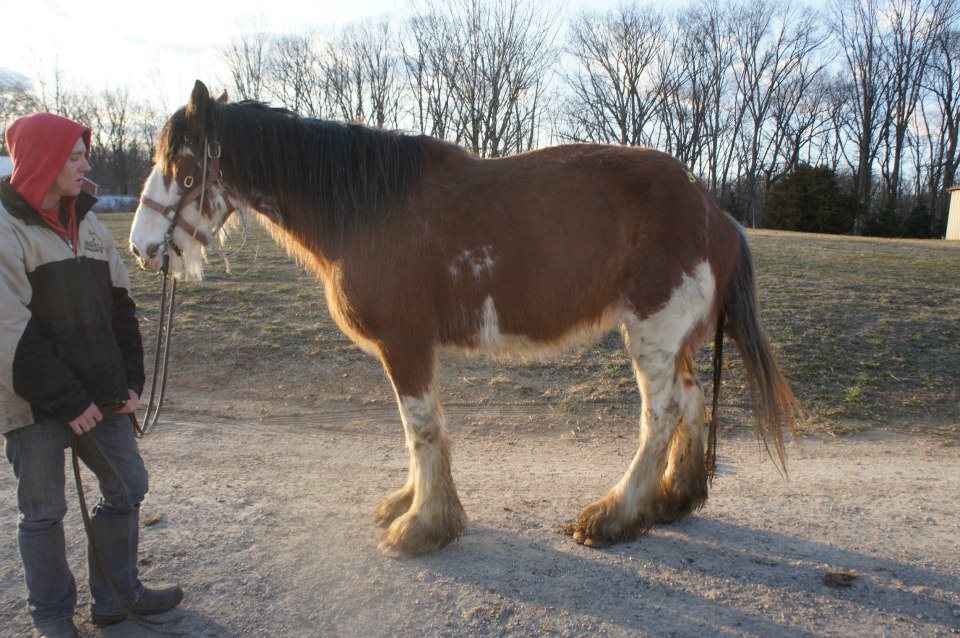
Image

Here is the text that went with the picture:

4-2-22-574- Clydesdale gelding approx 17 hands and 4 years old he has a “hump back” which is most likely genetic but could have been caused by an injury although he doesn’t have any visable scars or signs and it doesn’t seem to bother him. He did take a rider but doesn’t know cue’s picked up his feet willingly.

Note – Clydesdales genetically are prone to this condition It is a convex (upward) curvature of the spine in the area where the loins join the croup (the coupling). It affects collection or lateral bend and the horse will take shorter steps behind, since the vertebrae have less range of motion. The stiffness through the back limits both its up and down motion and its ability to bend laterally (side to side). Some improvement is possible through exercises, but these horses are better off in a companion/light work that doesn’t require collection and/or bending.

here is a picture of another horse with roach back-  http://i23.tinypic.com/10xzk9l.jpg

Instructions Placement/Proof of ownership form:  http://www.ac4h.com/BOABC.htm

500.00

Video: http://youtu.be/xE6eMH0o294

Payment/Donation link: http://www.ac4h.com/ac4hdonate.htm

To me there’s a really interesting blend of ignorance and knowledge in that descriptive bit.  From reading the comments that followed, this poor fellow was purchased by a kill buyer (currently still owned by that kill buyer) for $50.  Now, these people AC4H Broker Horses are advertising him for sale for $500 as a ‘light’ riding horse per their video of him.  One person comments: I saw this horse and felt him all over at Middleburg sale. He is in an immense amount of pain hot all over and tense.

You’ll have to scroll a little down their FB page to find this horse, but it appears these people sell horses owned by kill buyers.  Surprisingly the horse moves way better than I thought he would.  Besides the obvious spinal issue, he’s got issues with those back feet.  The left one is severely split and I can’t imagine this horse has been able to pick up those hind feet in a very long time to have them attended to.

I don’t know what to say at this point, other than I really do want to pop ‘her’ in the mouth for saying; ‘Look at that animation.  He sure does pick them up high.’  Really?  Well, I guess it’s a selling feature that he doesn’t fall on his face.

Unfortunately, this led me to another video of a whole other variety, which led me to a website.  I seriously do not have enough energy to punch all the people I want to.  I would like to know, though, if Clydesdale’s do actually carry a genetic structural defect like this.  If so, what lines and what’s being done to get it out of the breed?

Unknown's avatar

The Bad: Georgia Mare Has Twins

Anyone here from Georgia that could find out some additional information for us?  This 20-something Paint mare gave birth to twins recently.  It was featured on NBC and the result was an outcry from the public on the mare’s condition.

Here’s a link to the FB page of Horse Plus Humane Society that has a bit of an update.  The link to the actual NBC coverage is on that page as well, but I’ve linked it below for the Internet challenged.

NBC Coverage

I’m not entirely satisfied with the follow-up information.   An ‘accidental’ breeding can be ‘purposely’ looked after with a few medications so there’s not an ‘accidental’ foal.   Guess it was also an ‘accident’ she had twins, right?  And an ‘accident’ she’s so underweight and depressed.  As in, you were too cheap to ‘purposely’ have her ultra-sounded, and then ‘purposely’ have the twin pinched off, and finally to ‘purposely’ feed her appropriately?  There is a reason why twins are rare in equines and why we ‘purposely’ try to avoid that possibility. 

Grrr…

Unknown's avatar

I Like My Men…

…tough.

Fearless.

Wolverine, Dean Winchester, James Bond. When I’m embracing my inner damsel-in-distress, I need a real man to come to my rescue and save me, even if only in my dreams.

The guy in the following video is clearly tough; look, no helmet. We might even argue the shirtlessness makes him fearless, though, I think it crosses the stupid line.  But what removes him as a candidate from my tough guy list (because even in my dreams I have standards) is the fact that he thought this was okay to do in the first place.  I love the disclaimer below the video; “I don’t usually train them this way, but…” Uh, huh. Whatever, dude. My only regret is that it was your girlfriend/sister/booty-call who got lawn-darted and not you, although if she’s the one that proclaimed at the 1:37 mark of the video; ‘Look at her, she’s broke!” then maybe getting tossed on her head helped in some small way.

Quick Break!  Really? 

Here are some more tough men. Real ‘ca-boys’. It’s a 9-minute video, and to be honest I didn’t get past the 1-minute mark. So maybe it gets better? All I could see was terrified prey animals trying with all their might to get away to safety. Then I thought about all the soft tissue and skeletal trauma that was happening, while their heads were being pulled around and they were being yanked off balanced.  Shame on every single person in the stands who are clapping and cheering. 

Wild Horse Race – *Gag Me*

But wait!  We start’em young.

Future Tough Guys

I don’t want to pick on just the folks on this side of the ocean, so here are some of our Spanish brethren showing that barbarianism exists in all cultures. Such despicable treatment of horses in this day and age is unacceptable. I want to terrorize every single one of them and yank them around until they are mentally and emotionally broken.

The Spanish Version

And here’s the same thing, but packaged with some pretty accented talk and Elvis Presley eyes.

Outback Version

I think that last offends me the most.   “Because we have so many horses to get through in such a short time….”  Well, gosh, in that case you’re totally justified in your methods; it’s for their own good.  Let me take some notes:

  1. When I want a prideful horse to trust me, I make sure he’s confused and scared then force him to submit into the most defenseless position he instinctively knows.  Petting him on the neck then, pretending I give a shit, seals the deal.
  2. Breaking-in is okay, especially if I don’t have much time.  Even though the definition of break (v) is: to separate into parts, as in to damage by separating into parts.  And if that’s not clear, then how about this list of synonyms: smash, fracture, rupture, shatter, split, crack, sever.  Oh, yeah.  I’m all about breaking-in horses.
  3. If at first you get face planted; try, try again because clearly what you’re doing is working.

I still like my men tough, but I also like them to respect animals and treat them accordingly.  If my man baby talks to an animal when he doesn’t think anyone is looking, all the better.

Real Men Are Kind To Animals – And So Are Tough Men

Do not fear male readers of Hooves, I’m getting to the ladies…

Unknown's avatar

The Long And Short Of It – Part 2a – Back

The rider sits on the horse’s back and is carried forward. But the horse’s back is not designed to carry weight, and that is why so many horses travel with their backs hollow and tense. This is where I tell you to read a certain one hundred page book on skeletal, ligamental and muscular anatomy, center of gravity, the ‘ring of muscles’, how the horse must be ridden to counter this physical weakness, why it so often goes wrong, blah, blah, blah. The truth is if everyone knew that we wouldn’t be ‘here’ talking about something as simple as back length. Someday we’ll tackle that topic, but not today.

For now it’s good enough to know that a long back in a horse is a fault.   It lacks longitudinal strength and often sags under the weight of a rider, creating a ‘leg mover’ that certainly can give a smoother ride, but only at the expense of the horse.  Prime examples of leg movers are gaited horses that tense and hollow their backs to be able to move their legs in any number of timed sequences, as opposed to your ‘back mover’, the Dressage horse, that swings freely through the loin and back.  This latter requires a rider to have a supple lower back that follows and absorbs this movement to prevent being launched out of the saddle.

Additionally on the subject of longitudinal strength; without it the horse cannot easily maintain engagement.

A long backed horse often presents the rider with the additional challenge of trying to keep the horse straight from dock to poll.  Don’t, however, confuse that with lateral flexibility.  Indeed, a shorter backed horse is often more laterally flexible than its long-backed counterpart.  I will address that in an additional article (2b) in this series.

An excessively short back is also a fault in a horse.  Such a configuration doesn’t allow for enough room for a saddle to be placed, as well, sets the rider’s weight on the loin rather than on the ribcage.  It’s never a good idea to ride a horse from its loin; the weakest portion of an already weak structure.

  • A long back: >50%
  • A medium back: 45-49% (Note: 45% is considered ‘ideal’ for a riding horse; the ‘perfect’ length to provide lateral flexibility and longitudinal strength)
  • A short back: < 45%

To determine back length we measure the horse’s body length and divide that number into the back length number to arrive at a percentage. 

  • Body length is measured from point of shoulder to point of buttock. 
  • Back length is measured from highest point of wither to lumbo-sacral joint.

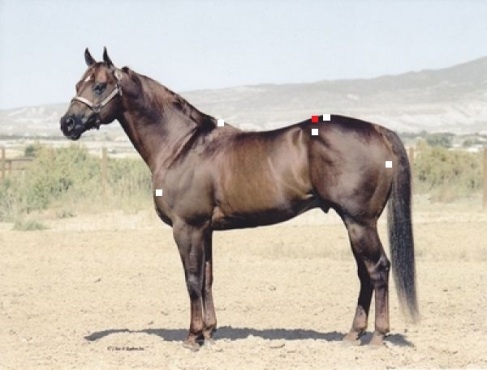
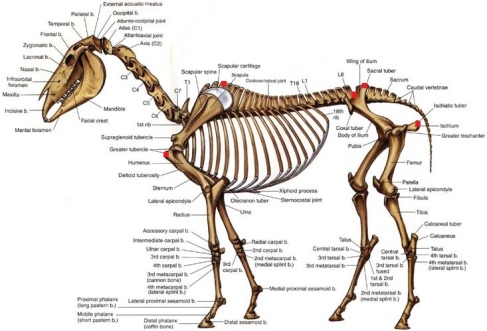
Here is our trusty skeleton horse with the points marked in red.  The highest point of wither is usually thoracic vertebrae four (T4) and the lumbo-sacral (LS) joint is located between lumbar vertebrae six (L6) and sacral vertebrae one (S1).  I’ve added an extra dot marking the highest point of croup (sacral tuber – top point of the pelvic bone) to help establish the location of the LS joint since it can’t actually be ‘seen’ in a photo; residing 2-4 inches below the surface of the skin. 

The best way to locate the LS joint on a horse is to palpate the horse’s back.  As you move along the length of the back you can feel the individual spines of the vertebrae, then you’ll hit a ‘mushy’ spot and finally vertebrae spines again.  Below that ‘mushy’ spot is the LS joint.  For article purposes, we’ll use the highest point of croup (which is located behind the LS joint) to help us find the LS joint in photographs.
Image

The LS joint is the most important trait to discuss in horses in terms of athletic potential and movement.  The entire hindquarter of the horse pivots on this joint and its location relative to the horse’s point of hip is instrumental to a horse’s ability to engage and collect.

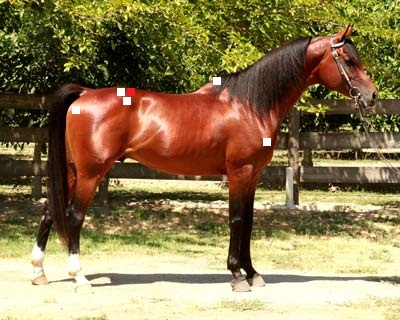
I’ve added more dots to our six candidates and it’s time to measure back lengths.  The LS joint is marked in a different color and though I’ve placed that mark at the skin level of the horse for measuring sake, remember that it resides 2-4 inches below the skin surface.

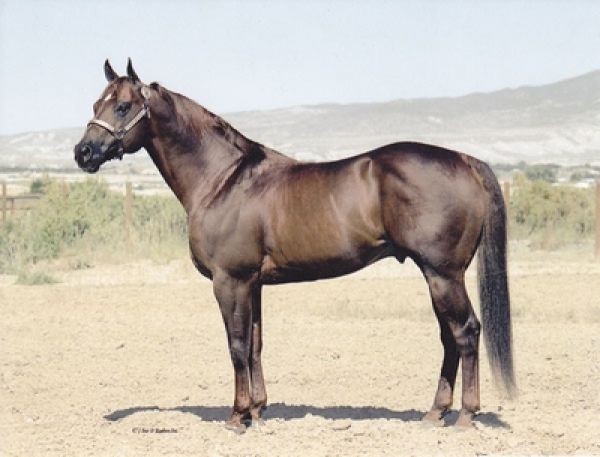
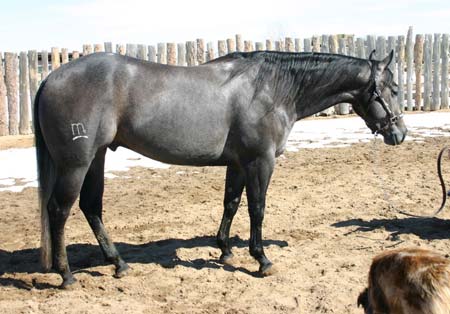
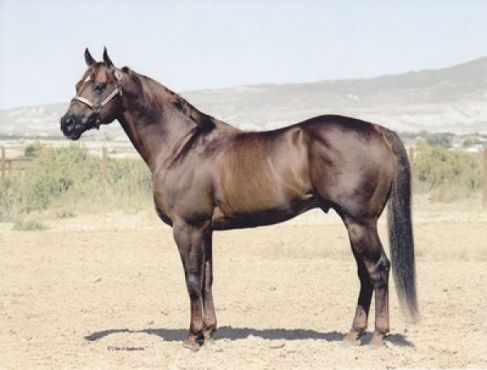
Horse #1 – 10yr old QH Stallion

Take a look at him unmarked.  Where do you see the points and how does his back length look to your eye?  Imagining a saddle on the horse and seeing how much space between the back of it and the start of the hip is sometimes helpful.  If there’s a lot of room, chances are the back is long.  If no room, then the back is likely short.
 Image

 Image

This horse has a back length of approximately 41.5%.  That falls clearly in the short back range, giving this horse a high degree of longitudinal strength.  Did you imagine a Western saddle on him and where the skirt might come to?

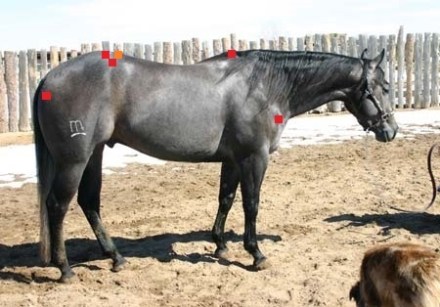
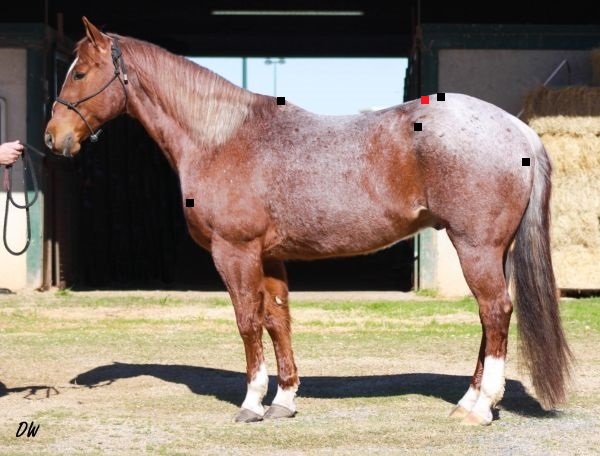
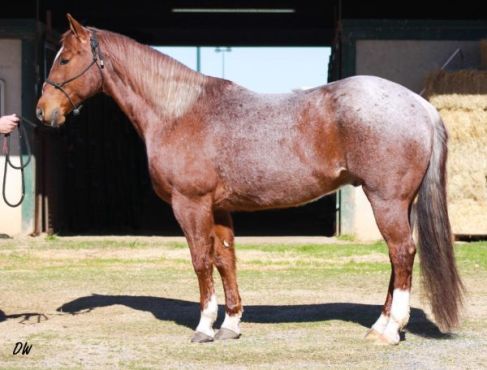
Horse #2 – QH Gelding

How does this horse’s back length compare?  Does it look longer or shorter?
 Image

 Image

This one measures almost 42.5%, so a full percentile longer but still falling in the short range and possessing a high degree of longitudinal strength. 

Start to take notice of the relationship of the highest point of croup, point of hip and LS joint, and how they differ for every horse.

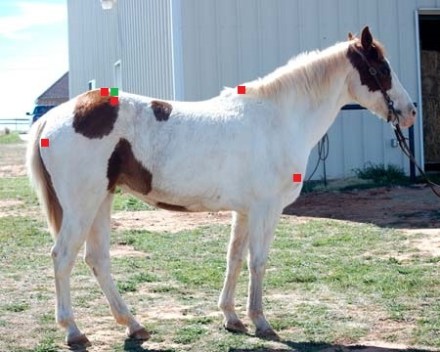
Horse #3 – 4yr old QH

Like the first time around, when it was difficult to spot his point of shoulder, it’s equally as difficult to spot this horse’s highest point of wither.  He has lower withers in general, which is not a fault and different than ‘mutton’ withers, which is a serious fault in the horse. 

How does his back length look?

 Image

 Image

If you thought this one looked longer than the first two, then you get a gold star.  This horse is approximately 48% falling in the medium back length category.

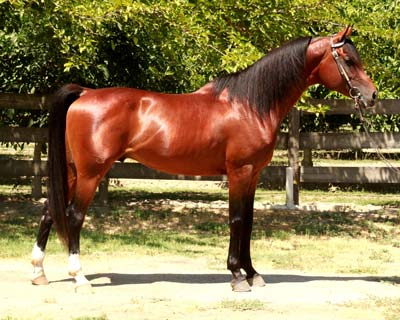
Horse #4 – Arabian Stallion

Here we see a set of prominent withers.  In this case they are also ‘camel withers’.  Though difficult to detect because of the mane and photo background, look closely.  Follow the top line of the mane and you’ll see a significant dip in front of the wither and then the wither drops off abruptly.   A dip in front of the withers can indicate a few different things, so not all horses with a dip there (and an abrupt ending) have camel withers.  Let’s compare horse #2, our roan QH.  The dip in front of his withers is easily gotten rid of with good riding and training, which would significantly change his neck musculature and fill in that dip.  Our Arabian stallion, though, already has way better neck musculature (mostly because it’s a stallion’s way to arch and telescope their neck to get the chicks) and still a big dip.  There is no amount of correct riding or training that will get rid of it.  Camel withers do not function as well as better constructed withers; that as a ‘fulcrum’.

Scroll back to the skeleton horse for a moment and look at the ‘spines of the wither vertebrae’ that make up the withers.  Those spines vary in length for every horse.  Thoroughbreds generally have very long spines compared to Quarter Horses.

Back to our Arabian stallion; how does his back look?

Image

Image

He too falls into the short back category at almost 43.5%.

Horse #5 – TB Gelding

Now that you’ve seen three short backs and one medium, has your eye gotten good enough to guess where this horse’s back length falls?  The mane and the background of this photo make it hard to see that highest point of wither.

Image

Image

If you guessed the longest back of all so far, but still falling in the medium range at 49%, then you were right.  What is most significant, though, is the placement of the LS joint.  Remember this horse had the shortest pelvic length of the group, representing the least power potential by falling in the poor category.  But I also said the horse had two ‘saving graces’, one of them being exceptional location of the LS joint, and earlier in this article I stated that the LS joint was the most important trait to discuss when talking about athletic potential and movement . 

Here we clearly see that the LS joint is located the furthest in front of the point of hip of any horse thus far.  That is most advantageous for ANY horse, ‘adding’ length to the hip and thus power potential.  In this case that poor length of hip is moved into the adequate/average category.  Is it then possible that the LS joint placed ‘behind’ the point of hip (such as seen with our roan QH) might ‘subtract’ length and thus power potential from the hip? (Rhetorical question)  Additionally and even more importantly, an LS joint placed in front of the point of hip makes engagement, as a whole, easier to achieve.

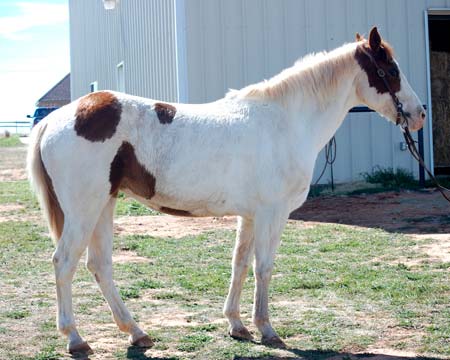
Horse #6 – Paint Mare

Last chance to test your eye on the horse with the hardest point of wither to identify.  I’m not entirely convinced I’ve got it right.

Image 

Image 

As it’s marked this horse falls long with a back of 50%.  If I’m off at all, it’s a touch to the long side, but either way we’re looking at a back as long as we ever want to see on a horse, and we’d really prefer it to be shorter.

There is one more thing I’d like to point out concerning back strength.  The further withers carry into the back, and the gentler they taper off into the back, the more strength they add to a back.  Of this group, our TB has the nicest set of withers that gently taper off the greatest distance into the back, adding strength.

It’s time now to go out into your barn and palpate your horses’ backs and find the LS joint and its relationship to the point of hip.  Look at their backs and guess their lengths, then measure to see how close you were with your estimations.  Look at their withers, are they prominent and drop off abruptly, or are they lower and flow smoothly into the back, or some combination.
Unknown's avatar

The Annoyed by trailrider20

Just the other day I received the following via e-mail and thought it brought up a few topics that need commenting:

From trailrider20:

Now THIS is annoying.

I took my horse to the vet last week, and found myself in a conversation about a supplement I should put my horse on.  Normal horse forage should take care of every horse nutritional need, and I know all about depletion of our topsoil and even human food not providing what we need, but the horse supplement industry is full of a dizzying array of claims about what to feed our horses.  In my lifetime I have seen the quality of hay deteriorate drastically.  But I make a point of getting the best I can.  

I have friends who swear by a certain supplement, and when I look at their hay, the hay is crap.  No wonder the horse does better with the supplement.

I still get sucked into driving long distances to get “the best quality hay”, only to find the same stuff I get in my own area.  

I am aware of all the pressures on hay dealers right now, but I do get annoyed with feed store personnel who insist that the hay they have is “great”!  I now do business with a small feed store that fesses up about the quality of their hay.  

With only one horse, I’m not too concerned about the price of hay.  $35 for a bale of timothy I can handle, but when I have to throw about half of the bale out, I am annoyed.  

Am I going to get this supplement?  Of course!  I get sucked in again and again.  But it is annoying.

  1.  Hay testing is an underutilized resource that doesn’t break the bank and yet can save gobs of money down the road.  How simple it is to know exactly what is lacking in your horse’s forage, therefore only needing to supplement that which is deficient.  And in most cases you don’t even need an overinflated priced ‘equine’ supplement.  There are no statistics on how much it costs an owner in healthcare for a horse that doesn’t have a balanced diet, but I think most of us know of several examples of horses that have suffered because of a poor diet.  Junk in equals junk out and no horse can perform and remain healthy and sound on junk.   At some point it catches up to all. 
  2. Farming isn’t easy and it’s not for the stupid.  Unfortunately, like any industry, farming isn’t immune to individuals who suck at what they do.  To be able to produce healthy, nutritious crops year after year takes knowledge, hard work, AND some weather luck.   The first two we are at the mercy of others so must do due diligence, but the last… Raise your hand if your region has been bombarded by unusual weather patterns over the last decade or so that have affected forage crops and increased the costs that you’ve had to endure. 
  3. The premium price gouging by the ‘Equine Supplement Industry’ – do they really deserve the capitalization, Mercedes? –  is a crime on par with the government taxing me up the wazoo and then cutting funding to the social programs that money was intended for (and that they told me it was for) so they can indiscriminately spend it on useless…deep breath…  Okay, it’s not the same, but I still want to hurt somebody.
  4. I hope that’s one big ass bale of hay for $35.
  5. Do I understand correctly that your vet talked you into the supplement?  Before or after the blood results?  And what’s the vet’s margin on that supplement?
  6. I’m annoyed too, and frankly I’ve never been able to forgive Rick for riding that horse into the city and getting it eaten by zombies.  What the hell was he thinking?!

Thanks to pallas broy for sending her thoughts on this recent experience and allowing me to put them up on Hooves for others to comment.  Remember:  thehoovesblog@gmail.com 

Unknown's avatar

The Bad: Neglected Horses – Seeking Help by raftert

Below is a comment posted by raftert to the Hooves Blog.  (In future – everyone – feel free to put together a short article on such subjects of interest and submit to:  thehoovesblog@gmail.com and I’ll be happy to post them for comments)  The comment is entirely off topic and rather than see it get buried or pull comments away from the article it’s posted under, I’m posting the comment here to be discussed.  Note that advice is being asked for.

This is off topic, but I’m hoping someone on here can give me some advice. I just heard about a group of horses in British Columbia that are in pretty dire straits. The SPCA visited there a number of times a few years ago but none of the horses were seized at that time. As is par for the course in our area, the SPCA is not really interested in helping horses, so I’m not surprised that nothing was done then.

There is approx. 30 horses on the property, many of which are young stallions. The stallions are kept in stalls, 24/7, in a very old barn without much light. The last time there were shavings on the property was in November. The horses don’t get trimmed, but their feet do rot off in the stalls, which are basically never cleaned. Halters are not removed as most of the horses are now unhandled, when the stalls do get cleaned, the owner simply herds the horse into a different stall. Some of the stallions have been inside for almost 20 years, and there has not been any turnout for approx 10 years now. The young colts are moved into the barn when they start breeding the mares, there are new foal crops every year and no idea who is bred to who. I would imagine none of the other basic care is being done, such as deworming, as most of the horses haven’t been handled.

20 years or so ago, this owner ran a really nice barn and the stock (AQHA) was quite high end and well cared for. Her mental health has apparently been declining (obviously) and she will no longer allow people she doesn’t know to even enter the property. So, while I would love to get in there to blow the lid off this, I can’t. As for the weight of the horses, I was not told they were starving or even significantly under weight, so I’m confident that the SPCA will not be of any help now either.

Because I am in a very small town, I also don’t want to be in the limelight. I can accept critisism for that, and it is what it is, and it’s not going to change. All that said, how does a person go about getting attention on this, when the society that’s supposed to protect these animals doesn’t and you can’t get onto the property to get the pictures which could force action from the society? Any advice would be appreciated!