Unknown's avatar

Supplement Article To The Supplement Article

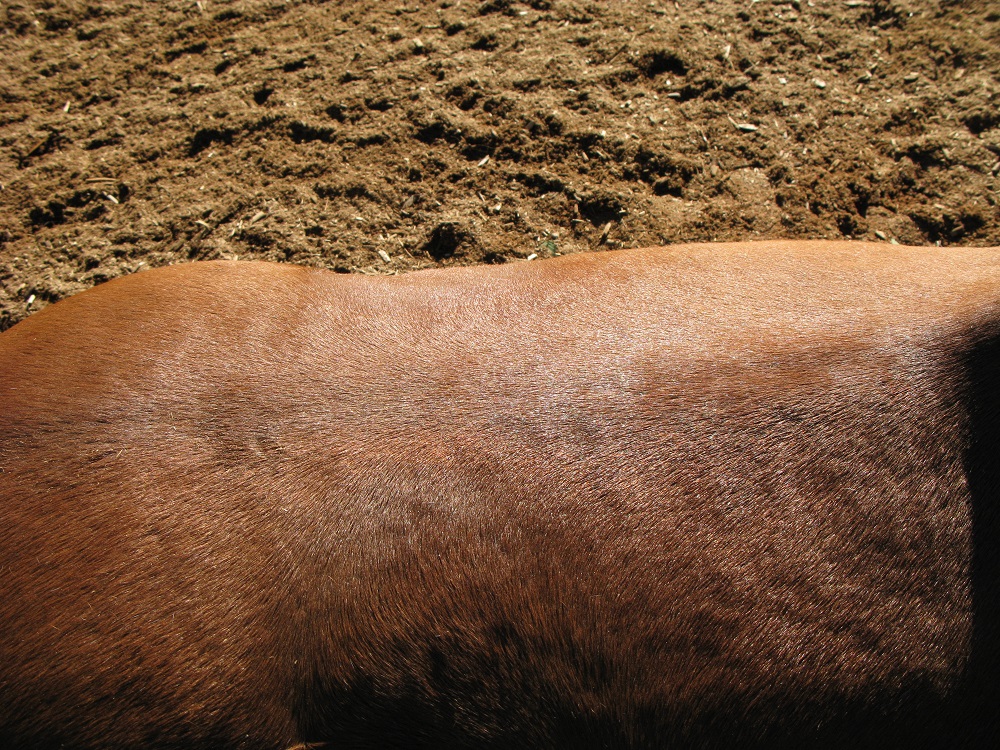
I’m indulging Paint Mare’s need to be the center of attention by doing one final installment.  🙂  Lakes thought she’d like to see an above view of Paint Mare’s horse’s loin, as otherwise it appears to be very well constructed.  Here’s that picture.
Image

There is great broadness to the horse’s loin with ribs carrying back well.  It doesn’t get a whole lot better.

In the first supplement article I talked about some musculature issues going on with the horse that I felt could be improved relatively easily.  Paint Mare has included a more recent photo of her horse.

Paint Mare wrote:  The one I sent in was from June 2012, and right now she doesn’t seem quite as muscled up.  But I think she might have lost some of the bad muscling on her neck? She has a groove for her windpipe now instead of a solid mass of neck.

June 2012

Image

Resent 2013

Image

Clearly the horse is better ‘conditioned’ in the first photo and carrying a bit less weight, but I would ask Paint Mare since when has she changed her training and riding approach with this horse.  Based on her comments and the attention she’s paid this mare, the current results are unexpected.

Yes, there is greater definition in the crease in the underline of the neck, but the rest of the muscling isn’t right and hasn’t improved.  Now her neck is starting to look more like a bull neck.  If she was using that neck better, lifting the base of it correctly and dropping her head freely from the poll we would be seeing some of the tubular complexus muscle.  Also the dip would have vanished and the ‘hump’ before that would also have decreased in size, while the flat spot before that, extending to the poll, would have filled in.

It appears as if there’s less muscle bunching directly in front of the scapula, but that’s only because her head is forward and not turned as in the first photo.  The muddy shoulder bed is still there, less defined with the lower overall conditioning of the horse but still there.

She also has more breast muscling, her back is tighter and for a greater portion of its length and her abdominals have weakened and sagged, which gives the impression she’s not as deep through the loin (though she is) and those things are all the result of being more on the forehand.

The other odd difference is that the mare now stands about three degrees more upright through the pastern than she did in the June 2012 photo.  Her coronet band is more horizontal and this change (obviously in her feet – too much heel) has changed her stance in front so that rather than standing ‘in’ the ground, she stands ‘on’ the ground with more tension and rigidity through the front end.

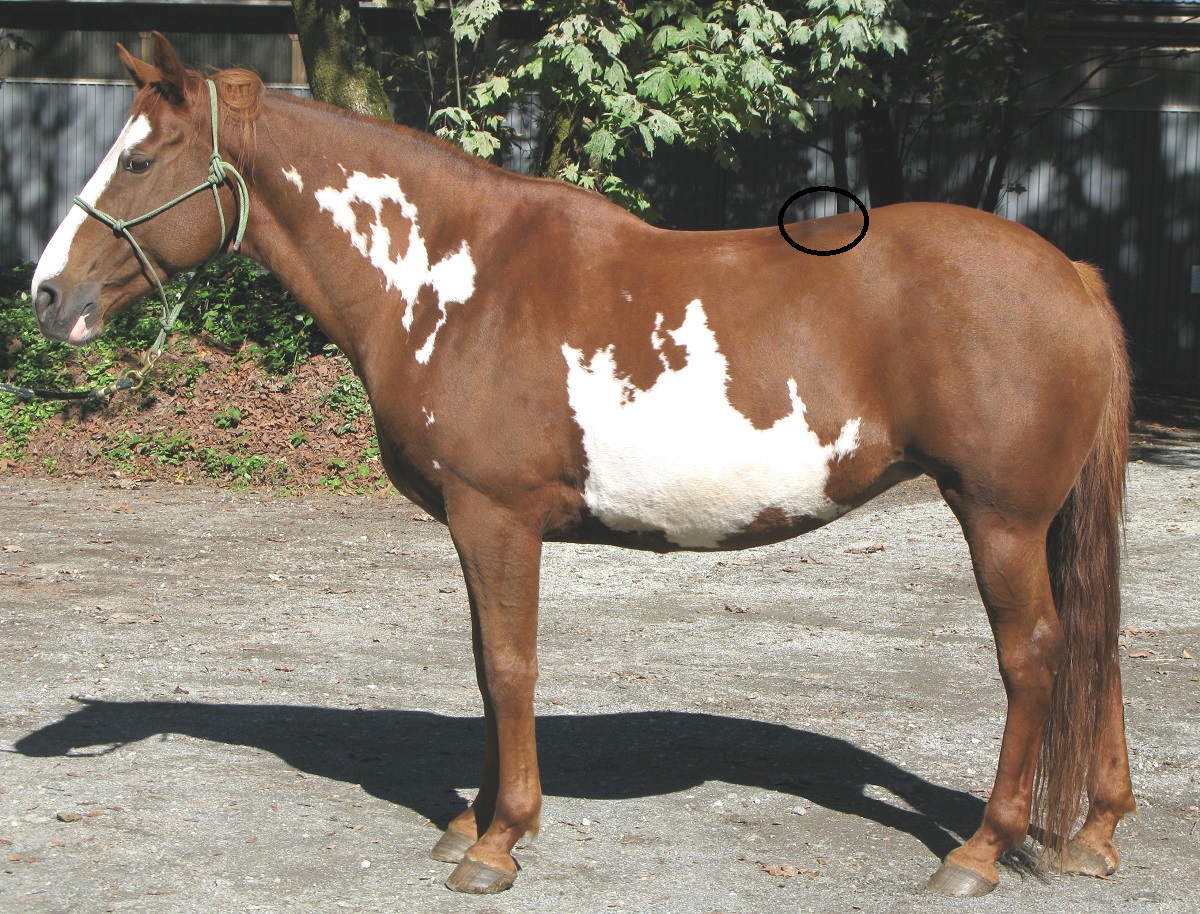
What I think has happened is that this mare has hurt herself.  It’s very difficult to see because of the dark background, but when viewed on my computer at full size there’s a very clear ‘hump’ and ‘dip’ in the back that was not present in the June 2012 photo.  I also noted that the overhead loin views that Paint Mare sent me also didn’t look right, but none are from the best angle to see.  Even the overhead photo I included at the top doesn’t show the kind of spinal definition it should, which also leads me to suspect an issue.
Image

Thank you very much, Paint Mare, for allowing the use of your mare as a guinea pig.

Unknown's avatar

Intent Matters

I’ve been kicked pretty hard a couple of times, but in none of those incidents was I the intended target of the horse.  In fact, I can only remember being the focused target of a horse once.  That time ended with the early and unfortunate demise of a plastic feed bucket and a pound of feed.  I’m not sure why that horse chose that particular meal time to think I needed my face rearranged, but it was early in our relationship and he hadn’t yet conceded to the fact that I was a bigger badass than him.  Even so it surprised me since feed time had never been a source of problems before, but more surprising was that he missed me – all four times (he was a very persistant sort) – though, his best chance had undoubtedly been his first.

Blondemare forwarded me this short video that shows clear intent on the horse’s part.  It made me wonder what history this horse and rider had, since it appears to me that from the very start of the pinned ears that this horse knew what it was doing and going to do.  The usual response of a horse, even one that’s been harrassed in the past is to simply leave.  Sometimes injuries happen in the leaving process, but there’s typically no intent to harm, it’s all about the escape.  I’ve worked with some pretty aggressive individuals and others who’ve been severely beaten, and in every case, if given an out, the horses chose the option to leave before standing to fight.

Why did the horse in this video go out of its way to purposely wound instead of just leaving?

https://www.facebook.com/photo.php?v=10151863568323680

Unknown's avatar

Supplement Article To: The Up And Down Of It – Shoulder Angle And Slope

Paint Mare wrote in the comments section:

After I read this post, I looked up the recent Equus articles on shoulders. The article on seeing a shoulder said that while usually you can measure the angle of the shoulder by tracing a line from the point of the shoulder to the middle of the withers, some horses have a shoulder blade that runs in front of that ideal line, further up the neck. The article said this isn’t the best conformation, though didn’t seem to really specify why. When I look at the Paint Mare, I think she is in fact built this way. And as she is the primary horse I get to examine and prod, that’s made me a bit confused over how to see the shoulder! Whether you follow the ideal line or the actual line changes how steep the angle of her shoulder is, and how open the arm joint.

I’m attaching a photobucket album that shows her in current fit mode, but also as a green broke 5 year old with less muscle. Any thoughts? We have always found her a bit restricted in the shoulder though she has some relatively snappy high knee action at the trot, and can lift her knees OK jumping if she gets the right distance.

Paint Mare sent me some photos of her – Paint mare – so let’s examine more closely.

Image

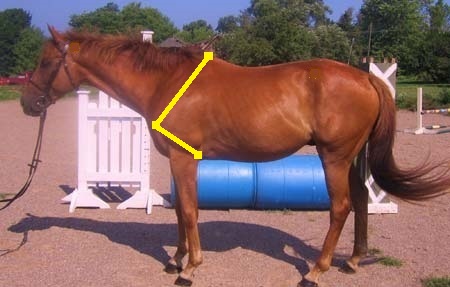
I don’t see her scapula being ahead in position.  It’s not ‘middle of withers’, it’s ‘highest point of withers’.  That latter gives the impression of being forward with the rest of the withers tapering off gradually as you want to see.  When measured, her slope is about 52/53 degrees with a closed shoulder angle of 85ish degrees.  Her humerus has great length being about 67%, and is a bit more toward vertical than horizontal.

Image
This is one of those contradictory type mixes of conformation, but in the end the humerus bone wins.  It’s not vertical enough in orientation and thus the creation of a closed shoulder angle rules the outcome: reduced range of motion causing an inability to get the knees up well for jumping (forearm below perpendicular to the ground) and be tight below.

Image

Paint mare included a second picture.  Note that to get the knee up on the right front her horse had to badly twist the shoulder and leg.  The left front leg shows a much tighter lower leg, but to achieve that the horse had to lower its knee and also twist the shoulder and leg.

Image

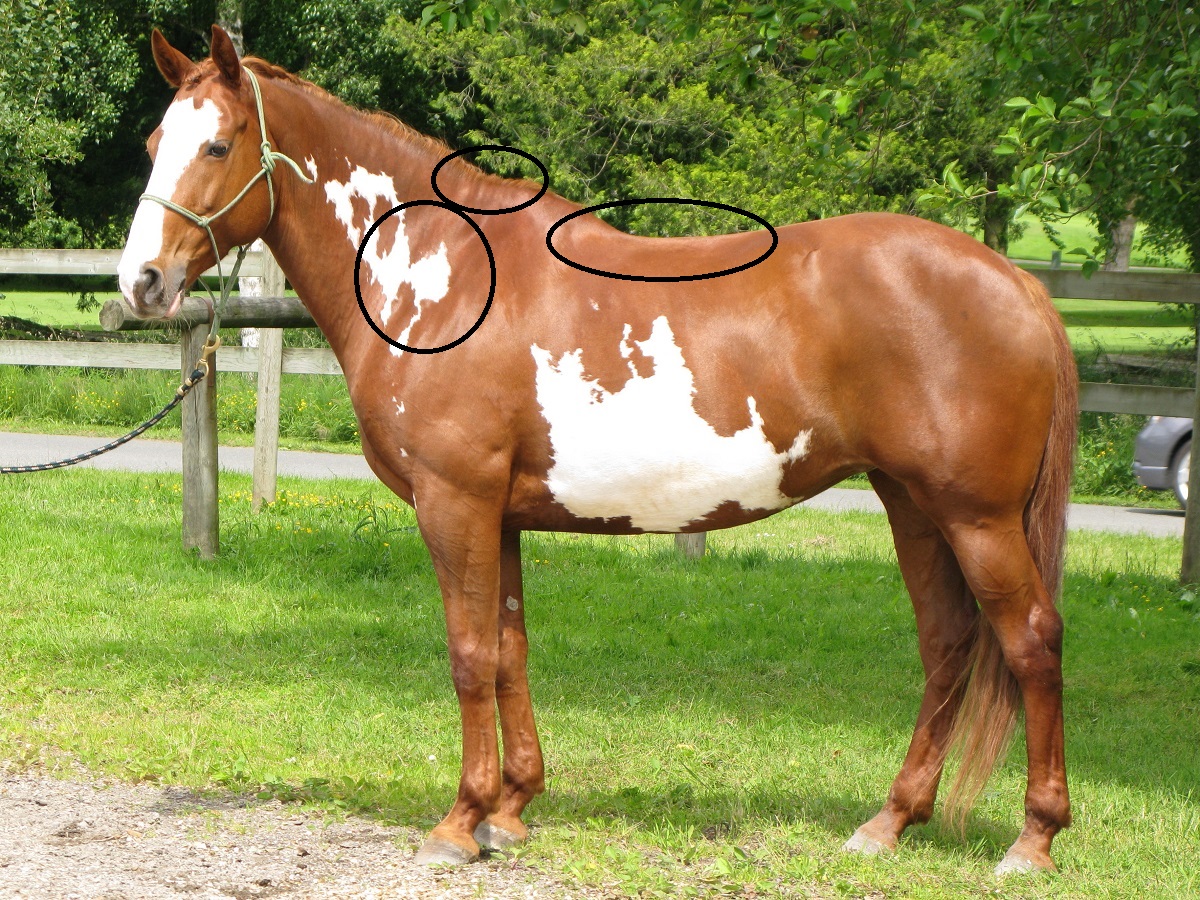
Additionally, some of the issue is from a muddy shoulder bed and tightness behind the wither and into the back.  This can be improved with stretching, massage and more engagement so that the horse lifts its base of neck, withers and back.

Paint Mare will know this has been achieved when the dip in front of the withers disappears, the lower neck thins, she can place her whole hand under the scapula along its entire length, the hollow behind the withers fills in and the horse develops a double back along its entire length.

Image

Looking at other aspects of this horse’s conformation, I see no reason it can’t be achieved rather easily and in a relatively short period of time – 4-6 months – and when done the horse’s jumping form will have improved.  There’s a lot to like about this horse, despite that closed shoulder angle.

Unknown's avatar

That’s Not A Horse, That’s A Mountain Goat!

Every once in a while the union of two horses produces an individual often thought extinct in the animal kingdom; ‘Got-too-much-time-on-my-hooves-let-me-see-if-I-can-commit-suicide’ horse.

http://atlantic.ctvnews.ca/n-b-couple-shocked-to-find-horse-standing-on-roof-1.1460707

I do own a horse who will go into buildings and climb ramps and stairs.  He even figured out that he needed to turn the doorknob to get into the arena lounge (after climbing onto the wheelchair ramp).  Fortunately, the doorknob was crushed between his teeth before he could get it turned all the way. 

But one of the scariest (for me) things any of my horses have done was a yearling filly (the one that grew into the elephant in the ‘Assessing Youngsters’ article) took a walk across the pond her second winter.  I happened to look out my office window and there she was standing in the middle of the frozen pond (it’s a big pond fed by artisan springs, but not especially deep). 

She was just standing there, looking around – then ‘relieved herself’.  It was snowing lightly and the ground was covered by an inch of snow.  Steam poured off her fresh poo.  Such a serene scene, almost postcard worthy.  Then she took a step and broke through the ice.  I thought, ‘Oh no!’ and started to panic, already thinking in my head what I needed to gather to save her; halter, lead rope, blankets, why the hell don’t I own fisherman waders?!

Before I could even move away from the window she took another step, then another, then another, busting through the ice with each step.  I swear I saw her smile.  I watched, with my chin on the floor, as she took her time and a VERY circuitous route – double-backing a few times – to the edge of the pond and solid ground.  Then she whipped her head around a bit and cantered back to the barn and her herd mates like nothing had happened.

What’s the silliest, craziest or scariest thing you’ve witnessed a horse do?

Unknown's avatar

Poll: Fun? Reckless? Or Both?

Introducing our first Hooves Blog poll!  I’ve kept it simple because I haven’t a clue how it’s going to work.  You should also be able to add comments to this post as well – which I’m sure many of you will have wonderful and insightful things to say.  🙂

Partway down in this link you’ll find the video of the Dublin Hunt Chase.  Have a looksee and voice your thoughts.

http://www.horseandhound.co.uk/people-places-pictures/hunt-chase-dublin-horse-show/?utm_campaign=DublinHuntChaseVideo&utm_source=facebook&utm_medium=social

Unknown's avatar

Equine Intelligence

Blondemare (aka Broodmare) recently wrote:

Had an interesting (good spirited disagreement) conversation with my vet this morning about what qualifies an intelligent horse and I’ve been mulling it over since he left.  I had raised the point in direct correlation to breeds, specifically Arabians.  He stated that Arabians can be a more difficult horse to work with, have a tendency to not tolerate even a rectal temperature check without a fight.  He also stated that they require more sedatives on average to quiet them to a workable sense of consciousness for certain procedures.  His take on the breed is that they are so intelligent that they sense danger more quickly than other horses.  I respectfully disagreed.  My thought is that behavior makes them over-reactive and flighty, that they rely on their flight mechanism every time something new, noisy, moving is encountered.  No curiosity to the stimuli, only a fear reaction and wanting to escape the object/sound as quickly as possible.  I find an intelligent horse to be one that processes information; one that thinks before running blindly into serious danger over a perceived threat.

I’ll use an example of a wooden ‘bridge’ I use to teach horses to accept the sounds of hooves on a noisy object, to prepare them for trailer loading and how to step up and down from an object.  I use this bridge for all youngsters once they are lunging quietly; moving forward readily from a go cue, willingly spiraling out and away from me, whoaing and reversing from my body position. 

I will approach the bridge and allow a thorough sniff-over, as long as it takes.  After a good sniff, and in the case of many geldings, a paw or two may be used to test authenticity.  After this, I’ll apply the go forward cue and most responses are hesitance, looking for a way around (I block away with the line, toward me with my body/energy, back with a whip or the line and only the front door is open), another good sniff and a half-hearted jump….next loop around I’ll get a foot on it and by the 3rd or 4th loop, most horses will give a good effort and put all fours on, looking quite proud of themselves I might add.  Stop, reward, stand, repeat. 

I present the challenge, tools in place, and ask the horse to make a decision – avoid fearful object and receive a correction or process information and apply it.  I feel that when a horse applies the combination of aids, he is attentive, learning and responding to the education presented.  Using thought and making a rational decision.  Now enter Arab, given the same choices, the first decision when presented to the bridge is to jump into my space nearly knocking me down, and attempt to run off with tail in the air, eyes bulging out of the sockets, and no notable thought process.  Second attempt is similar to the first though I’m ready and apply pressure via the lunge line firmly to the belly followed by a quick halt.  Fleeing and knocking me to the ground, not acceptable options. 

So….the process continues, 10 minutes later we are on loop 30? 40? doing what I asked, somewhat, which is getting over the bridge, but without contact.  We are still in trot/jump mode.  It’s like the 300th rerun of Pretty Woman, nice to watch but it gets old.  A few more minutes, trot turns to walk, and an occasional hind hoof touches wood, horse is relaxing somewhat.  Change directions, get one hoof on, quit for the day.  Repeat again on day two, slightly less drama, still only 1-2 hooves on wood at any given trip around, though no longer attempting to flatten me.  Quit.  Day 3, 5 minutes, four hooves on. Stop, reward, rest, breathe.  We got it done.

So I ask.  Is the Arab smarter than a stock horse because he’s fearful and reactive to everything in his environment?  Or is the horse that succeeds 20 times faster utilizing a process of thought the smarter individual?  Me?  I’ll take the thinker any day.  I want a horse I can trust to take care of me, a horse that won’t over-react to a silly, nonsensical perceived threat and put my and his life in danger.  I want a horse that has try, which lets me into his world, respects me and trusts me not to hurt him. 

I’ve heard it said time and time again at various events from the Arab community that Arabians are the most intelligent breed of horse.  They also state that you can’t do (enter request) with an Arabian because they won’t tolerate it as they are soooo smart.  So I say to you, tell me why this is?  Tell me why a horse that is flighty and willing to put himself in a precarious situation is smarter than my stock horse that removes snaps, opens latches, saunters to the grain room, opens a spin cap off the plastic cookie jug and has a feast of horse treats, without breaking the cap or the plastic jug. And when caught in action, comes right to me and offers a lip kiss across my cheek as in sucking up MAJORLY for being a bad girl.

So, what makes a smart horse and why?  Is it self-preservation?  Trainability?  Cooperation?  How do we give our horses a fair IQ test?

Unknown's avatar

The Up And Down Of It – Shoulder Angle/Humerus Bone – Part 2

In part one I talked about the difference between shoulder slope and shoulder angle.  The important parts to remember are;

  • We want the horse’s shoulder slope to largely land between 45-55 degrees, the lower end for a Dressage horse and the upper end for a jumper, outside that range at either end is doable but comes with potential issues
  •  Anything less than 90 degrees is a closed shoulder angle and significantly affects potential stride length, and for most horses it should be a deal breaker
  •  A horse standing with its front legs too far under its body or too far out in front of its body will artificially change the shoulder angle

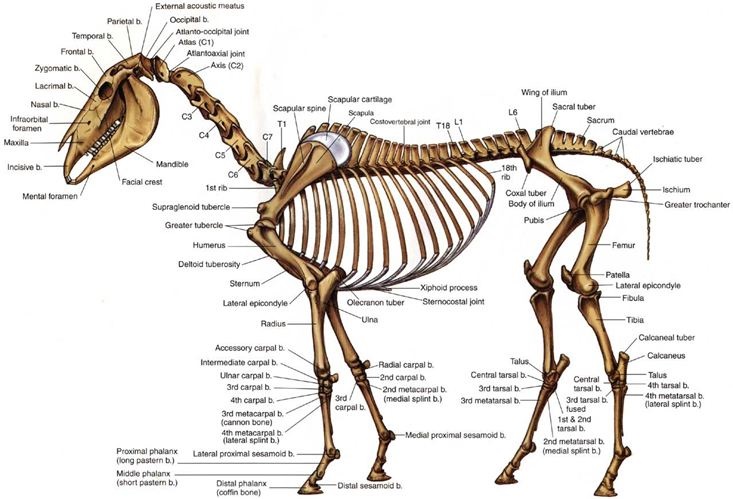
The above addresses the swing potential of the front leg, but there’s something else in the front end that determines all the rest, specifically the style of the horse’s movement; daisy cutter or high knee action and everything in between.  Even the horse’s front end lateral movement comes from this: the length and orientation to the horizon of the humerus bone.   The humerus is attached to the scapula at the point of shoulder by a ball and socket joint giving the humerus bone forward and back motion as well as side to side motion.  At the other end the humerus joins the radius-ulna (forearm) bone creating the elbow joint.

 Skeleton

Here are the basic rules about the humerus bone:

  • The longer the humerus bone the more scope to the horse’s movement, forward and back as well as laterally – a long humerus bone must be at least 50% the length of the scapula
  • The shorter the humerus bone the more choppy the horse’s movement – a short humerus bone would be less than 50% the length of the scapula
  • The steeper (vertical) the humerus bone the higher the horse can lift its knees (think knees to ears in the jumping horse)
  • The more horizontal the humerus bone the less natural ability the horse has to lift its knees to create high action or fold it’s knee (think daisy cutter and a horse that hangs its knees over jumps)

(Note: The humerus bone along with the shoulder angle determines a short, choppy stride, not a short or upright pastern as is so often claimed.)

Gaited horses that are prized for their high knee action would thusly possess a long humerus bone orientated more vertically and likely also possess a quite open shoulder angle, well exceeding 90 degrees.  This would be the same for a Jumper that could put his knees to his ears with the exception of the placement of his knees being lower by having a shorter cannon bone; a requirement to stay sound from repeated landing concussion.

The Dressage horse will also possess a long humerus bone, but less vertical compared to the gaited or jumping horse and in most cases not as open a shoulder angle, but certainly still maintaining the minimum 90 degrees.  The shoulder slope of the Dressage horse will tend to be more laid back than the jumper.

The Hunter horse with a long, sweeping, and low daisy cutting action will also have a long humerus bone, but it will lie more horizontal limiting the ability of the knee to be raised.

The stilted front end gait of many Western horses is due to a closed shoulder angle and/or a shorter humerus bone set horizontally.

Horse #1 – QH Stallion

 ZansParityQHStalEquineNowAd

Our QH stallion has very good length to his humerus bone at approximately 64%.  This trait helps to minimize the effects of his slightly closed shoulder angle.  The humerus more on a horizontal orientation giving flat movement.

 ZansParityQHStalEquineNowAd-ShoulderMarked

Horse #2 – QH Gelding

QHGEquineNowAd

This QH gelding also has very good length to his humerus bone at about the same 64%.  Its orientation is identical to our stallion, except that we know this horse is not standing with his front legs properly underneath himself.  If he was, then his humerus would be a bit more vertical than our first horse.  However, paired with a slightly more laid back shoulder (and the same closed shoulder angle) these two horses should move in the same general manner with their front legs.

 QHGEquineNowAd-ShoulderMarked

Horse #3 – 4yr old QH

QH4yrDHad

This horse has the longest humerus bone of the group at 67%.  He also has the most vertical orientation of the lot and with the most open shoulder angle.  Coupled with his upright shoulder and surprisingly this horse has the potential to bring his knees up the most and fold his lower leg the tightest of this group, as well to have very good scope and potential for lateral movement.   Though he should have more expression to his gait than the first two QH’s, I’d bet my own money (again) that he moves in a typical QH fashion, flat and short.  I’ll talk about why in a future article.

QH4yrDHad-ShoulderMarked

Horse #4 – Arabian Stallion

 BaskeAflameArabDreamHorseAd

Another long humerus bone at 60%, with a vertical orientation between that of the QH stallion and the grey QH, paired with an all-around shoulder slope of 50 degrees and adequate shoulder angle gives this horse middle of the road action (neither daisy cutter nor hackney) and scope.

 BaskeAflameArabDreamHorseAd-ShoulderMarked

Horse #5 – TB Gelding

 IvanOFTBDreamHorseAd

We’ve won the lottery as here is another horse that still maintains a long humerus at 59%.  The orientation is identical to our Arabian, but with the more upright shoulder we should expect our TB to be able to lift the knee a bit higher, but the lower leg no tighter due to shoulder angle and humerus bones length being very much alike.  Both horses should possess similar scope and lateral potential.

 IvanOFTBDreamHorseAd-ShoulderMarked

Horse #6 – Paint Mare

PaintMareDHad

Our Paint mare has the shortest humerus of the group at approximately 55.5%, which still makes it long enough but she will have the least scope and lateral movement of all of our horses.  Unfortunately it’s also the most horizontally placed on a quite upright shoulder.  Still she manages to keep a minimum 90 degree shoulder angle.

While it’s a desirable trait to have a long shoulder, this horse has too much shoulder length placing the point of shoulder too low.  This low placement puts a horse more over its shoulder and onto its front end.  Horses of this construction tend to be forever pigeon-breasted.  She’s a contradiction.  The upright shoulder says she can bring the knee up, but the horizontal humerus says she can’t.  The humerus bone wins every time and so a horse constructed like this will lead with its chest when it jumps and hang its knees all day long, every day.

PaintMareDHad-ShoulderMarked

Unknown's avatar

The Up And Down Of It – Shoulder Slope And Angle – Part 1

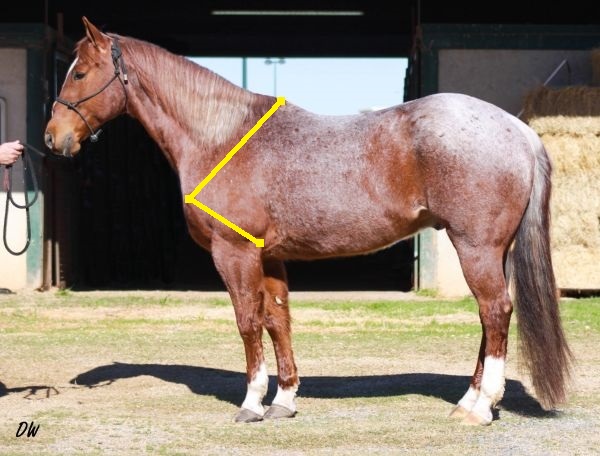
Shoulder slope and shoulder angle are two entirely different things when discussing equine conformation, yet many times the terms are used incorrectly or interchangeably. Shoulder slope references the slope at which the scapula sits in direct relation to the horizon, while shoulder angle is the angle created at the joining of the scapula and humerus bones.

Shoulder slope:  is marked from highest point of wither to point of shoulder and then measured against the horizon. The slope of the horse’s shoulder ranges between 40-60 degrees. A slope of 45 degrees is considered ‘laid back’ and is ideal for Dressage horses. A slope of 55 degrees is considered ‘straight or upright’ and is more useful in jumping or gaited horses for lifting the knee.  A shoulder slope of 50 degrees is what I call ‘utility or all-around’.

At the outer limits of range we have 40 and 60. A horse possessing a shoulder excessively laid back is still quite functional and not necessarily prone to lameness, but a horse designed like this will give their owner a headache when it comes to saddle fit. The scapula will lay back so much that it’s next to impossible for a saddle to be done up when it’s sitting in the correct position on the horse’s back. Placing it so it can be done up with the girth not around the horse’s belly puts it over the scapula.  As we know, a saddle in this position would block the ability of the scapula to move freely thusly also blocking movement of the horse’s entire front leg. Even a cutback saddle won’t always fit this conformation. The only horses I’ve ever seen carry this kind of conformation are some Friesians and some Drafts.  Note that for carriage or Draft horses, that a laid back shoulder is desired to more readily fit a collar.

 At the other end of the range, the very upright 60 degree shoulder also does not create unsoundness, in and of itself. Nor does it create a short, choppy stride as is often thought, though, a feeling of less elasticity can certainly be an outcome. What it does do is create added concussive stress through the entire forelimb, which in turn can cause unsoundness. Neither ends of the spectrum are desirable in a horse and should be avoided on principle alone, that principle being what’s best for horses and allowing them to perform their jobs without undue risk to longevity.

Shoulder angle:  is marked by adding a second line to the shoulder slope line from point of shoulder to point of elbow.  The subsequent angle created between the two lines is then measured. The angle created at the joint can range from 80-115 degrees. 90 degrees is the magic number here; anything less and the horse will be short-strided in the forelimb. No other combination of traits can make up for that short-stridedness, or nullify an angle below 90 degrees. In many cases it should be a deal breaker. Anything over and above 90 degrees is a bonus. Many of the GP jumpers who are able to bring their knees to their ears possess an angle at the higher limit of the range.

Skeleton

Let’s look at our random sampling of horses and see how they measure up.

Horse #1 – QH Stallion

Image

Our stallion carries a typical lovely shoulder slope of 50 degrees.  It’s the kind of trait that fits a versatile breed.  Not surprisingly, though, he also carries a shoulder angle of less than 90 degrees – about 85.  This latter is unfortunately a trait that is quite prevalent in the QH breed.

Image

Horse #2 – QH Gelding

Image

This horse’s shoulder slope is approximately 48 degrees, unfortunately he too has a closed shoulder angle and more so than our first horse.  It measures about 78 degrees.  However, this is not really his actually shoulder angle, which is closer to the same 85 as our first horse.  Note that this horse stands with his shoulder angle artificially closed by standing ‘over’ his point of shoulder with his forelimbs too far under his body – leaning forward.  If he stood how he should, his shoulder angle would open a bit, but still be less than 90 degrees.

Image

Horse #3 – 4yr old QH

Image

Here we have our first upright shoulder at 55 degrees.  What surprised me was that it’s combined with an open 95 degree shoulder angle.  This combination is unusual in QH’s, more often seen in TB’s.   I wonder if this guy isn’t expressing some TB influence in his pedigree.

Image

Horse #4 – Arabian Stallion

Image

Another lovely all-around shoulder slope of 50 degrees, but to my surprise his shoulder angle is also closed at 85 degrees.  This is highly unusual for an Arabian, such that I actually went back a few times to recheck the points and numbers.  The lighting in the photo, which perfectly highlights his bones, confirms the results.   If we account for the right front leg being, perhaps, a bit too far underneath then we can add a degree or two, but it still puts the angle short of adequate.  But then I had to consider the clubbed foot, which with its too high heel is going to artificially close the shoulder angle by lifting the elbow (note it also slightly buckles the horse’s knee putting him over at the knee on that leg).  I would bet some of my own money that if we had a photo from this horse’s other side, that the shoulder angle would measure the desired 90 degrees.

Image

Horse #5 – TB Gelding

Image

As expected, our TB has a more upright shoulder at approximately 54 degrees.  The angle is ever so slightly closed at 89 degrees, but note the left front leg is a bit too far underneath the body and so our TB actually possesses an adequate shoulder angle of 90 degrees (and possibly even a touch more).

Image

Horse #6 – Paint Mare

Image

Our paint mare has the most upright shoulder of the lot at approximately 57 degrees and an adequate angle of 90 degrees.

Image

In part two I’ll discuss the signficant importance of the humerus bone and its direct relation to the scapula.

Unknown's avatar

The Ugly And The Bad – Hyperflexion And Us

I’ve said it before, when people suggest I’m being overly critical about their breed or discipline of choice, that I play no favorites.  The following blog article written by Erica Franz covers many things that are wrong in Dressage – Hyperflexion Breaks The Rules

But don’t let the title of the article scare you off, this applies to all of us no matter what discipline we choose.  It’s not just about the Dressage coined term ‘hyperflexion’, or a bunch of FEI rules being ignored by judges, riders and trainers that should know better.  It’s about our shortcomings as human beings and making really bad decisions at the expense of the horse, which we claim to love so very much.  The hypocrisy is enough to choke an elephant.

I echo Ms. Franz’s closing words:  Get involved, speak out, make this unpopular. Why are we afraid to protect our horse from abusive training methods, to save face from those who are popular at the moment. Have we never left high-school and the cliques and peer pressure? The horse must come first!

I also add, that ‘this’ applies to anything and everything that isn’t in the best interest of the horse.  Don’t stop at ‘hyperflexion’ or think because you don’t do Dressage that ‘this’ doesn’t apply to you or your discipline of choice.  In whatever discipline you choose there’s something smelly going on that needs to be stopped for the sake of the horse. Be brave, speak up, take action.

Unknown's avatar

The Bad: A Rule In Need Of Changing

Take a moment to read the short article I attached below about a pony competing and doing well in upper level Dressage. A pony who’s not allowed to compete in CDI events because of an old FEI rule that assumed every pony on the planet is ridden by a child. Did those who wrote that rule not realize that there are petite women (and men) in the world? Imagine if Karen O’Connor had been told that ‘Teddy’ was too short to compete at Rolex.  Imagine if the AQHA told all those big Cowboys on their pony-sized cutters that they couldn’t compete.

To implement a Dressage rule based on the height of the equine in question is a pretty big oversight. So, to all association members who fall under this FEI Dressage ruling, I ask you to contact those in charge and get this silly rule off the books. Here’s a link to get you started:  USEF

Pony – Oke Doke