Unknown's avatar

The Up And Down Of It – Neck – Part 1

Neck Length

The equine neck is made up of seven cervical vertebrae.  Most mammals have seven cervical vertebrae.  That’s right humans, horses, cows and giraffes all have seven cervical vertebrae.  What accounts for the great range of neck length in those four mammals is simply the length of each individual vertebra.

In an earlier, unrelated article (Stretching – Part 3), I mentioned that a longer equine neck is not necessarily a more flexible equine neck.  Indeed, my subject horse has a neck on the short end of the equine scale and he quite adeptly showed very good neck flexibility – and here’s why:

Let’s pretend a giraffe’s neck is seven feet long.  That equates to one flexible cervical joint per foot.  (There’s an eighth cervical joint, but it’s immobile).  Now let’s pretend that the horse’s neck is three and a half feet long, which means there are TWO flexible cervical joints per foot of neck length.

Question:  Which neck is going to have more potential flexibility?

Answer:  The one with more joints per comparable length.  In our example that would be the horse.  And between two horses it would be the one with the shorter neck.

We have created unnaturally long necks in horses through selective breeding.   Initially, adding length to the equine neck served a purpose, to help the horse balance with rider aboard and while doing all sorts of additional maneuvers like jumping or changing direction at high speed such as in polo.

I call this – Stupid Long (also known as Swan Neck):

Image

http://www.polyvore.com/mpa_giovanni_arabian_horses_stallions/thing?id=26962517

And this is the longest you’d ever want to see on such an individual:

  Image

http://dba-oracle.blogspot.com/2011/03/hirohitos-arabian-horse-scam.html

Funnily enough, if you Google ‘short neck equine pictures’ the above picture shows up.  Go figure.

This is short:

Image

The other issue with long necks is that they are also always thin necks.  That means less muscle mass to stabilize the joints, which means they get out of alignment much more easily.  This also gives the horse more opportunity to evade between each joint in the length of its neck.  A long neck is far more likely to be a stiff neck and an incorrectly bent neck.  Look at the Stupid Long neck and see that though the stallion is telescoping the neck, the neck is incorrectly flexed with a visible break at C3.

An overly long neck should be a deal breaker without question.  A plain, ole, ordinary long neck should be reserved for those you don’t particularly like.

Neck Set – Depth

There are two ways to view neck set, height and depth .  One matters a lot, the other not so much.  And contrary to popular belief (and an egregious myth) a low set neck doesn’t cause the horse to naturally carry its head lower, indeed, it’s just the opposite, but we’ll get to that later.

This is a deeply set neck – as in how low into the chest it connects.

Image

And this is a shallower set neck.

Image

Both are good equine necks.  The point you should be taking away right now is that depth of neck is purely aesthetics (with one non-riding exception – draft/carriage horses that need to wear a collar to pull against).

Neck Shape

The horse’s neck vertebrae are shaped roughly like an ‘S’.    What determines outward shape of the neck ie., straight vs arched profile is the length of the upper cervical curve, the length and depth of the lower cervical curve, and the length of middle section.

  • A straight neck is structured with a medium to long upper curve, a medium to long middle section and a short, shallow lower curve, and is best suited on a speed horse; racing, endurance, stock, polo, eventer.
  • An arched neck is structured with a medium to long upper curve, a medium middle section and a short, shallow lower curve, and is best suited on horses that need to collect to higher degrees; dressage, jumping, park/saddleseat/parade, reining, bullfighting.
  • A ewe neck is structured with a long, deep lower curve.
  • A hammer-headed horse has a short upper curve.
  • A bull-necked horse has a short upper curve and a wide, deep lower curve.

Posture and muscle development will also determine the shape of the neck, but it’s the cervical vertebrae curves that determine what the neck can be with correct training and conditioning.

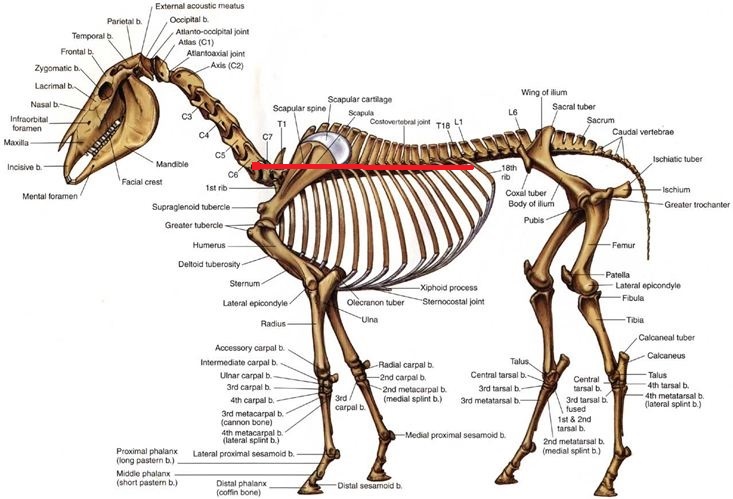
Our skeleton horse has a long upper cervical curve and a short, shallow lower cervical curve, with a medium length segment in the middle – an arched neck.

Image

 Neck Set – Height

What determines ‘set’ ie., high, medium-high, medium, medium-low, low or ewe-necked is the location of the lower cervical curve in direct relation to the scapulae.

The lower cervical curve forms the widest part of the horse’s neck.  You can palpate this by standing in front of your horse and running your hands down the length of the neck toward the shoulder.  When you hit the widest part of the horse’s neck, before it enters between the scapulae, you’ve found the lower cervical curve.  You’ll also notice that this is where the vertebrae are closest to the surface.   Where that curve is in direct relation to the scapulae determines set.

  • A lower curve below mid-point of the scapula is a ewe-neck.
  • At mid-point of the scapula is a low set neck.
  • Easily above the mid-point is a medium neck set.
  • A good amount above the mid-point is a high neck set.

Our skeleton horse has a high neck set.
Image

The last thing we need to know about the neck is its ability to ‘telescope’, like our grey Arabian pictured earlier in the article.  Telescoping the neck is part of engagement.  If it doesn’t exist, the horse is not engaged and cannot flex at the poll and come correctly onto the vertical, onto the bit, or even accept contact.

To telescope the neck the horse must contract the scalenus muscle, which attaches to the root of the neck (at that lower cervical curve) and to the first rib.  When this muscle shortens, it flattens the lower cervical curve and lifts the horse’s base of neck.  The anterior and spinalis portions of the longissimuss dorsi muscles also contract, the horse’s forehead is pushed away from the chest, the dorsal ligament system lengthens, the complexus muscle fills with blood…blah, blah, blah.

The point being, the shorter and shallower the lower cervical curve is to begin with, the easier it is and the less muscle strength it takes for the horse to raise his base of neck.  The higher that curve is located in direct relation to the scapulae, the less muscle strength it takes for the horse to raise his base of neck.  And when the horse raises its base of neck, and everything else happens, the horse lowers its head.

This is not telescoping the neck, the base of neck is not raised nor are the other muscles working properly.  This is simply gravity as if preparing to graze and serves no athletic purpose to the horse.

Image

http://www.ponybox.com/news_details.php?title=Western-Pleasure&id=1173 (bottom of article)

But this is:

Image

In Necks – Part 2 we’ll look at our sample horses’ necks.
Unknown's avatar

Year One Is Over

Just a short note to thank everyone who has visited Hooves during its first year on The Net.  Without all of you, I might as well be talking to myself – which I do often enough.  I’m very appreciative of those who have participated in the comments section, sharing views or asking questions, and those who’ve e-mailed in ideas, photos or articles.

I wish you all a Merry Christmas and hope that 2014 brings you happiness, health and success in your endeavors, especially any and everything equine related.

Cheers!

Unknown's avatar

Equine Canada Amateur Status

Recently a woman, who’s been involved in horses for over three decades, claimed on a forum – quite proudly – that she had EC Amateur Status.   This didn’t make any sense to me.  She’s trained TB racehorses, later trained those that didn’t make the races or retired from the races for hunter/jumper, has had boarders on her farm, has purchased PMU foals on behalf of others and for herself to raise, train and sell, has sold horses to others for personal mounts, organized clinics, currently stands a TB stallion for stud service, and otherwise would be classified as a professional having received monetary compensation for services rendered…and yet…claims Equine Canada recognizes her as an Amateur.

Upon discussion with some acquaintances, that have far more knowledge about Amateur Status rules than I, it appears as if EC Amateur Status is wholly a joke.  That one merely ticks the ‘amateur’ box on the application and it is given.  That one can *reclaim* amateur status after a two year hiatus from being *paid*.   What?  This last is ridiculous.  If you’re good enough to be hired for a job and accept remuneration for those services, making you a professional, then simply not having received monies for a two year period doesn’t suddenly make you less knowledgeable or less skilled, does it?  And let’s face it, the point of separating amateurs from professionals in classes is for fairness of competition, otherwise why do it?

Here’s the Amateur Status requirements:

ARTICLE G108 AMATEUR STATUS

1. All seniors competing in amateur classes at EC-sanctioned competitions must possess a current EC amateur card, which is purchased annually at the price listed in the EC Schedule of Fees. Competitors in FEI-sanctioned competitions must comply with the FEI definition of amateur.

2. A person competing in EC amateur classes must hold a valid EC senior sport license, have a current amateur card and adhere to the following guidelines:
a) Pilot Project: An EC amateur may hold an EC Instructor Beginner
Certificate and teach within the context of the Instructor Beginner Certificate.
b) An EC amateur may accept remuneration for instruction of or coaching of the disabled.
c) An EC amateur may not accept remuneration for training a horse or for showing a horse at any EC-sanctioned competition. See Glossary for definition of “Remuneration”.
d) An EC amateur may not accept remuneration for coaching any person to ride or drive a horse, including riding or driving clinics and seminars.
e) An EC amateur may not train or show a horse, or instruct a rider or
driver, when remuneration for this activity will be given to a corporation or farm which he or she, or his or her family, owns or controls.
f) An EC amateur may not act as an agent nor accept commissions for the sale, purchase and/or lease of a horse.
g) EC Amateurs may not use their name, photograph or any form of a personal association as a horse person in connection with any advertisement or article sold without the approval and signature of EC (e.g. product endorsement or advertisement of their activity as a coach).
h) An EC amateur may not enter into any form of sponsorship agreement
that is in conflict with the provisions of this article. See division rules for further information governing amateur status within divisions.

3. Persons who have not engaged in any of the activities in Article G108.2 (a-g) during the preceding two (2) calendar years may request reinstatement as amateur competitors. Such requests must be sent in writing to EC.

4. Application for Equine Canada Amateur Status:

a) Amateur status is issued by EC.
b) For EC members, certification of amateur status is issued annually on EC sport license cards.
c) All persons wishing EC amateur status must complete and sign the amateur declaration, which is on the sport license application/renewal form, affirming their eligibility.
d) Eligible amateurs who are not members of EC may receive amateur status issued by EC upon payment of the fee as listed in the current

I’m interested in hearing about amateur status in other countries and if it works the same as it does in Canada.  Do people regularly run across those like this woman I mention, who’ve clearly been professionals for many, many years (decades in this case) able to compete against true amateurs AND doing it proudly?  As someone who is a stickler for what’s fair, I find the whole situation and that someone would exploit an exploitable system to be on par with cheating.  Just because you can, doesn’t mean you should.  And what’s happened that a professional would even want to compete against anyone other than their direct peers?  It’s a hollow win, otherwise.

Unknown's avatar

The Head You Want To Ride

Even though most of us know that we don’t (aren’t supposed to) ride the horse’s head, many still insist on commenting about the personal aesthetic aspect of such in conformation critiques.  Rather than continuing to fight (and correct the validity of) a comment like; ‘She’s got a pretty, refined head’, in a conformation study, I’ll just talk about the kind of head that is a requirement for the horse to be useful, healthy and sound.  Ergo, the kind of head you want to ride.

Profile:  The horse’s profile (straight, convex or dished) is created simply by the relationship between the cranium and the face.  Think of the cranium as a ball that extends from poll to eye socket, and think of the face as a shoebox that extends from the eye sockets to the tip of the muzzle.  Changing how those two pieces sit relative to each other is what creates the horse’s profile.

Over the years people have selectively bred horses for exaggerated dished profiles, shortened faces and teacup muzzles, purposely (and ignorantly) breeding in facial faults that affect the horse’s ability to breath, chew, have properly rooted teeth with plenty of room, and easily hold a bit (or two in the case of double bridles).  Over-bite, under-bite and other tooth misalignments, that would have seen the individual die in the wild without the advantage of human caretaking,  processed feeds, soaked hay cubes etc…, now exist and propagate.

We also don’t want the horse’s head to look like that of a donkey or mule.  In asinines the cranium (ball) is smaller.  This causes the donkey’s neck vertebrae to attach to the skull from below the ears, unlike the horse whose neck vertebrae should attach to the skull from behind the ears.  When the vertebrae attach from below the ears, it’s called ‘hammer-headed’.  Most horses that are ‘hammer-headed’ are also ‘ewe-necked’; both serious faults in the horse.

Poll:  This should be broad in the horse causing the horse’s ears to be set a good distance apart.

Forehead:  Also needs to be broad so that the eye orbits are widely spaced and on the *sides* of the skull, not on the front.  The orbits are higher placed on the cranium for ‘ox-headed’ breeds; Quarter Horses and Morgans as an example.

Eyes:  Large and almond shaped.  The eyeball should not extend beyond the orbital ridge, if that’s the case then the horse is ‘bug-eyed’ and it can indicate endocrine system issues.  A ‘pig eye’ is a small eye, sometimes rounder and also a fault.

Muzzle:  Like the poll and forehead, the muzzle should be broad with large nostrils.  ‘Tea cup’ muzzle are a fault, directly affecting the ability for the horse to draw in air, as well, disrupting proper tooth rooting.

Mandibles:  The lower jaw bones should possess depth for good tooth rooting and have plenty of space between them; no less than a hand’s width (4”).

Here is an example of one of those ‘pretty, refined’ heads.  Let’s look more closely.   This horse has a ‘straight’ profile.  We can’t help but notice the exceptional broadness of forehead and the large, well-defined and well-placed eyes.   The ears are equally as sculpted as the entire head with their turned-in tips.  We might argue, though, that this horse lacks a touch of broadness in that poll.  Below the eyes are classic inflated sinuses.  The shorter face tapers (a bit too much, perhaps) to a smaller muzzle possessing large nostrils.  We can surmise that this horse should have no issue pulling in air.    The biggest question for this horse’s head is if there’s enough room for the teeth.

It may come as a surprise to many, but this is a purebred Standardbred, one that you certainly can’t label as having a ‘jughead’.  Indeed, I’ve known many Standardbreds to have equally ‘pretty’ heads.

Racing Standardbreds are often required to wear two bits, a driving bit and an overcheck bit.  This horse didn’t possess enough room in her mouth to comfortably carry an overcheck bit, so technically, though pretty, this is not an ideal head for her breed and purpose.  To get around the lack of room in her mouth, she wore an overcheck rein with a leather strap under her chin.  She did not have any chewing or teeth alignment issues.

Image

This next is not a great picture, but I use this horse’s head as an example of eyes that are decidedly ‘frontal’ placed, rather than the more correct ‘side’ placed as the horse before.  The other thing of note is that the horse’s jaw is narrower than its eye orbits.  As with the previous horse, this head is lacking a bit of broadness to the poll, and is a short-faced, but without the tapering.  Overall, this is not nearly as good of a horse head, but many would find it pleasing to look at nonetheless.

Image

This is a classic convex profile typical of the noble breeds.  The eye is large (don’t be fooled by the heavy ‘sleepy’ lid, and is placed lower on the skull than our previous two horses.  There’s plenty of depth to the jowls.  This is another short-faced horse that’s also rather short in the muzzle, but with good depth.

Image

Here on the front view we can see he’s broad through the forehead, poll and muzzle.  This is a good head despite its lack of refinement.

Image

Here is another straight profile with a big, generous and well-placed eye.  The jowls lack a bit of depth, but the muzzle sure doesn’t.  This is a long-faced horse that should have plenty of bar length in its mouth to hold two bits.

Image

Our viewing wouldn’t be complete without looking at a classic dished profile.  This is a good head with plenty of broadness and depth throughout.

Image

And this is an abomination.

Image

Next time you’re looking at a horse’s head, see if you can determine what specifically about it that you’re attracted to and if those traits make for a good horse head, or if you’ve been fooled by irrelevant aesthetics that are detrimental to the horse.

Unknown's avatar

Stretching – Part 3

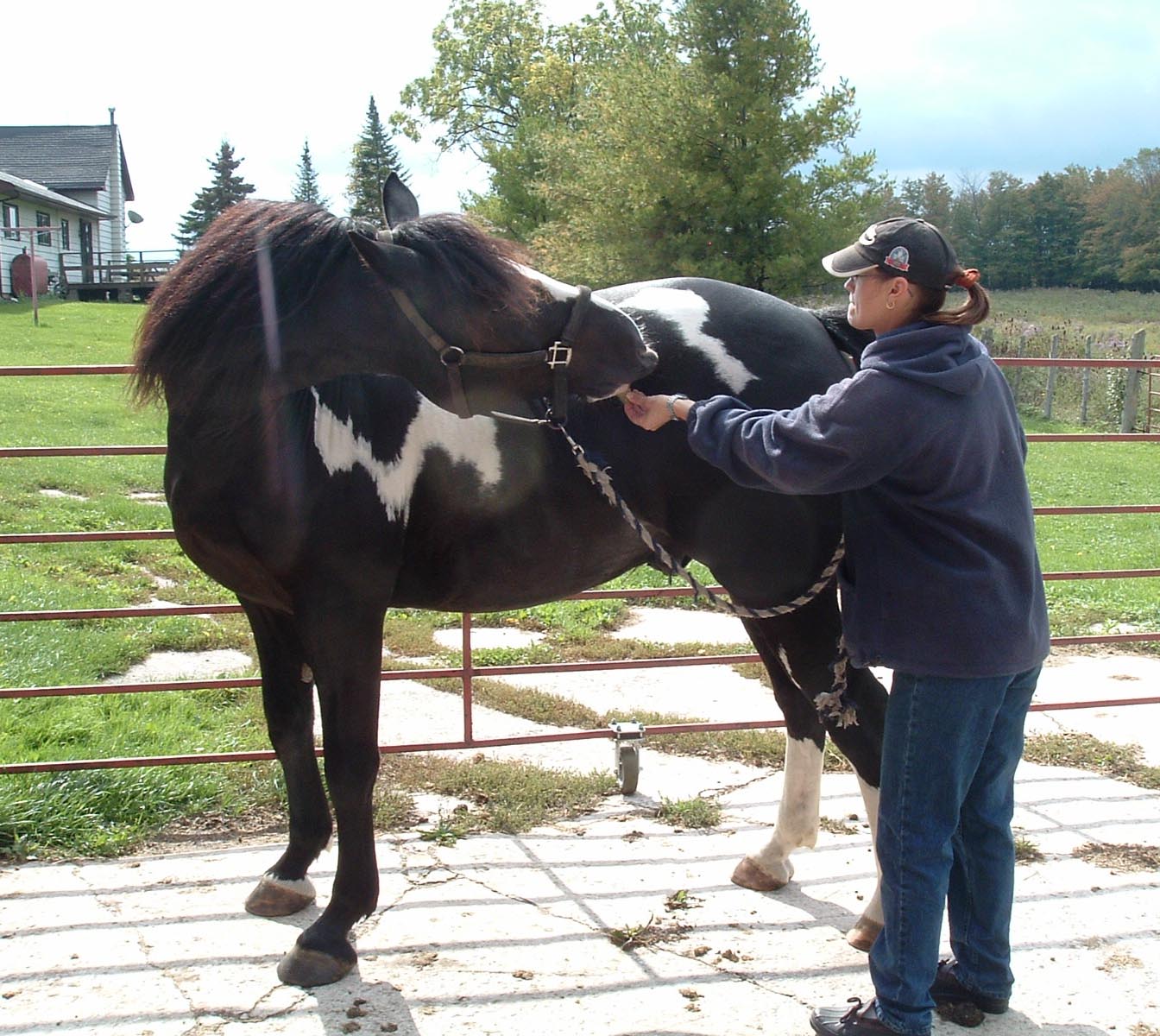
This is the final installment of this series and involves mostly the neck, but also the shoulders, back and ribcage.    The key to this set of stretches is that the horse plants its feet fairly square, and that there be minimal head tilting.  The ultimate goal is for equal ease and depth of stretch to both sides.

In this first stretch I place my body between the horse’s shoulder and its head, causing the horse to bend its neck around me.  From this position I can better control head tilting, as well it adds depth to the stretch.  I use treats to encourage this whole set of stretches, though, it’s not necessary.

Image

The candidate horse has a neck on the shorter end of the equine scale, and yet as is evidenced in the pictures, there’s plenty of flexibility.  Short doesn’t instantly mean a lack of flexibility, and in fact if you do neck stretches on horses with various neck lengths, you’re likely to discover that the longer necks tend to be stiffer.  This is due to the ease at which a horse can evade through that additional length, creating uneven soft tissue.  The shorter neck allows for pure strength of bracing against a poor set of rider hands, but it’s less likely to ‘snake’ between poll and shoulder.   It’s an upcoming discussion for our conformation series.

This second stretch is a version of ‘long and low’.  You’re looking for some base of neck lift, as well an even bend through the entire length of the neck with minimal head tilt at the poll.  Be sure the horse keeps its throat open (for all the stretches!).

I’ll often play around with this stretch, sometimes making it higher, sometimes lower.  Start with a straight forward tradition ‘long and low’ stretch, and then go from there.   I’ll also often have the horse touch the front of its knee, or the outside of the knee, or its fetlock, or toe, or heel bulb etc…  Whenever I find resistance or an inability for an equal stretch, I’ll play around to try and unlock it.

Note the *crinkling* of the skin through the ribcage, while the side the stretch is to is compressed, the other side is being elongated.

Image

The next stretch is the hardest to execute without having the horse move its feet.  The natural tendency is for the horse to spin around because the stretch can be tough for an individual with any sort of tightness in the neck, shoulders or ribcage.  Take your time deepening this stretch to encourage the horse to stand still in squareness.  The other big cheat in this stretch is head tilting, so beware.  One way to encourage straightness is to start the stretch away from the body, then slowly ask the horse to ‘close’ the stretch by bringing the muzzle to the hip. The ultimate goal is that the horse can easily touch nose to point of hip.

Image

You may have noticed that this horse has taken on a rather wide stance front and back.  Part of that is the fact he’s a wide-bodied horse, but the other part is that he’s done these stretches hundreds of times and knows that a wider stance gives him more stability and balance to do the depth of stretching.  Try to set your horse on the right path by encouraging a good strong stance of balance before starting.

The final stretch is the prelude to a full-fledged bow.   Start with a ‘long and low’ stretch and then slowly bring it in.  Head tilting or stretching off to the side that the person is standing on are common errors.  Sometimes switching to standing on the off side of the horse will correct the tendency to stretch crooked.

How deep you go is entirely up to you and your horse.  You can see this horse has reached the point where he’s had to bend his knee and lift his heel off the ground to go deeper.  Obviously, if you’re going to take the horse down to a full bow, do so on a soft surface of grass, sand or deep bedding.

Image

And that concludes basic horse stretching.

Unknown's avatar

Nova Scotia Petition

I am not familiar with the rules and regulations in Nova Scotia, but it appears they are not enough to protect the horses or to punish those doing the abusing. 

http://www.change.org/en-CA/petitions/ns-agriculture-minister-the-honorable-keith-colwell-acting-minister-paul-lafleche-save-the-horses-of-breighmara-and-create-nova-scotian-legislation-protecting-equines

Thanks to Steph C for spreading the word.

Unknown's avatar

Acceptance by Stephanie Hart

The following opinions expressed in this article do not necessarily reflect the opinions of the blog owner.  *BEG*  (I’ve always wanted to use that line, plus it’s a true statement.  I still stand where I stood in the discussions of Tao of Equus.)

Hi there!

First off, thanks so much to Mercedes for letting me blither a bit about a topic that is very near to my heart!

Let me introduce myself; My name is Stephanie Hart (MA, for those who like to know these things, and heck, it looks good on a business card ;)), and I am an Equine Psychotherapist.

I usually get asked at this point, “Like for kids with disabilities?”

Well, no, that’s physical or occupational therapy (which is also super important and tends to have many emotional benefits). What I do is take clients who struggle with all sorts of mental and emotional illnesses including anxiety, depression, trauma, eating disorders, addictions, attachment difficulties, and many more, and I bring them into a space with my equine partners where we promote healing and the development of new relationship and life abilities. If you want to learn more about what I do (or check out our blog and hear from the horses!) our website is www.svetc.webs.com.

Horses bring so much to the table that, to be honest, sometimes I feel like the horses are the “therapist” part of the equation (so remind me what I went to grad school for…). Horses bring many, many (many, many…) things to therapy (for more info see the website [‘scuse my shameless self promotion]), but today I would like to talk about the one that drew me into this work to begin with: Unconditional Acceptance.

Image

Vicky accepts my ridiculousness and I accept her refusal to pose for pictures.

The basics:


 – Horses have few expectations of humans, nor do they hold prejudices against them, making the human-equine relationship a place of emotional safety and trust

 – Through biochemical feedback and subtle body language horses can sense tremendous amounts of emotional information, and they will react to it accordingly. It is impossible to hide emotion from a horse, and as a person comes to realize this they find that the horse’s acceptance is not conditional on their projecting a certain front, as the horse sees through the mask anyway.

So yeah.

I’m going to tell you about the coolest experience I have had with acceptance. Back during my rather less secure days (aka my teenage years and on into my undergrad) I was very anxious and had little inner source of self-esteem, which eventually came to a head in a fairly nasty depression. A lot of this was rooted in my inability to accept myself and my actions, constantly expecting more of myself and being totally crushed when I inevitably failed to measure up.

I’m sure this sounds familiar to plenty of people.

This is when I met Sally.

Sally is a very sweet black and white pinto mare; she was born a wild mustang in Alberta and was rescued from a meat lot at age 9 (yes, she’s Mustang Sally. I had nothing to do with it, I promise). I have never ridden Sally, nor done any work with her beyond giving her a pat in the field. Horses don’t need much of an opportunity to work their magic.

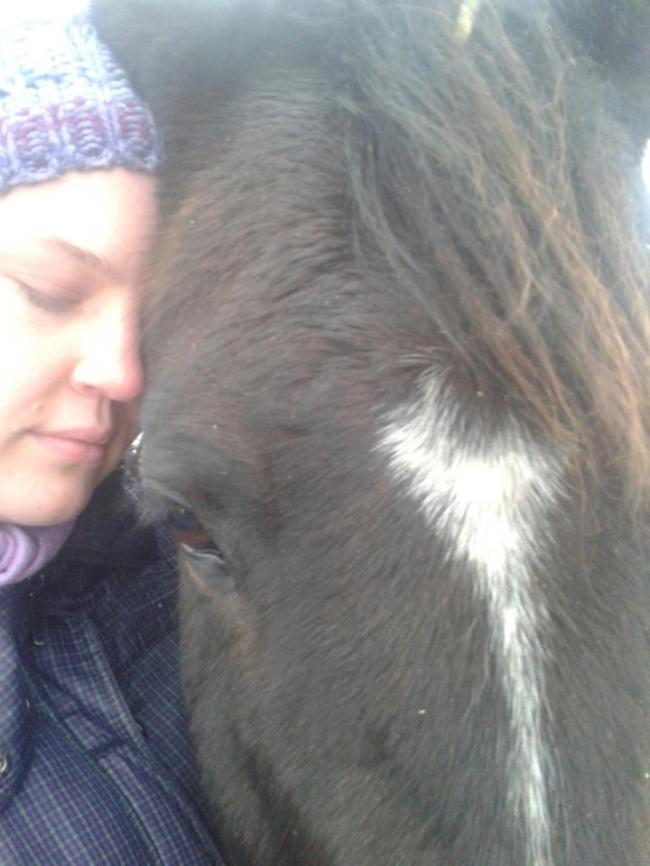
One day while feeling particularly rotten I went out to get my own horse and stopped to pat Sally. It was winter and getting on into the evening so the air was crisp and clear, and together we paused for a moment to look out over the adjacent hay field. As we stood there I got the sense she was scanning me. Being born wild Sally has remarkable instincts and reads people even better than most horses do; she also tends to take a little more careful of a look before relaxing in any given situation. She heaved a big sigh and lowered her head, and as she did I felt deep in my heart that she saw all of me, every little thing that drove me crazy or made me so sad I had to push it down, and that she was perfectly fine with what she saw.

And if she was fine with it, then I was fine too.

In that minisculte moment of connections she lifted a huge weight off my shoulders.  In 10 minutes she had done what therapy can take months to accomplish: then she moved off and went back to the usual business of bossing her herd away from her hay.


Image

This is what they do. They take our troubles and carry them for us just enough so that we can heal and do it on our own.

They are truly remarkable, these animals that we love.

Unknown's avatar

Another Glue On Shoe Option

I’ve never had a need to choose a glue-on or plastic shoe for a horse, but I can think of some possible scenarios in which one might be a good choice.  Here’s a new glue-on steel/plastic combo shoe coming out of the U.K.

http://www.dailymail.co.uk/news/article-2287987/Crocs-horses-Plastic-slip-hooves-making-nailing-horseshoes-thing-past.html

Some pretty basic questions pop into my head immediately.   Starting with the title of the article.  Crocs for horses?  Nail on shoes becoming a thing of the past?  Yeah, right.  Give me a break.  I understand the idea of a catchy title to get people to read your article, but I dislike when it purposely misleads.

The next obvious question; besides little girls, who’d buy these in pink (or whatever gaudy color)?  Then I wondered; that’s a whole lot of glue being used.  What sort of time frame are we looking at until it starts to breakdown and I can get that sucker off, or is there some kind of quick acting compound that will eat away at the glue (and not the hoof) so that I can get that sucker off – should I need to?  And what happens if the back edge of the shoe gets caught and the horse rips it off?  Is the whole hoof going with it?  Or is the glue just not that…um…sticky?  I know what can happen when a regular nail on shoe comes off that way.   Then I had a question about traction.

As I read further down the article it became apparent that this really seems to be aimed at therapeutic applications.  Phew!  I was having a hard time envisioning a performance horse of any level in these.    Look at the hind legs of our horse-in-pink.  Can we say stove pipe?  And looking at the video at the bottom of the article and seeing the trim jobs, I could understand why these horses might be having some foot issues.  Finally the video ends with a crippled horse.  If these can help him, I’m all for it.

Any of our U.K. readers have experience with these?

Unknown's avatar

Stretches – Part 2

…continuing on with the front end…

A reminder:  It’s best if someone can show you the stretches the first time, or oversee and make corrections.  Do not pull the horse’s limbs, instead, guide.  You do not bounce the stretches or hold them.   Keep limbs properly aligned, twisting and crooked stretching is frowned upon and more importantly can hurt the horse.    Make note of differences between limbs or any stretches that seem unusually difficult for the horse to perform – that means there’s an issue.

Shoulder Lift

Cup the back of your horse’s knee and lift it straight up.  Make sure the forearm stays in alignment and that you don’t pull the leg crooked.  This will drop the scapula down and back, open the point of shoulder joint and stretch the back of the elbow.   Be sure to gently place the leg back down – don’t ‘drop’ it.

Horses with short and/or horizontal humerus bones, or those horses with closed shoulder angles will not be able to lift their knees as high as horses with long and/or vertical humerus bones, or those horses with open shoulder angles.

Image

Front Leg Stretch

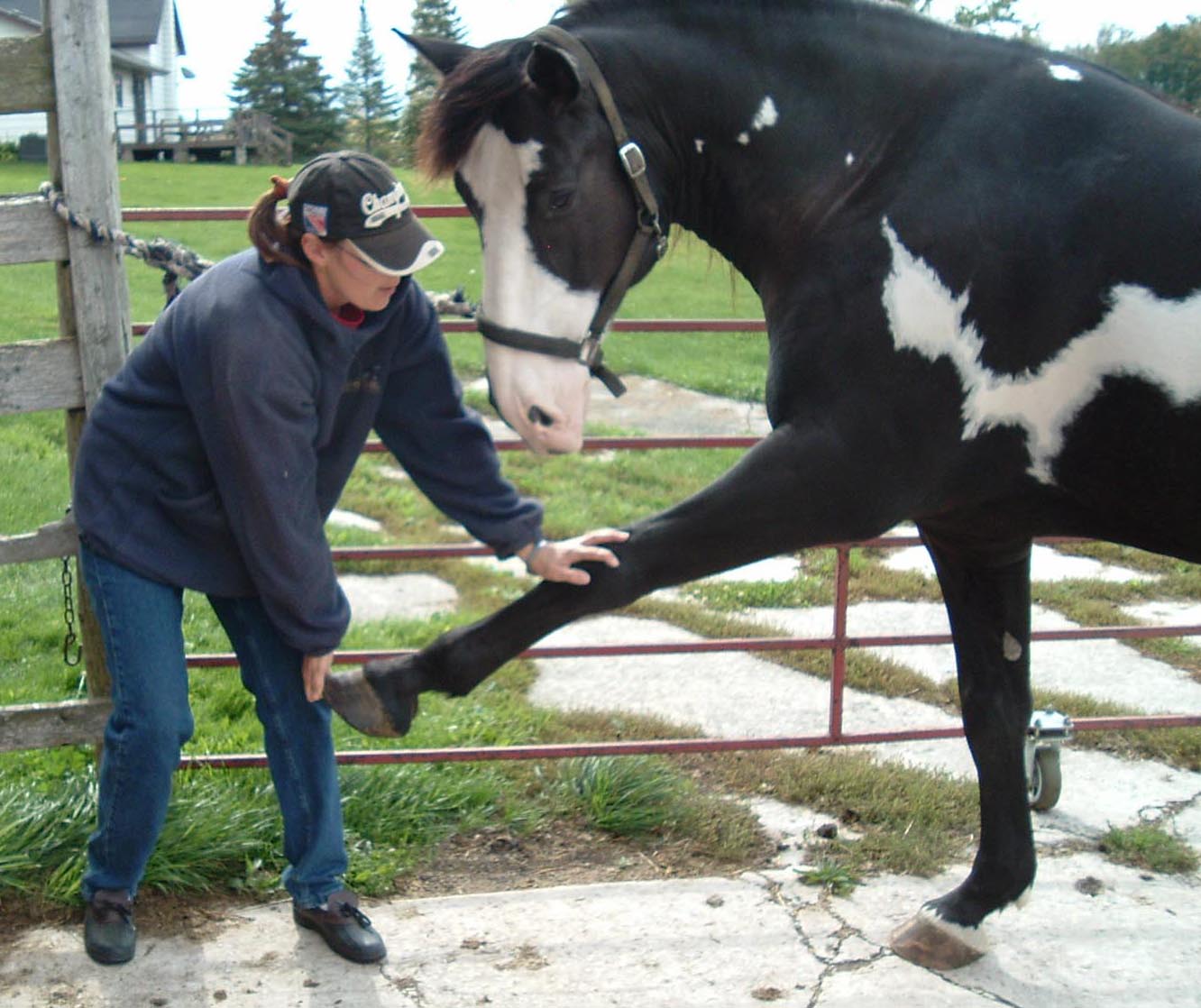
With your outside hand, grip the toe of your horse’s hoof.  Place your inside hand on the horse’s knee.  Gradually straighten the leg.  Again, make sure you aren’t pulling the leg to the side, it should extend straight forward and all the bones be in alignment.  The inside hand does NOT push down on the knee, it is merely there to prevent the horse from bobbing the person in the face with it should the horse pull away or attempt to paw.

Horses that are very front leg oriented; those that like to paw, strike or climb will often finish this stretch on their own, so be careful and stand off to the side slightly so you don’t get nailed.

Again, gently place the foot back on the ground, don’t ‘drop’ the foot, that’s a good way to give a horse a stinger and can even cause a fracture, if like with this horse, you are stretching on a hard surface.

Typically, I will move directly from the shoulder lift into this stretch, reaching down with one hand to grip the toe, while slipping my other hand on top of the knee.  In fact, once I start the front leg stretches I don’t put the foot down until I’ve completed them all, making the stretches a seamless exercise.  This isn’t, however, a requirement and some horses struggle with balancing on three legs for that length of time.  It’s something you can work up to, but don’t expect it the first time around.

Image

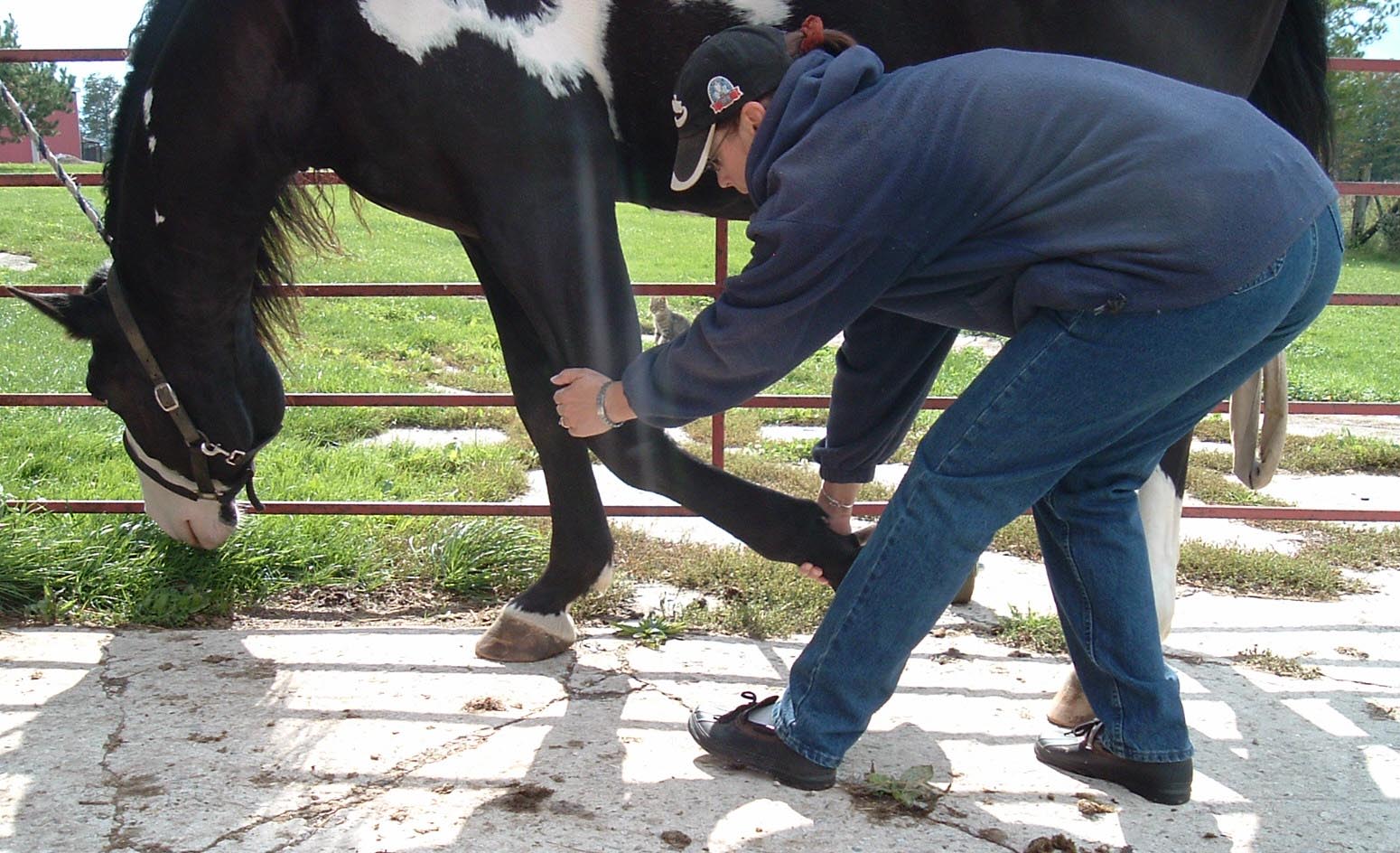
Extensor Stretch

For this stretch place you outside hand just above the horse’s knee and grab the front of the horse’s pastern with your other hand.  Lift the foot up and then very gently ‘guide’ the knee back, stretching the front of the leg.   Keeping the foot low to the ground will make it an easier stretch.

Image

Like with the hind leg, if you once get to a certain amount of stretch, the horse will often finish the stretch for you and fully extend the leg.

Image

Another variation giving a deeper stretch is to hold the lower leg parallel to the ground.

Image

Knee Bend

This stretch is simply folding the horse’s front leg up tight so that the bottom of the hoof touches the horse’s elbow.  Horses with arthritic knees will have a hard time with this one.  Also, if the horse is experiencing inflammation in any of the joints of the front leg, they’ll also find this hard to do.

Image

Circles And Lateral Humerus And Scapula Stretch

Circles: Grip the pastern with both hands and hold the leg directly under the horse so it remains straight.  Allow the horse’s foot to hang freely.  Start by drawing small circles with the toe of the foot in a clockwise direction.  Then reverse and draw circles in a counter-clockwise direction.  Repeat by drawing a larger circle.

Image

Lateral: I unfortunately don’t have a picture of this stretch.  Hold the cannon bone parallel to the ground (create a 90 degree angle at the knee).  Place the horse’s knee (bent one) slight behind his other knee (knee of leg horse is standing on) and then use the outside of your knee to gently press the knee (bent one) toward the other knee – as if the horse was taking a lateral step.  Release, and then move the knee (bent one) directly in line with the other knee.  Press again and release.  Finally, move the knee (bent one) slightly in front of the other knee and press then release.

The final part of this series will cover some neck and body stretches.