Unknown's avatar

Stretches – Part 1

Stretching is an important part of any athlete’s life.  Heck, it’s important in everyday regular life.   I know that all of you never get on your horse without first limbering up and stretching out any tension and tightness in your body, knowing full well that that would automatically be translated to the horse, just as I know that all of you never begin working your horse without fully stretching him/her out as well.  *wink*  But, on the off chance…here’s a review of some basic equine stretches.

BELLY LIFT

I believe this is the single most important and effective stretch for horses.  It simulates what you want to happen under saddle with engagement and takes only a few seconds.  I do it on horses whether they are in work or not, and I do it several times a day; feedings, before exercise, after exercise, when turning out or bringing in.

The stretch can be down with your fingertips, but is easier with a hoof pick, end of a pen (NOT ink end), pen cap or needle casing.  Find the mid-line of your horse (there’s a natural indent along your horse’s midline) just in front of where a girth would sit.

Image

With the tips of your fingers – use both hands – (or with your apparatus – one hand) gently press up.  The horse should immediately react by lifting the wither slightly.  If the horse does not, then a) you’re not pressing upwards firmly enough, so press harder until he/she does react, and/or b) you’re pressing plenty hard enough, but your horse is so tight  through the wither that he/she is locked down – do some wither massage to loosen, then try again.

Now slowly drag your fingers (or apparatus) along the midline maintaining the upward pressure.  As you do so you should see your horse’s back rise.  When you’re about ¾’s of the way down the midline, stop and hold the upward pressure for a count of 10-15 seconds.

Image

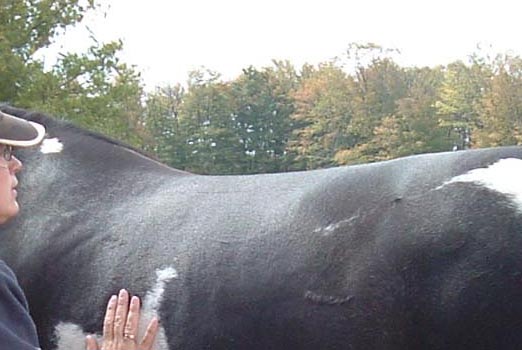
What you have done is trigger the abdominal muscles as would happen with a horse that has engaged to a high degree, and stretched the topline.  Here’s a snapshot of this horse’s back before the lift and after the lift:

Image

Image

The horse will hold this stretch for a few seconds after you stop, but as you repeat this stretch over several weeks you’ll notice that the horse holds it for longer periods of time and eventually the horse’s posture will change permanently.  If your groundwork and riding are complementary, as in they are correct and also encouraging engagement, then you can quite quickly change the horse’s posture using this stretch in conjunction with exercise.

When checking saddle fit, you should also do a ‘soft’ belly lift and make sure that the back of the saddle doesn’t lift off the horse, if the saddle lifts off the horse’s back, then your saddle does not fit because it does not provide room for your horse to lift its back into it while being ridden.  What you’ve got is a saddle that fits a hollow-backed horse and will press down, triggering the back muscles to stay in a contracted state when ridden.  A horse cannot engage its haunch if its back muscles are triggered in perpetual contraction.

If a horse is tight anywhere through the length of its back, you can expect reactions from ear pinning to tail swishing to teeth gnashing.  These reactions should lessen as your horse’s back loosens.  More violent reactions such as swinging the head around to try and bite you or cow kicking are a sure sign your horse is in significant pain that requires immediate further investigation.

Once the horse is supple in its back to easily do this stretch, and its posture improves, you’ll start to notice that when you begin in front of the girth that not only does the wither easily lift, but you’ll also start getting lift in the base of the neck.  Bringing the stretch more between the front legs will encourage the base of neck.

BUTT SCRUNCH

This is another topline stretch, only deeper and more complete.  Make sure that your horse can freely walk forward a step or two.  If you have a holder make sure the holder is standing to the side of the horse, and if the horse is crosstied, that there is plenty of length to the crossties.

Again you can use the tips of your fingers or one of the objects I listed earlier.  Place your fingertips or instrument about two inches on either side of the sacrum and press moderately firmly down and then begin to drag down the line of the horse’s haunch and down the hamstrings, while continuing to press.
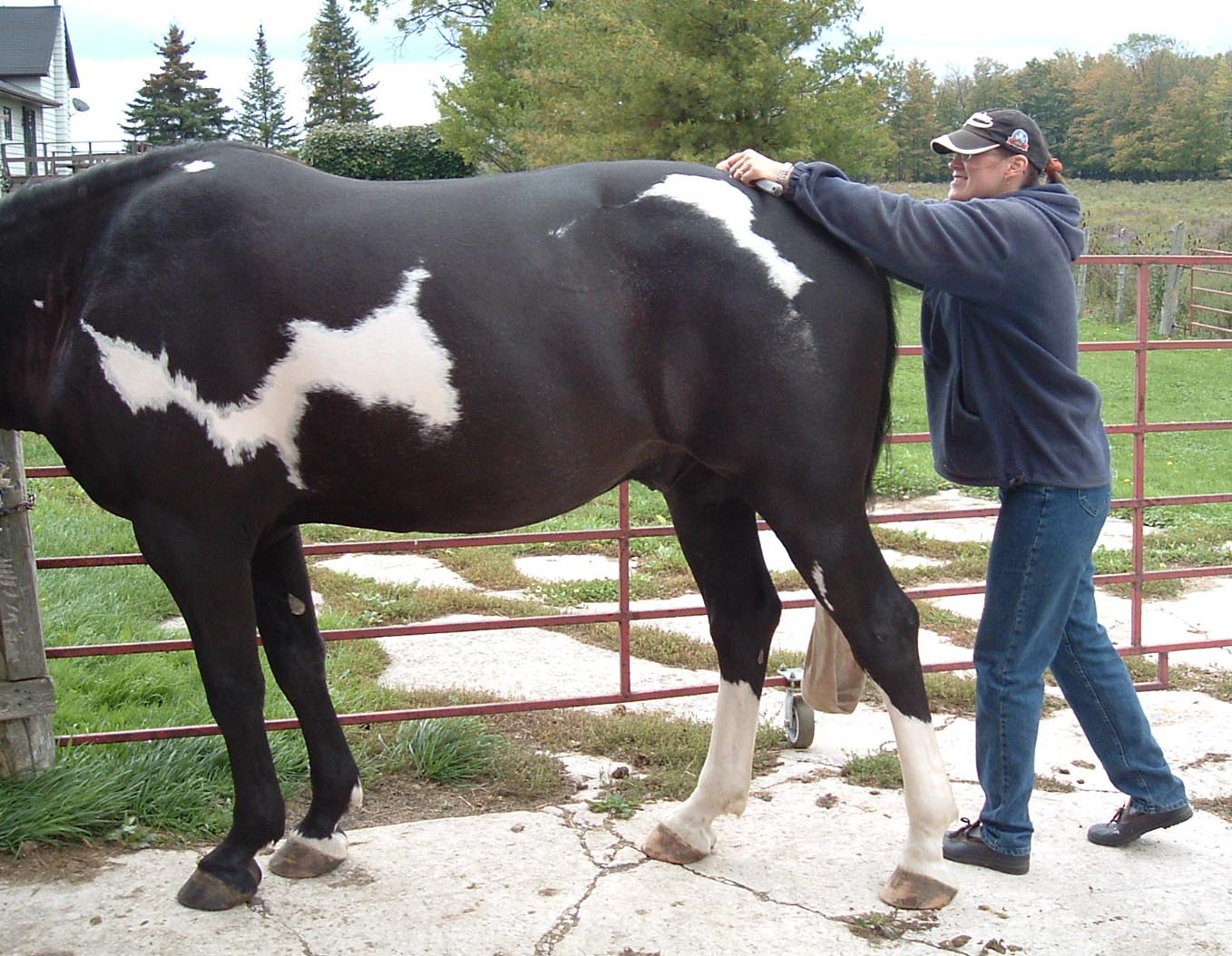
Image

Some horses are particularly sensitive to this stretch and will literally ‘sit down’ on their haunches; others will tuck their pelvis and walk forward.

Image

Note:  Horses that are very sore through their pelvis have been known to double barrel kick when this stretch is applied.  *raises hand*  Been there, done that.  Fortunately, this stretch puts the horse’s momentum forward and the stretcher’s momentum backward.   If your horse was particularly cranky and cowkicking during the belly lift, I highly recommend NOT doing the butt scrunch, until you’ve found out and addressed the issue that your horse possesses.

Hind Leg Forward

For this stretch you need to cup your hands and then scoop up your horse’s hind leg at the back of the pastern, lift the leg and then gently ‘guide’ the foot forward toward the outside of the horse’s knee.  Most horses should be able to stretch to a point where the hind foot is directly beside the knee.   Over angulated horses can often get beyond the knee, while post-legged horses typically can only get to the back of the knee.

The lower you hold the foot to the ground, the easier the stretch for the horse.  This is where I suggest you start.  As the horse gets more stretched through the tendenosis muscles and hamstrings, you can then raise the foot a bit.  Massaging the back of the haunch and hamstrings prior to the stretch will help increase the stretch.

Note:  DO NOT PULL!  Guide the foot forward, SLOWLY.  Do not ‘bounce’ the stretch.   Keep the leg straight, as in on the same angle as the stifle angle.  This angle generally has the hind foot just to the outside of the corresponding knee, but some horses have a little less stifle angle and some have a bit more.
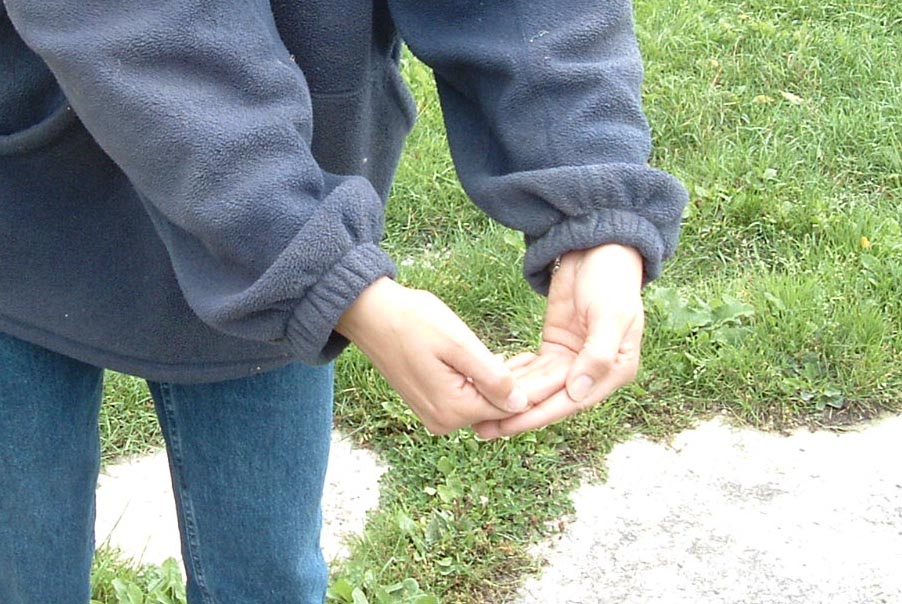
Image

Image

Using a towel is easier if you have a bad back, but you don’t get the same ‘feel’ as if you use your hands.

Image

Hind Leg Back

With your outside hand, grab the front of the horse’s pastern and place your inside hand gently on the top of the horse’s hock.  The hand holding the horse’s pastern ‘guides’ the horse’s leg back.  The hand on the hock is only there to prevent you from getting smacked in the mouth or face by the hock if the horse jerks its leg.

Again, the lower the foot is to the ground, the easier the stretch is for the horse, so start low.  Also, make sure to bring the leg back straight from the hip, not pulling it to the side.  Once you’ve stretched the leg to a certain point, some horses will finish the stretch for you and fully extend the leg out.  If that happens, awesome!
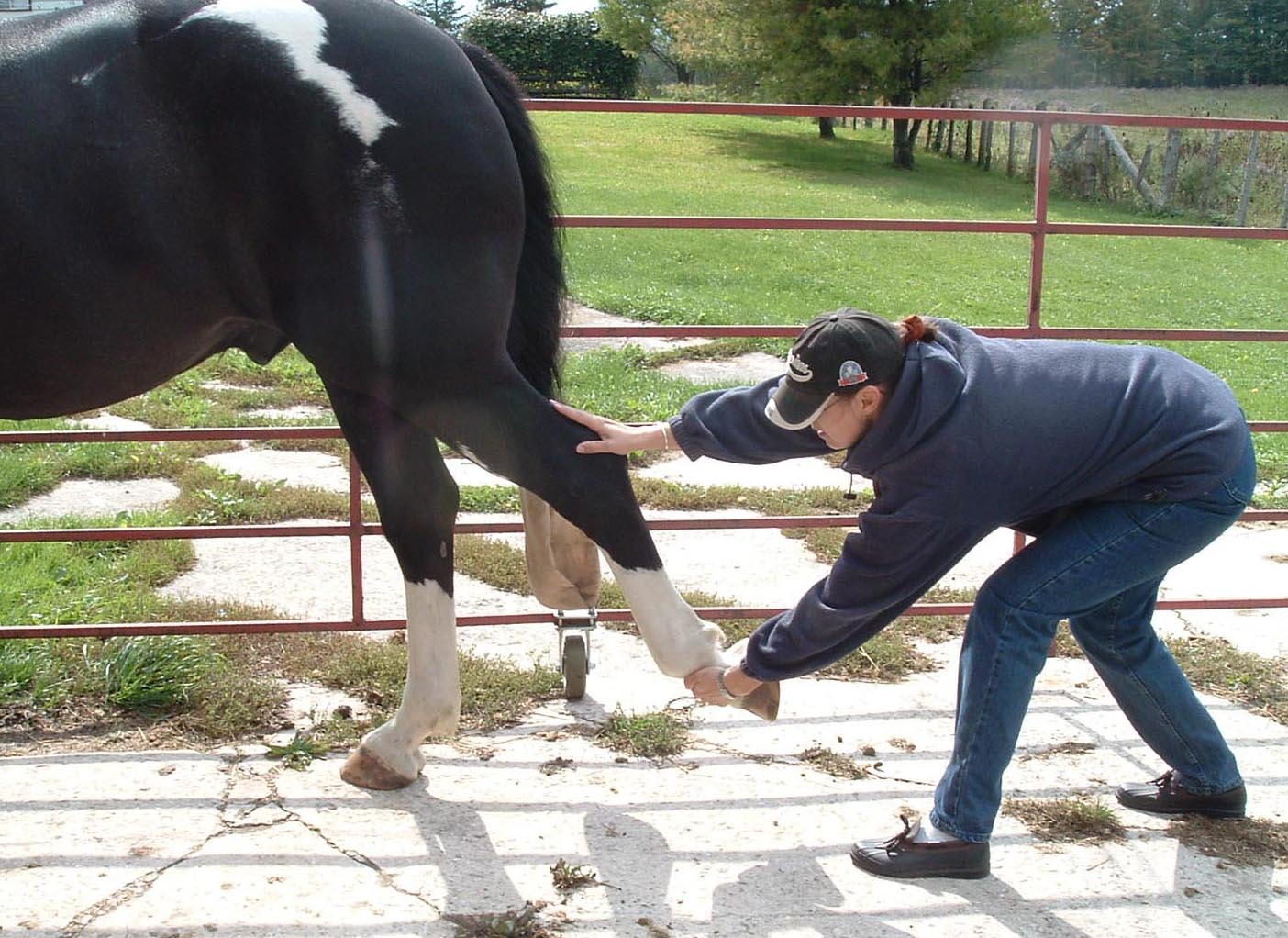
Image

Note:  DO NOT PULL!  DO NOT PUSH DOWN ON THE HOCK!  Gently and slowly guide the foot back.  Do not ‘bounce’ the stretch.

Part 2 of this series with cover front leg stretches.

Unknown's avatar

The Possibilities Are Endless

I stumbled across a cool video that horse owners and trainers should see, if only to remind them of what’s possible without all the restraints.  We always have such awe and high praise for the few individuals who do bridleless or free work.  And if they can do it in front of a crowd, even more praise worthy.  Most have seen Staci Westfall’s freestyle reining tribute to her father.  A lot have seen the One-Armed Bandit and his Paints, Mules or Mustangs.  Some have seen shows like Cavalia.  And I know every single one of you knows who Pat Parelli is and have to at least seen some bareback, bridleless jumping, or his famous lady-in-a-wheelchair Friesian demo.  But how many of us have actually taken those shows to heart and gone back home and committed to training, working or just being around our horses without restraint?

One of the many flaws that we humans have is that we’re control freaks.  Some are control freaks in every aspect of their lives, others hone their control freak streak and direct it at a single purpose or target, as the rest of their lives roll uncontrollably down a hill at full speed.  Take a moment to think about what you are always trying to control in your life.  Is it your weight?  Your spouse?  Your kids?  Or your horse?

I’ve always had fences to keep my horses ‘in’, because that’s the responsible thing to do to keep them safe and off other’s property or away from dangerous situations like a road.  But despite that I’ve had several escape over the years.  Sometimes boards were kicked down, gates left unlocked, or hotwire shorted out, but none of the escapees ever left.  They did laps around the house, ripping up the lawn, or went to visit other horses in another pasture on the property, or just wandered about investigating things, leaving behind a trail of poop piles for me to clean up.  I have had, though, the occasion to leave a few horses entirely loose without fencing for days on end.  It was the only gift I could think to give them before they passed on.

I have been reminded recently of the control freak in people as I rehab a horse.  A horse who explodes without warning when tied, crosstied or single tied.  So, I don’t tie her.  I know that the approach for most people is to fix the tying issue by using breakaway ties, or bungie/rubber, or to tie her tight to an immovable object, like a tree, and let her fight until she gives up (or kills herself).  When was the last time you brushed your horse, picked its feet, and tacked it up without having it tied, AND the horse just stood quietly the whole time content to have you around it, and content in the knowledge that when you were done it was going to have to work for you?

Here’s one more question for you to ponder at various times during your next horse interaction.  Given the choice in the moment, would your horse choose to stay with you or leave?

The video is long, but try and stick it out.  There are some really cute moments when a horse or two decides to ‘improvise’.  The second video is much shorter and represents snippets of a similar show, but there’s foals involved.

Unknown's avatar

2013 Breeder’s Cup

Welcome to the first Hooves Blog Breeder’s Cup Roundup!

Might as well get the bad news out of the way first.  In the Juvenile Fillies race, Bob Baffert’s Secret Compass was euthanized after suffering a lateral condylar fracture and a dislocation.  Her jockey John Velazquez took a hard fall and was taken to the hospital.  A number of hours in, the doctors detected internal bleeding and just before the last cup race of the day, he was in surgery to have his spleen removed.

http://www.thehorse.com/articles/32807/secret-compass-euthanized-after-suffering-condylar-fracture

This first race wasn’t shown on TV as coverage hadn’t started yet, so I missed the race.  I was able to catch a replay on livestream, but didn’t see the injury or fall take place.  Just as well.  We can argue all day long about racing two year olds, but I’m having a harder and harder time remembering a ‘big televised racing event’ happening WITHOUT a tragic end.  I imagine what keeps people coming back year after year is that despite the tragedy the end of this race was thrilling.  After leading the whole way, She’s A Tiger, hung on by a nose to win only then to be placed second behind Rio Antonia for a very minor bump in deep stretch.

The Filly and Mare Turf race went to the English horse, Dank.  Who charged from the back in the stretch and then held off other hard charging horses.  The time of the race was a new race record.  I noticed after the race that Dank was bleeding from her mouth.  I’m guessing she bit her tongue.  She really fought her jockey through much of the race.

Groupie Doll and Wise Dan were both repeat winners in their respective races; Filly and Mare Sprint and The Mile on the Turf.

The post-race interview that irked me the most came from the owner of MizDirection, who was also a repeat winner in her race, The Turf Sprint.  After a long layoff last year and after a long layoff this year, she came into both Breeder’s Cup races to dominate.  She was to get on an airplane shortly after her race yesterday to be entered in a sale, presumably to begin a career as a broodmare.  The owner was asked in the winner’s circle how he felt about the whole situation.  To paraphrase; he said he was going to miss her, but it’s business.  I admit, I yelled some obscenities at the TV screen.

The 1 3/4 mile Marathon was won by the UK horse London Bridge.  Funnily enough, London Bridge is a New York bred.  It was the first time the three year old colt had raced on Lasix.  The days leading up to the race saw him struggle with the race surface, so his shoes were changed.  The day before the race he was put in the starting gate and allowed to break.  He came from way back and though he looked like he was flying at the end and an easy winner, I assure you, the rest of the horses were staggering badly for most of the stretch run.  I could have out run them.  London Bridge is apparently on his way to Australia next for a race.  The Argentine horse, Ever Rider, was pulled up in this race by his jockey Gary Stevens.  This horse was touted as the best conditioned horse prior to the race by all the race announcers.  Pfft!  The horse walked off on his own and it was later reported that Gary pulled him up because he tired badly.  No injury reported.

One of the best looking horses on the day was the Goldolphin two year old colt, Outstrip.  He came from way behind to win the Juvenile Turf race.  Bobby’s Kitten was the heavy favorite in this race and his jockey put him out front in blistering fractions.  He battled hard with Giovanni Boldini in the stretch, but Outstrip ran them both down.  All the talk for the rest of the day and next was how upset the trainer was of Bobby’s Kitten’s jockey, Javier Castellano, who he felt blundered by setting fractions of 22.27, 45.70 and 1:09.53.  Javier said the two year old broke well, felt good, but then ran off a bit and wouldn’t settle.  Duh!  It happens, especially when you’re racing immature horses.  Maybe put a bit more training on them and wait for them to mature?  At least he didn’t run sideways the entire race like Bob Baffert’s Tap It Rich.

Which brings me to the second most annoying interview of the event.  When Bob Baffert was asked (in reference to his talented two year old colt, Tap It Rich) if he’d prefer having a horse that shows moments of brilliance or one that’s just plain tough, Mr. Baffert announced brilliance without hesitation.  And that, sir, is exactly why the American TB is in such dire straits nowadays.  When prolific trainers such as yourself put importance on characteristics that last a moment, instead of the stuff that matters for a lifetime.  What good is a flash of brilliance, if your horse doesn’t have the brain to run straight, or if your horse doesn’t have the substance (Secret Compass – remember her?) to stay sound?  But then what should he care when he can simply pull out another horse, like New Year’s Day, and win the 1 1/16 mile Juvenile and let Tap It Rich finish fifth running sideways most of the race?

Goldencents had a phenomenal wire-to-wire win in the Dirt Mile.

And now we get to the big race, The Classic.  I should have taken that bet with blondemare.  She was so sure Game On Dude was going to win, and I was so sure he was not.  I put my virtual bet on Mucho Macho Man.  Both horses broke well and were on top with two others.  My fifty year old out-of-retirement jockey, Gary Stevens, took Man back a bit and placed him fifth on the outside, while the all-time winning jockey of Breeder’s Cup races, Mike Smith, kept Dude near the front with the other two horses, three wide.  Three quarters of the way around the final turn, Man stuck his nose in front on the outside and put the pedal to the metal.  Dude gave it up at the top of the stretch and started to fade, while Man trucked on.  Coming late and hard were Declaration Of War and Will Take Charge.

Here’s the  Photo Finish:  Mucho Macho Man on the inside, Declaration Of War in the middle, and Will Take Charge on the outside.

Video of the race: Race Replay

Unknown's avatar

Western Dressage Revisited?

I don’t particularly want to rehash this topic, but Zanhar found a video that represents what Western Dressage should really be all about, in my not so humble opinion.  There are some mistakes in the movements on the first part of the video in the ride, mistakes often made in Dressage as well (and Western riding in general), but still far more representative of what Western Dressage should be all about if we require such a discipline.  The second part of the video is near flawless.

I could get behind the discipline of Western Dressage if it looked like this.  Anything else is hogwash.

Unknown's avatar

The Up And Down Of It – The Rest Of The Front Limb

I’ve talked in previous articles (ie. Speed Kills) about the importance of straightness of the fore limb. A quick summary goes something like this; the horse’s front legs act as supporting/foundation pillars. Crooked supports and those too thin for the weight above crack and eventually break.

If a person plans to ride their horse on its forehand, do speed events, race their horse, jump it or any other activity that stresses those front legs by specifically weighting and torquing them, then straightness and substance should rate high on the conformation criteria scale.

If, on the other hand, a person plans to correctly gymnasticize their horse asking for a shift of weight rearward onto the spring-like hind limbs on a consistent basis, and be considerate of the horse during cross-training, then fore limb crookedness and substance, while still important, can drop a notch.

The conformation pictures we have of our sample horses do not allow us to view much in the way of front limb crookedness, so when considering a horse for purchase or breeding one should insist on additional views. There are still some important conformation aspects we can look at from our side view shots; knee alignment, pastern and cannon bone length, pastern slope and toe to heel foot balance.

Knee alignment – when viewed from the side, the horse’s knee should ‘pop’ out a little bit.  If there’s a perfectly straight line down the front of the leg then the horse is too straight through the knee and calf-kneed.  This is a significant fault, and if the knee falls clearly behind that line it becomes a serious fault on similar terms to ewe-necks, post leggedness and poorly placed LS joints.  If the knee ‘pops’ too much, it’s also a fault, though not as severe as calf-knees, and is called over-at-the-knee, or buck knees.  You’ll see this latter type of knee fault quite frequently in Thoroughbreds.

Note:  Farriers should never try and ‘fix’ these kinds of knee conformation faults by trimming feet to lessen the effects.  And yes, many do try.  The last horse I worked on that was significantly over-at-the- knees and had a farrier trying to shoe it out of the horse, the horse broke a coffin bone from the stress being placed on the foot.  The horse also suffered from significant pain at the base of his neck, through his shoulders and withers.

Pastern and Cannon bone length – there’s no specific measurement for cannon bone length.  It’s an eyeball measurement about what constitutes longer vs shorter, however, if the horse’s knee is placed relatively high in relation to the ground, the cannon bone length is likely to be long and if the knee is relatively low in relation to the ground, the cannon bone length is likely to be short.  A short forearm is often accompanied by a long cannon bone, but not always as in some cases a long scapula, short forearm, short cannon bone can exist.   While people may disagree on cannon bone length in a specific horse, most everyone will agree that a short cannon bone is preferable for almost all horses.  Longer cannon bones would be part of the requirements for the action of gaited horses.

Fortunately, pastern length is much easier to determine.  If the pastern is greater than 75% the length of the cannon bone, the pastern is long.  If the pastern is less than 50% the length of the cannon bone than the pastern is short.

The slope of the pastern should be such that it can absorb concussive shock.  It does NOT have to be equal to the horse’s shoulder slope and it is not a fault if the two are different.

Note: Farriers should not try and make a horse’s pastern slope equal to the horse’s shoulder slope through trimming or shoeing means.  And yes, some do.  The foot should always be trimmed for balance in direct relationship to the underlying foot structures, not outward appearances.

Pasterns that are overly sloped can place too much stress on tendons and ligaments, straining or tearing them, and can also cause the horse to smack the back of the fetlock on the ground, risking fracture of the sesamoid bones.

Pasterns that are overly upright reduce the ability to absorb concussive shock, in turn creating abnormal wear and tear on joints and bone, early onset of arthritic conditions and stress fractures.

In this area the best structure for the horse is a medium pastern length of medium slope.  While longer, more sloping pasterns can provide a ‘softer’ riding experience, it is at the possible expense of the horse’s soundness.  By the same token, short, overly upright pasterns should also be avoided.

It should be noted that short, or upright, or short and upright pasterns do not in and of themselves created a ‘short and choppy’ stride as is often reported.  It is the humerus bone, its length, horizontal orientation and/or the existence of a closed shoulder angle that creates a ‘short choppy’ stride (as discussed in a previous article – The Up And Down Of It – Humerus Bone).  What a short, or upright, or short and upright pastern will do is create a more ‘jarring’ riding experience.

Foot balance –  this topic really requires an entire article or two or three of its own, but I did want to mention here that foot balance or foot imbalance can be the difference between night and day for a horse, how it stands, how sound it stays, and how well it performs at any level.

Some horses are more sensitive to foot imbalances than others.  Typically horses with good, solid and relatively proper bone structure above can stand up better to foot imbalances, often not showing signs until years later.  By the same token, more stoic, survival intense personalities or those with strong constitutions will be less sensitive to foot imbalances as showing weakness to the world means certain death.

Regardless of the horse, this is one area that the average horse owner doesn’t pay enough attention to by taking the quality of farrier work as a given.  After all, they are the professionals so they should know, right?  Wrong.  Like any profession there will always be members who are poor, most will be average, and a few will be excellent.   The saying, ‘no foot, no horse’ exists for a reason – because it’s true.

I can’t emphasize the importance of proper foot balance for horses enough.  If you’ve never thought about it before, you should be getting that awful pit in your stomach feeling right now that you’ve missed something really important all these years.  Yes, even if your horse/s aren’t currently head bobbing lame or have/are performing successfully.

Now it’s time to take a look at our sample horses and see how they measure up.

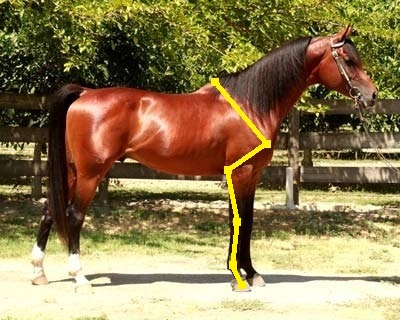
Horse #1 – 10yr old QH Stallion

Image

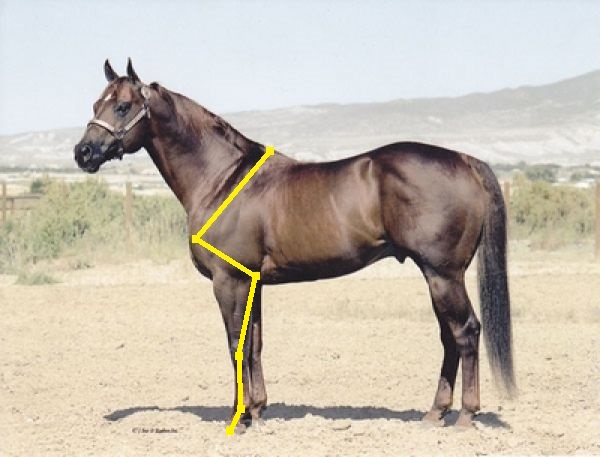
This horse is too straight through the knee and therefore is a bit calf-kneed.

We measure the cannon bone from mid knee to mid fetlock joint and we measure the pastern from mid fetlock joint to P1.  Then to get our pastern percentage we divide the pastern measurement by the cannon bone measurement.  This horse has a short cannon bone and his pastern is right about 50% the length of it.  His pastern is also upright.  Without actually being able to measure the circumference of his cannon bone to determine if he carries the minimum requirement of 7” per thousand pounds, we’re going to have eyeball it.  IMO, I don’t think this horse carries quite enough bone.

When we consider that this horse is also downhill built putting more weight on the forehand, we might begin to get nervous about the prospects of him staying sound.  Those upright, shorter (but not technically ‘short’) pasterns are going to reduce his ability to absorb concussive forces, which puts even more strain on the calf-knees, which is as I mentioned earlier, is a pretty serious fault.

While I’m not embracing what I see so far from this lower limb, I’m not entirely turned off and here’s why:  the horse is the sum of his parts and as far as we’ve delved so far, this horse has a superior loin and haunch.  That means that if this horse can utilize his haunch, he’ll be able to lift weight off his forehand relieving tremendous stress off those forelimbs.  We can then be more forgiving of the imperfections up front.

Since he is a stallion, it would be prudent to get that front view angle photograph to further assess the straightness or crookedness of the front legs.  If it turned out that everything else was in order, and the stallion had proven himself in performance (and stayed sound on those front legs), then at that point (and assuming we don’t find anything else we don’t like going further in this conformation study) a complementary mare would be one that possessed perfectly aligned knees and pasterns that sloped a bit more generously.  If she also possessed a touch more length to those pasterns, that would be a bonus.

We can’t see this horse’s feet to comment in that regard.

Image

Horse #2 – QH Gelding

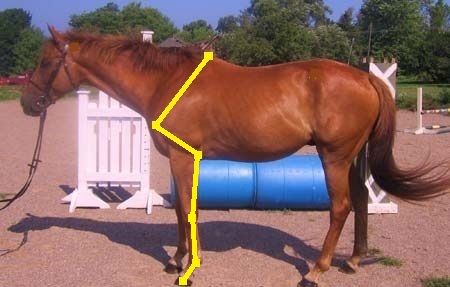
Image

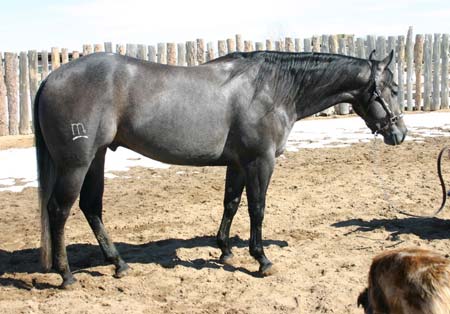
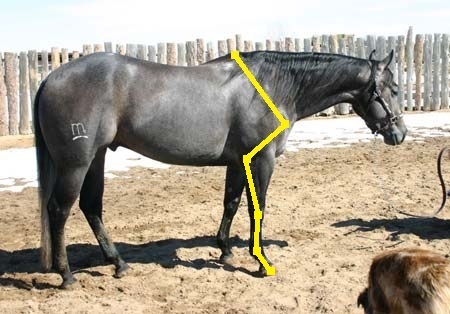
Your first inclination may be to say that this horss is also calf-kneed, but he’s not.  His stance of front legs too far underneath the body can give the illusion of calf-knees.  If he was standing correctly, he’d have perfectly aligned knees from side.  They also appear to be of substantial size.  In general this horse carries more substance than our QH stallion.  His cannon bone is short and his pastern is an ideal medium length, though more upright.  This horse is also short in his forearm with a lot of fore limb length taken up by his scapula.  This isn’t a fault, but it affects lateral movement.  A horse structured like this may find he hits himself if asked for too deep a lateral movement, particularly if heavy on the forehand.  Fortunately, he has that good length of humerus bone to help.

The big issue for this horse is his feet.  Here we can clearly see those front feet are horrendously unbalanced, such that he’s actually broken back in the pastern.  Undoubtedly the feet are why this horse is standing awkwardly in front on the points of his coffin bones.  If this horse isn’t obviously lame on these front feet, it’s a wonder and the owner can thank this horse’s otherwise solid bone structure and stoicism.

Image

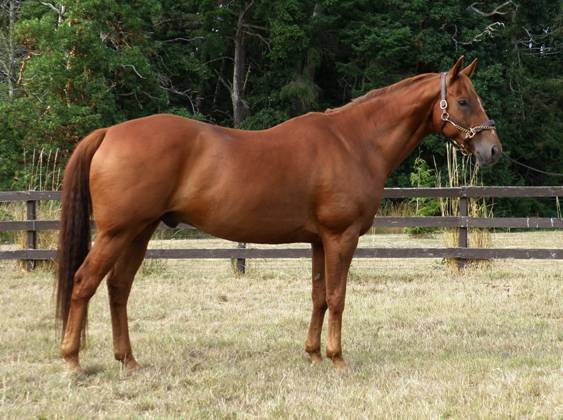
Horse #3 – 4yr old QH

Image

This horse has a well-aligned knee and short cannon bone.  His pastern is as the upper most end of medium in length and has a very pleasing slope.  The only thing that would make this lower leg combination better is a bit more substance, otherwise it’s very good and very functional.  We can’t see this horse’s feet to assess.

Image

Horse #4 – Arabian Stallion

Image

I’ve talked a bit about this horse’s front leg issues in a previous article (or comments section).   His knees are higher than ideal from cannon bones longer than ideal and this gives him a shortened forearm.  His right knee is bucked a bit and the right pastern more upright than the left because of his obvious clubbed foot.  The pastern length is otherwise fine.

I’m not a fan of clubbed feet, even though many horses go on to have serviceable lives, some even in higher performance.  Club feet are hereditary and require an above average skilled farrier to recognize them, not try to fix them etc…  This horse shows quite a bit of difference between those front feet – even with the left front foot also showing a clubby look – and difference between legs (steeper pastern, higher fetlock and knee joint, bucked knee) such that that unevenness has no choice but to carry on up his limbs, into his shoulders, into his withers, into his neck, and along the length of his back.   He’s only four in this picture, but as he ages the asymmetry in his fore limbs is going to wear on his body.

When I also take into account the serious fault of his table top croup and the camel withers, which we’ve discussed before, I can only conclude that the best thing to do for the breed is to cull this one and geld him no matter how good the rest of his conformation that we have not yet talked about.

Image

Horse #5 – TB Gelding

Image

Our TB is as straight through the knee as we want to see.  It’s actually quite nice seeing one that isn’t over-at-the-knee or tied in.  Here we have a horse that stands over a lot of air and that’s essentially because he’s got a lot of leg length in general.  Even though he has excellent bone proportions throughout the entire limb, his cannon bone and pastern are on the longish side of things.  He also lacks the most substance of all our sample horses.  On the positive side of things, his joints, tendons and ligaments look very clean.  If a front view revealed good straightness throughout, this isn’t a terrible set of front legs by a long shot.  They’re functional and with a little consideration they should serve this horse well enough.

We can’t quite see all the front feet, but we can determine for sure that this horse doesn’t have those ‘racetrack’ feet.  He might be a bit boxy in those front feet if anything.

One other thing I’d like to point out is the muscling of the forearm.  Take a moment to scroll back and compare the amount of muscling on our TB and Arab to our three QH’s.  While we expect there to be a difference, it’s a bit too much.  Our TB, in particular, is lacking in this department.

Image

Horse #6 – Paint Mare

Image

It’s really hard to see this horse’s knee alignment.  I think she’s okay, though.  Her cannon bone length is okay, as is her pastern length and slope.  Her feet on the other hand are not balanced and do her no favors.  I’d like to see her carry a bit more bone as well.

If I was teacher and she a student, she’d easily get a passing grade on this subject, but I’d write to her parents that I felt she’d underachieved somewhat.  Her legs are good enough for our TB to stay sound on, but she’s not our TB.  She’s our Paint mare with the weak loin, the too long scapula, the too low point of shoulder, the downhill build, the bit too long back, the bit too short and a bit too horizontal humerus, and we haven’t even got to that neck yet.  This makes me want to see that front view of her fore limbs because any crookedness there and my thoughts about her being able to stay sound on them becomes debateable.  At the time of this photo, she did have clean joints, tendons and ligaments, so that bodes well moving forward.

Image

Unknown's avatar

Speaking Of The Foamy Mouth

In the most recent link we saw a horse with enough foam coming from his mouth to top every Starbuck’s latte for a week.  That’s too much and a clear indication of an unhappy horse, who finally had had enough and simply left.

Have a look at this short blog article entitled The One Picture.  The author points out several issues with the picture that are spot on.  I’d like to point out a few more, starting with the foamed mouth.  It’s still too much.  This horse has no white on his face, so that’s a big gob of froth about to splatter his chest.  If the flash wasn’t so tight, there’d be more foam flying out of this horse’s mouth.  The cavesson also looks to be cranked beyond tight.

Now look at the horse’s throat and how the skin is folded.  This horse isn’t just behind the vertical, he’s a lot behind the vertical with a throat closed tighter than a shuttered up summer cottage in mid winter.  I also have a real issue with the horse being pushed into this level of work at just 4 years old.  Remember what happened to the fancy grey mare this rider rode back in 2006?  Does anyone think this horse will have a better fate?

As the author mentions, a lot of people will praise this photo, the rider and the horse’s way of going.  They’ll be unable to identify all that’s wrong, but there is one flashing red neon sign, that anyone can be taught to see, that clearly indicates this horse is not engaged.  Simply look at the flexion of the weight bearing front fetlock and compare it to the flexion of the weight bearing rear fetlock.  As evidenced in the photo, this horse is solidly on his forehand, bearing strikingly more weight on the front leg than on the hind.  Engagement requires a horse to shift weight to the haunch.  My downhill, post-legged, Heinz 57 horse, can shift more weight to his haunch than what this royally bred, solidly conformed horse is displaying.  Imagine what *we* could do with this kind of horse if we were also Internationally acclaimed trainers and riders.

In conclusion, it’s wrong, all day long, every day and someone of this level should know better.  So the question I’d like to pose to this rider, to the judges and everyone else involved:  Do you not know better, or do you simply not care that you’re hurting the horse, that you’re corrupting the discipline, and that you’re setting the worst possible example for up and coming owners, riders, trainers and judges by systematically killing the future of good horsemanship.

Oh, and do you also not realize the horse is unsound behind?

Unknown's avatar

The Power Of A Martingale

Hate ‘em!

Let’s just get the supportive argument of ‘if it’s adjusted correctly then they are a great tool in the toolbox’ argument.

  1. I don’t care about the people who use them sparingly.
  2. I don’t care about the people who use them correctly (and sparingly).

There!  We’ve now eliminated the ‘exceptions to the rule’ 5% and we can move onto the truth of 95% of the martingale use around the globe.

The intended purpose of this little piece of leather was to prevent the rider from getting smacked in the face by the horse’s poll or upper neck.   For that situation to occur, the horse has to either have really lost its balance, the horse has to have some severe behavior issue in the moment, or the horse has to have a ewe neck, be muscled horribly, and ridden on 6” of rein.

A secondary outcome of sporting a martingale, that I believe is what people really use them for, is to prevent the horse from being able to evade the boisterous rider hand.  You could also just call it poor training and poor riding; your choice.

Hunter

This is one way to adjust stride and get in the right number for the line, problem is it’s not a long term fix.   I’m sure this team is working on the half halt from the seat as a rebalancing tool (and rotating that leg from the hip socket so the heel (spur) doesn’t inadvertently pinch the horse), then they’ll be ditching the martingale – I’m sure.

Barrel Racer

There’s no doubt this horse is being pulled around the barrel by his face.  He’s come into the barrel with too much speed (too much on his forehand) and got in too deep.  The rider now cranks on his face to try and reduce the circuit around the backside of the barrel.  The horse has no choice but to hollow and cross his jaw and gape in an attempt to relieve the pressure on his tongue.  Thank goodness for that martingale!

Jumper

There’s just nothing better than setting a horse up to get the right distance to the next fence by hauling on his face.  Bravo!

Polo 1

Polo 2

Keep your eye on the ball Princes!  Those martingales and draw reins will make sure the horses can’t evade your hand even if they are all over their forehands, hollow, and trying to stay on their feet.  Prince William gets a few extra bonus points for his horse’s milder protest (when the picture was taken he’d just released the hand brake).

I came across this little article about bitting polo ponies and couldn’t help but chortle.  I loved the talk of ‘leverage for stopping at speed’ and ‘it’s not the bit, it’s the rider’s hands’, so it’s okay to throw the kitchen sink on as long as you have soft hands when you pull on the horse’s mouth.    I’m hoping that one day they’ll realize the way to stop a horse is to shift weight to the horse’s haunch.  Kind of like this:

http://en.wikipedia.org/wiki/File:Spooks_Gotta_Whiz.jpg

Yeah, yeah, that’s going to chew up the polo field.  The fact remains, as long as a horse is on its forehand, it’s not going to want to stop or be easy to stop.  Its balance and weight is forward and down like that snowball rolling down a hill.  Putting something with more bite in its mouth doesn’t help the horse readjust its balance and weight back onto its haunches, no matter how educated the rider’s hands.  It’s more likely to teach the horse how to evade contact, brace through its jaw, poll, throat, neck, shoulder, back and loin.  And it’s more likely to make the horse hard-mouthed.  The proper way to slow a horse down quickly is to engage the haunch.  Funny thing about doing that – there’d be no chance of the rider getting smacked in the face by the back of the horse’s head, therefore no martingale would be required.

Zanhar was kind enough to send me a couple of pictures of her horse several months ago.  (And for those of you that have also sent me pictures et al a while back – I still have them, I haven’t forgotten, eventually I’ll cover a topic and I’ll utilize them.  Thank you for sending.)

18 year old Thoroughbred hunter worked in a martingale:

Image

2 years later as a 20 year old after having stopped using the martingale:

Image

What was once an inverted, shortened bull neck is now a long, arching, correctly muscled neck.  Certainly that didn’t just happen by taking off the martingale, other work was involved, but it does show:

  1. The horse didn’t need the martingale in the first place
  2. The martingale didn’t help the horse move correctly
  3. The martingale gave the horse something to lean on and brace against

The horse never lies and neither does its body.  Horses that regularly wear martingales, side reins, draw reins, or any of the other number of ‘put your head here’ apparatus can be picked out of a lineup by a blind man.  Even if none of those artificial aids are used and only the rider’s hands are employed to place the horse’s head ‘here’, one can still identify that horse’s poor training and riding by the incorrect muscle patterns it will wear.

Zanhar made a significant change in how her horse was trained and ridden, and her horse shows the spectacular results of those improvements.  Great job!

*Side note:  I’m heading off for a week’s vacation.

Unknown's avatar

The Art Of Craptastic

Just as there are people who work diligently and with singular purpose toward the goal of mastery in their profession, so there are also those with equal determination to suck at what they do for a living.  Let’s take for example the riding instructor, who sits in one spot for the duration of the lesson often times in some remote corner of the arena.  Never before have I seen so many sit down riding instructors as I have since moving to California.  And these are not people new to the profession, but rather nationally successful people in their discipline of choice.  Winners in the show ring with the wall of ribbons, awards and medals to prove it.

I inherently know that all those prizes don’t mean diddly squat in the scheme of things, but your average riding customer clearly does not since these instructors always seem to have a full lesson schedule with more waiting in the wings to receive this particular brand of teaching.  I can’t decide if it’s laziness  or boredom that keeps them planted on their derrieres.  Maybe it’s something else?

Here’s a recent article that’s making the rounds on the Internet that discusses why America is producing a large quantity of mediocre instructors.  http://theridinginstructor.net/75/top-3-reasons-why-america-producing-so-many-mediocre-instructors/  I’m not sure these are my top three reasons, but I won’t argue the validity or truth of the reasons presented.  For argument sake let’s just go with them.  Now that the top three reasons have been identified and discussed – what now?

At this point I am reminded of how a big company works, or the Government.  Meeting announced.  Problem dissected.  Potential catalysts discussed at length.   Good meeting all, let’s go for lunch.  Six months later another meeting is called. 

‘How are we doing on that matter we discussed at out last meeting, George?’ 

‘Well, sir, we’ve confirmed that those were indeed the top three reasons.’

‘Excellent! Excellent!’

‘We’re thinking of putting together a small team to further analyze the situation.’

‘Good!  Good!  What’s for lunch?’

I can’t realistically do a thing about the current state of American instructorship.  It’s beyond my means, capabilities and willpower.  What I can do, though, is warn off people who might become potential clients.  So following is a list of warning signs that you might be entering a Craptastic Instructor Zone:

1) As previously mentioned, unless the instructor is confined to a wheelchair or body cast there’s no good reason for them to be sitting or standing still during the lesson.  One of the greatest tools an instructor uses at his or her disposal is their eyes.  They are constantly adjusting their position to see horse and rider from different perspectives to be able to pick up on nuances.

2) Students that have been students ‘forever’.  Except for the very odd exception, a good instructor will teach a student all that they know and then move the student on.  No one instructor knows everything.  There are great athlete and coach combinations, but very few that stick it out together for a whole career.  There’s a reason for that.  While familiarity with one another can have its advantages, it can also have its disadvantages.  I’ve seen many cases of instructors purposely (and sometimes inadvertently) making their students dependant on them.  Beware the instructor with a long list of ‘forever’ students, especially if they’re still working on how to halt the horse without throwing out the anchor after all those years.

3) A smorgasbord of ‘new’ students.  This might simply indicate the instructor is new to the region having moved there recently.  That’s easily found out.  But for an instructor who’s been around long enough to have established themselves, big turn over in the student ranks can indicate big issues like that particular coffee shop in town on the corner, run by the Ogre, that always has the ‘Help Wanted’ sign in their window.

4) Disproportionate amount of ‘accidents’.  Riders falling off, horses running off, tack breaking, weekly ambulance or vet visits etc…  While all of these things happen from time to time, an instructor whose students and horses are plagued by accidents and injuries is the proverbial flashing red neon sign.

5) Unhappy participants.   If rider and horse aren’t happy in the lesson and no attempt is being made to rectified that, walk away unless you like being miserable and paying for that privilege.

6) Avoid the instructor who puts students on lame or drugged horses and especially if they a) don’t recognize the horse is lame, b) don’t care that the horse is lame, or c) carry the needle in their back pocket.

7) You’ve all seen – and heard – the hockey (soccer/baseball/football etc…) parent.  Well, they also come in the form of riding instructors.  You’ll see them at shows all uptight, making their students nervous, ‘coaching’ (read yelling at) their students, and otherwise displaying uninstructor-like behaviors.  Again, unless you like to pay for that type of treatment – pass.

8) Too much sugar is fluff.  That’s right, a cotton candy instructor is just another form of a dependency maker, unless you’re five years old.  Teaching requires balance.  You’ll never progress as a rider unless you are challenged, occasionally pushed, and corrected.  If all you ever hear is how awesome you’re doing, rest assured you aren’t actually that awesome.  Unless you’re five.  In which case, you are definitely going to be a gold medalist in the Olympics.

9) Either an instructor that never schools their school or client’s horses, or the instructor that has to get on every horse before a student rides at a show, or in a lesson.

10) If students regularly ask questions that don’t get answered directly, the answers don’t make sense, no clarification is offered when a student is confused, or answers always leave the student unsatisfied, then the instructor is wanting in the communication, and likely knowledge, departments.  Maybe try another language?

11) Displaying and talking about credentials everywhere, all the time, is either one super insecure instructor or one that knows they don’t know anything of value and needs to cover it up.  By the same token, a complete lack of credentials or history and continued avoidance of the topic when asked is a red flag.  Everyone has their own tolerance level for papered or show ring credentials.  Be more impressed with the person in front of you and what comes out of their mouth than the certificates and ribbons hanging in the office.  Feel super confident when both match.

It can be a trying endeavor to find a good riding instructor, but the profession is no different than any other.  If you need a mechanic for your car you don’t just run your finger down the Yellow Pages, pick a garage at random and hope for the best.  You talk to friends and family.  You call the BBB.  You look on Yelp for reviews.  You call and talk to someone at the business.  You maybe do a drive-by in your Mother’s car.  Then you make an informed decision.

Go watch an instructor give some lessons, not just one.  Talk to students, current and former.  Have a close look at the lesson horses.  Interrogate the instructor, asking some of the tougher questions not just how much per hour.  Nobody should feel so desperate for instruction as to settle for mediocrity.  And if people stop settling for mediocrity, it’ll cease to exist.  It’s a simple case of supply and demand.

Always remember; it takes more time, energy and resources to unlearn bad lessons than to learn them right the first time around.